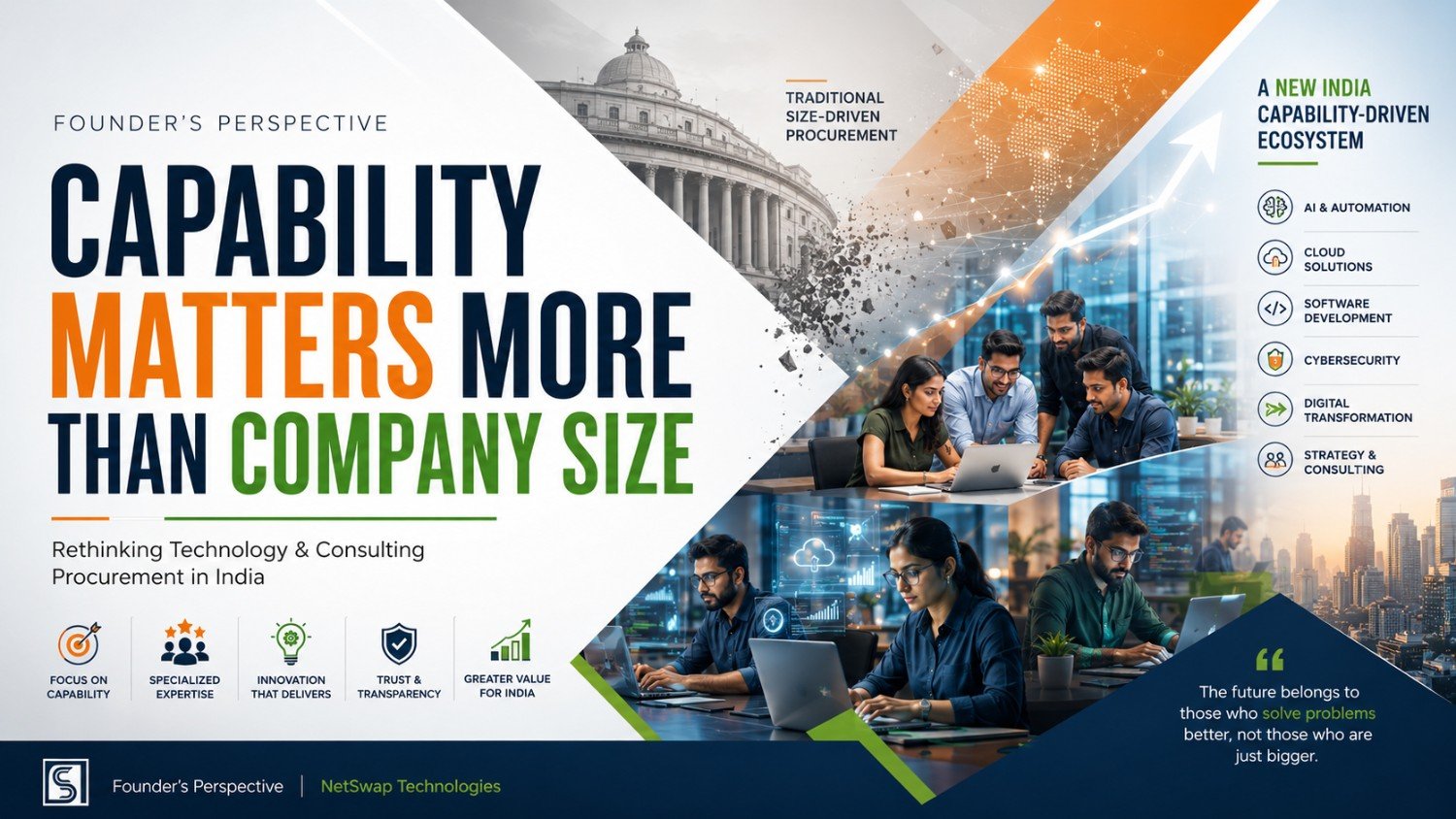
When Capability Matters More Than Company Size: Rethinking Technology Procurement in India
For too long, we have often treated company size as a shortcut for capability. A large turnover feels reassuring. A large employee count looks impressive. A long list of enterprise clients creates confidence. A famous brand appears safer.
But there is a fundamental question that every business leader, government department and technology buyer should ask before selecting a partner:
Can this organisation actually solve the problem we need solved?
That question is becoming increasingly important as India's technology ecosystem matures. The country now has startups, specialist software companies, AI teams, cybersecurity firms, SaaS businesses, fintech developers, product studios and highly focused technology consultancies capable of solving sophisticated problems without necessarily having thousands of employees.
The larger the technology ecosystem becomes, the less useful it becomes to judge capability through simple proxies alone.
From my perspective as the Founder of NetSwap Technologies, this is not an argument against large companies. It is an argument for better evaluation.
Size can be relevant. But size should not become a substitute for capability.
The Real Question Is Not "How Big Are You?"
When an organisation evaluates a technology partner, the easiest questions are usually the numerical ones.
- How many employees do you have?
- What is your annual turnover?
- How many years have you been operating?
- How many large contracts have you completed?
- How many enterprise customers do you have?
These questions are not meaningless. They can provide useful information about financial stability, operational maturity and organisational capacity.
The problem begins when these numbers become the definition of capability.
A technology project is not delivered by a company's annual revenue. It is delivered by people.
The people need to understand the business requirement. They need to understand the technology. They need to make good architectural decisions. They need to execute. They need to communicate. They need to test. They need to deploy. They need to maintain what they build.
That is why I believe the better question is not:
"How large is the organisation?"
It is:
"How capable is the team that will actually solve this particular problem?"
Why Company Size Can Be a Misleading Proxy
Imagine two organisations competing for a specialised technology assignment.
The first has a very large workforce, substantial turnover and a globally recognised brand. The second is much smaller but has a highly specialised team with direct experience in the exact technical problem being addressed.
If the evaluation is based primarily on headcount, the first organisation looks stronger.
If the evaluation examines relevant expertise, proposed resources, architecture, implementation methodology, security capability and delivery history, the result may be completely different.
This distinction matters particularly in areas where expertise is highly specialised.
Artificial intelligence, cybersecurity, fintech infrastructure, cloud architecture, data engineering, enterprise integration and automation are not areas where simply having more employees guarantees better results.
Sometimes a smaller team with deeper expertise can be more relevant to a narrowly defined problem than a much larger generalist organisation.
That does not mean smaller is automatically better either.
The principle is simple: both large and small organisations should be required to demonstrate relevant capability.
The Turnover Trap
Turnover is an especially interesting metric in technology procurement.
Financial strength absolutely matters. A company needs sufficient operational capacity to execute a major assignment, retain its team, manage infrastructure and provide ongoing support.
But turnover is not a technical skill.
A company can have significant revenue from one area while having limited expertise in another. At the same time, a smaller specialist organisation may have a highly capable team operating within a relatively lean business model.
So when a buyer evaluates a technology partner, turnover should answer one question:
Does this organisation have sufficient financial and operational capacity for the assignment?
It should not automatically answer another question:
Is this organisation technically better qualified?
Those are two different questions.
A more balanced evaluation should therefore examine:
- The proposed project team
- Relevant technical expertise
- Comparable implementation experience
- Architecture and engineering methodology
- Security and compliance approach
- Project management capability
- Support and maintenance model
- Financial and operational capacity
- Expected business outcomes
The Experience Paradox: How Does a New Company Get Its First Big Opportunity?
This is one of the most important issues for emerging technology companies.
Experience matters. Nobody should argue otherwise.
The problem appears when a particular type of previous experience becomes an absolute entry barrier.
Consider a software company that has successfully delivered complex commercial systems but has never worked directly with a government department.
If the next opportunity requires previous government experience as a mandatory qualification, that company may be excluded before it has the opportunity to demonstrate its actual technical ability.
Then the circular problem appears:
You cannot get the experience because you do not have the experience required to get the opportunity.
The same issue can happen with contract size.
A company may be capable of executing a particular project, but if eligibility requires a previous project many times larger, the company may never receive an opportunity to demonstrate that capability.
This is where procurement needs to distinguish between risk management and unnecessary exclusion.
Relevant experience should reduce risk. It should not automatically eliminate every capable organisation that has not yet had the opportunity to build that exact reference.
Capability-Based Procurement Is the Better Direction
For me, the logical evolution is toward capability-based technology procurement.
Instead of starting with the vendor's size, start with the problem.
If the requirement is cybersecurity, evaluate cybersecurity capability.
If the requirement is artificial intelligence, evaluate AI capability.
If the requirement is enterprise software, evaluate software architecture, engineering, implementation, testing and support.
If the requirement involves disconnected systems, evaluate integration expertise.
If the requirement is business process optimisation, evaluate automation and workflow expertise.
This is a much more logical relationship:
Business problem → Required capability → Qualified team → Technical approach → Expected outcome.
The procurement criteria should follow that chain.
What Should a Modern Technology Procurement Process Evaluate?
1. Relevant Technical Expertise
The organisation should demonstrate that it actually understands the technologies required for the assignment.
2. Domain Understanding
Technology does not operate in isolation. The team should understand the business, regulatory, operational or institutional environment in which the system will operate.
3. Proposed Delivery Team
The total employee count is less useful than knowing who will actually work on the project.
4. Comparable Experience
Previous work should be evaluated for relevance, not simply for the size of the contract.
5. Technical Approach
The architecture and technology decisions should be explainable and connected to the actual requirements.
For example, technology selection should not happen because a particular framework is fashionable. It should happen because the architecture fits the project. A buyer may need to compare Laravel and Node.js, evaluate React versus Angular, or compare MySQL and PostgreSQL based on actual technical and business requirements.
6. Security and Compliance
For sensitive applications, security should be evaluated directly rather than inferred from company size.
7. Financial and Operational Capacity
Large projects may require significant operational resilience, infrastructure and support capacity. This should remain part of the evaluation.
8. Measurable Outcomes
The most important question should ultimately be what the selected partner is expected to deliver and how success will be assessed.
Why Smaller Specialist Companies Matter
India's technology ecosystem is much larger than its biggest IT companies.
There are specialist firms working in AI, fintech, healthcare, education, logistics, manufacturing, SaaS, cybersecurity, e-commerce, enterprise software and automation.
These organisations may not have enormous headcounts, but their expertise can be highly concentrated.
That creates a valuable opportunity for buyers.
Instead of automatically choosing the largest generalist provider, a business can identify a partner whose expertise is closely aligned with its actual problem.
For example, healthcare organisations may need healthcare software development expertise. A logistics company may need a specialist logistics software partner. An education organisation may require education and EdTech technology expertise.
Similarly, financial organisations may require fintech software development, while manufacturing businesses may need manufacturing software solutions.
The important thing is not the label.
The important thing is whether the partner understands the problem deeply enough to solve it.
Competition Should Mean More Qualified Competition
Opening the market to more companies does not mean lowering standards.
It means creating more opportunities for qualified organisations to compete.
When more capable firms can participate, buyers potentially gain more choice around:
- Technical expertise
- Pricing
- Innovation
- Implementation approaches
- Delivery speed
- Customer support
- Product thinking
Competition should never mean selecting an unqualified vendor simply because it is cheaper.
The goal should be better competition among capable vendors.
That distinction is critical.
Large Companies Still Have an Important Role
A capability-first model should not become an anti-large-company model.
Large organisations can provide real advantages:
- Large implementation teams
- Established processes
- Extensive support networks
- Large-scale infrastructure
- International experience
- Operational resilience
- Experience managing complex programmes
For some projects, these strengths are exactly what the client needs.
The principle is simply that the large organisation should win because those capabilities are relevant to the project—not merely because the organisation is large.
Likewise, a smaller company should win only when it can demonstrate that it can deliver.
This is pro-capability, not anti-scale.
This Is Not About Foreign Companies Versus Indian Companies
I believe this distinction is important.
India does not need fewer global technology companies. India needs more capable Indian companies alongside them.
International organisations bring expertise, experience and global perspectives. They should absolutely compete when they are the right fit.
But Indian technology companies should also have a fair opportunity to demonstrate their capabilities.
The objective should therefore be:
Open competition with evidence-based evaluation.
If a global organisation is the best fit, it should win.
If a large Indian organisation is the best fit, it should win.
If a specialist company with a lean team is the best fit, it should have the opportunity to win.
This is not about excluding anyone.
It is about asking everyone the same fundamental question:
What can you actually deliver?
The Same Principle Applies to Private-Sector Technology Decisions
This discussion is not limited to public procurement.
Private businesses make a similar mistake when selecting software companies.
They sometimes ask:
"Which is the biggest software development company?"
I believe the better question is:
"Which technology partner understands my business problem and has the capability to solve it?"
Businesses evaluating technology partners can begin by understanding their own requirements and then reviewing a company's technology capabilities, relevant experience, industries and delivery model.
For an early-stage product, product discovery and MVP development may be more appropriate than immediately commissioning a large system.
A startup may first need startup technology consulting to determine what should actually be built.
A business building a subscription-based product may need SaaS development.
An organisation with complex internal workflows may require custom software development.
Technology Should Start With the Business Problem
This is one of the strongest lessons I have learned as a Founder.
Businesses often begin technology conversations with a solution:
- "We need an app."
- "We need AI."
- "We need a CRM."
- "We need an ERP."
- "We need a website."
- "We need automation."
But those are not necessarily the problems.
A business asking for AI may actually have a repetitive workflow problem.
A company asking for a CRM may actually have a sales-process problem.
An organisation asking for an ERP may actually have an integration problem.
A company asking for a mobile app may actually have a customer-experience problem.
A company asking for a website may actually have a visibility and lead-generation problem.
This is why our philosophy at NetSwap Technologies is straightforward:
Understand the problem → Choose the right technology → Build the right solution → Create measurable business value.
Our broader technology and development services are therefore not something I believe should be selected from a menu before understanding the requirement.
The requirement comes first.
Where Custom Software Development Makes Sense
Custom software is useful when the organisation has requirements that generic software cannot address effectively.
That can include:
- Industry-specific workflows
- Custom approval processes
- Internal operational platforms
- Complex dashboards
- Customer portals
- Unique business rules
- Specialised integrations
- Automation workflows
Our custom software development services are relevant when a business genuinely needs a tailored system rather than simply wanting something custom for the sake of it.
The same thinking applies to CRM decisions. Sometimes a ready-made CRM is perfectly adequate. In other cases, a business has workflows that justify a custom platform. The difference between the two approaches is explained in our guide to custom CRM versus ready-made CRM.
AI and Automation Make Capability Even More Important
Artificial intelligence is changing the economics of software development and business automation.
A specialist team can combine APIs, AI models, automation workflows, business logic and custom applications to address a very specific operational requirement.
This means that the relevant question is increasingly not how many people an AI company employs.
The better question is:
Can the team understand the workflow, integrate the required systems, implement the solution properly and create the intended business outcome?
For businesses exploring intelligent workflows, AI and automation solutions can be relevant when repetitive operational work is the underlying problem.
For more specialised autonomous workflows, AI agent development services can become part of the architecture.
For broader emerging technology requirements, businesses can also evaluate emerging technology development according to the actual use case.
Digital Transformation Is About Outcomes, Not Buzzwords
Digital transformation should not mean adding technology everywhere.
It should mean improving the way an organisation operates.
That may involve:
- Modernising legacy applications
- Connecting disconnected systems
- Automating repetitive processes
- Improving data visibility
- Building digital customer channels
- Modernising internal operations
- Improving software reliability
- Introducing cloud infrastructure
- Applying AI where it creates practical value
Businesses can explore broader technology solutions according to the problem they are trying to solve.
Cloud-dependent systems may benefit from cloud and DevOps solutions.
Applications that require stronger quality controls may need software QA and testing services.
Existing platforms may need software maintenance and optimisation rather than a complete replacement.
And organisations dealing with complex financial workflows can evaluate specialised fintech solutions rather than trying to force generic software into specialised operations.
Specialisation Is Becoming a Competitive Advantage
One of India's biggest technology opportunities is the growth of specialised companies.
A company does not necessarily need to become enormous before it becomes valuable.
It can become exceptionally good at solving one category of problem.
That could be:
- Fintech
- Healthcare
- Education
- Logistics
- Manufacturing
- Real estate
- Construction
- SaaS
- E-commerce
- CRM
- AI automation
- Enterprise integration
Businesses can explore industry-specific technology requirements such as real estate software development, construction software development, education software development, SaaS and technology software development, and e-commerce and online store development.
For specialised digital commerce requirements, businesses may also consider e-commerce development.
For organisations building financial systems around identity and financial workflows, specialised Aadhaar and PAN fintech software development can be evaluated according to the specific use case and compliance requirements.
CRM, ERP and Integration: Choose the Problem, Not the Buzzword
Customer and operational systems are another area where capability-first thinking matters.
A business may say it needs a CRM when the real issue is lead management.
Another organisation may ask for an ERP when the real issue is fragmented data.
Sometimes the right answer is not replacing existing systems at all. It may be connecting them.
This is why CRM and ERP solutions should be considered only after the business process is understood.
Businesses can also examine the difference between systems through our guide to ERP versus CRM.
When systems already exist but do not communicate properly, API and system integration may be the more appropriate solution.
For example, an organisation may need to connect a CRM, payment system, accounting platform, mobile application and internal dashboard instead of replacing every component.
That is a perfect example of why technology architecture should follow business requirements.
SaaS, Mobile and Web Development Should Also Be Requirement-Driven
The same principle applies to product development.
A company building a subscription product may need a SaaS architecture rather than a conventional application. A customer-facing business may require a high-quality web platform. A service business may need a mobile application.
The decision should follow the business model.
Businesses can evaluate SaaS development capabilities, web development expertise and mobile application development according to their requirements.
For mobile projects, the technical decision should also be evidence-based. Depending on the use case, teams may need to compare approaches such as Flutter versus React Native or consider the broader trade-offs between native and hybrid mobile applications.
For web platforms, businesses can also evaluate the difference between frontend architecture, backend architecture, database strategy and infrastructure instead of treating "website development" as one generic category.
Architecture Decisions Should Be Connected to Business Goals
A capable technology partner should be able to explain why a particular architecture is appropriate.
There is rarely one universal answer.
A startup may need a simple architecture that allows rapid iteration.
An enterprise platform may require stronger separation of responsibilities and independent scaling.
A high-traffic application may require different infrastructure decisions from an internal business application.
This is why architecture should be evaluated in context.
Our resources on monolith versus microservices illustrate the broader principle: architecture should be selected according to the problem, constraints and future requirements—not because one approach sounds more advanced.
The same thinking applies to databases, frontend frameworks, backend technologies and deployment models.
Technology Buying Is Also About Long-Term Ownership
One mistake buyers make is evaluating only the initial development phase.
A software system does not become successful simply because version one launches.
Businesses also need to consider:
- Maintenance
- Security updates
- Performance optimisation
- Scalability
- Monitoring
- Backups
- Testing
- Infrastructure
- Future integrations
- Feature evolution
This is why software maintenance and optimisation should be part of technology planning from the beginning.
A business should also understand its infrastructure strategy. Our guide on choosing the right hosting for a website highlights a broader principle: infrastructure choices can influence the reliability and performance of a digital product.
Likewise, businesses should understand the role of APIs in modern business systems and why integration architecture becomes increasingly important as organisations add more digital tools.
The Founder Lesson: Do Not Confuse Scale With Strength
There is a broader entrepreneurial lesson here that goes beyond procurement.
Do not confuse scale with strength.
A startup does not become valuable simply because it hires more people.
A software product does not become better simply because it has more features.
A technology company does not automatically become more capable because its revenue increases.
And a consulting company does not automatically become the right choice because its name is familiar.
Real strength comes from the ability to repeatedly solve meaningful problems.
As founders, we should therefore ask:
- What problems can we solve exceptionally well?
- What expertise have we built?
- What evidence demonstrates our capability?
- What outcomes do customers receive?
- What processes help us deliver consistently?
- Where should we specialise?
These questions are far more useful than simply asking how impressive the organisation looks from the outside.
What This Means for Founders and Business Owners
If you are evaluating a technology partner, I would recommend following a simple sequence.
-
Define the business problem.
Write down what is actually broken, inefficient, expensive, slow or difficult.
-
Define the expected outcome.
Decide what improvement you expect the technology to create.
-
Identify the required capability.
Determine whether you actually need software development, integration, automation, AI, CRM, ERP, cloud infrastructure or something else.
-
Evaluate the people.
Ask who will actually execute the project.
-
Review relevant experience.
Prioritise comparable problem-solving experience over unrelated brand names.
-
Challenge the architecture.
Ask why a particular technical approach has been recommended.
-
Evaluate long-term ownership.
Understand maintenance, security, infrastructure, scalability and future development before signing the project.
-
Measure business value.
Do not let the project become successful merely because the software was delivered. Measure whether it solved the original business problem.
India's Opportunity Is to Build More Capable Companies
India already has an enormous technology talent base.
The next opportunity is to create an environment where more of that talent can become companies, products and specialised institutions.
Small firms need opportunities to build references.
Specialist companies need customers willing to evaluate capability.
Startups need opportunities to demonstrate that their teams can solve meaningful problems.
Established organisations need more qualified choices if they want stronger competition, better innovation and efficient technology investment.
The progression can be simple:
Capability → Opportunity → Experience → Credibility → Growth → Scale.
Sometimes capability comes before scale.
We should not design systems that require scale before capability can even be demonstrated.
Location Should Not Replace Capability Either
The same principle applies geographically.
A technology buyer should not assume that the best partner must come from one particular city simply because that city has a stronger technology reputation.
Businesses can evaluate technology companies across India's growing digital ecosystem, including software development companies in Indore, software development companies in Bhopal, software development companies in Ujjain, software development companies in Dewas, software development companies in Gwalior and software development companies in Jabalpur.
The same evaluation principle applies to larger technology markets such as Delhi, Mumbai, Pune, Bengaluru, Hyderabad, Chennai, Ahmedabad, Jaipur, Noida and Surat.
Geography can matter for communication, visits and operational requirements. But it should not become a shortcut for technical quality.
Industry Expertise Should Be Evaluated the Same Way
The principle also applies to industry selection.
A healthcare business may need a technology partner familiar with patient workflows. A logistics company may need an understanding of shipment and fulfilment processes. A real estate organisation may require property and lead-management workflows.
That is why industry context matters alongside technical capability.
Relevant examples include healthcare software development, logistics software development, real estate software development, fintech software development, manufacturing software development, construction software development and custom CRM software development for different industries.
The lesson is not that an industry-specific company is automatically better.
The lesson is that relevant expertise should be evaluated because relevance reduces the gap between the problem and the solution.
What We Build Should Reflect What Businesses Actually Need
At NetSwap Technologies, I do not believe technology should be selected because it sounds impressive.
Sometimes the right answer is a website. Sometimes it is a web application. Sometimes it is a mobile application. Sometimes it is an API integration. Sometimes it is automation. Sometimes it is a SaaS platform. Sometimes it is an ERP or CRM.
Our broader technology capabilities cover different technical approaches, while our industry-focused solutions help frame technology in the context of business requirements.
For product-led businesses, we also work across areas such as SaaS development, web development, mobile application development, CRM and ERP solutions, fintech solutions, e-commerce development and API and system integration.
For businesses looking at digital growth, digital growth and SEO can become part of the technology and acquisition strategy.
For customer-facing experiences, UI/UX and brand design can influence how effectively users interact with a product.
And for specialised interactive experiences, organisations can evaluate game development according to the actual product requirement.
Real Products Show Why Capability Must Be Contextual
A technology company's capability is easier to understand when you examine what it can actually build.
For example, software products can range from a single-vendor e-commerce platform to a multi-vendor marketplace.
Business operations may require an HR and payroll management system or a warehouse and inventory management platform.
Customer-focused businesses may need a SaaS sales CRM or a multi-channel marketing automation platform.
Industry-specific requirements can include a hospital management system, hotel channel management software, real estate CRM or education CRM and learning management platform.
Travel businesses can require a travel booking platform, while fitness businesses may need a gym management CRM.
The point is that "software company" is too broad a category by itself.
The real question is what kind of problems the team has demonstrated that it can solve.
Proof of Capability Is More Useful Than Claims of Capability
There is another lesson I believe technology buyers should remember.
Do not evaluate only what a company says it can build.
Look at evidence.
A technology company's portfolio can provide useful context about the types of problems it has worked on.
Examples can include a multi-vendor e-commerce platform, an automotive e-commerce platform, an AI-powered personalised reporting platform or an LMS and CRM platform.
Other examples may involve financial and accounting software, shipping and fulfilment management, AI-powered real estate CRM and automation or a multi-tenant SaaS sales CRM platform.
Portfolio evidence does not automatically prove that a company is right for every project.
But it helps a buyer move from marketing claims toward observable evidence.
Founder Perspective: Build Capability Before Chasing Scale
As a founder, I see a lesson here that applies directly to company building.
There is constant pressure to appear bigger.
More employees. More offices. More services. More features. More announcements.
But a company becomes stronger when its internal capability becomes stronger.
That means investing in:
- People
- Technical expertise
- Domain knowledge
- Engineering processes
- Product thinking
- Customer understanding
- Quality assurance
- Security
- Documentation
- Long-term support capability
Scale should be the consequence of solving meaningful problems consistently—not the substitute for solving them.
That is also why I believe founders should be careful about chasing every technology trend.
Specialisation can be powerful when it is connected to genuine customer problems.
What Technology Buyers Should Ask Before Signing a Project
- What exactly are we trying to solve?
- What does success look like?
- Who will actually execute the project?
- What relevant experience does that team have?
- Why has this technology been recommended?
- What are the major technical risks?
- How will security be handled?
- How will the system scale?
- What happens after launch?
- How will business value be measured?
These questions are more meaningful than asking only how many employees the vendor has.
Useful Technology Decisions Require Context
Technology buyers should also resist false binaries.
Not every organisation needs SaaS. Not every organisation needs custom software. Not every mobile product needs native development. Not every business needs microservices.
For example, a business can compare SaaS versus traditional software according to its business model.
It can compare Flutter versus React Native according to its mobile requirements.
It can compare frontend approaches such as React versus Angular.
It can compare databases such as MySQL versus PostgreSQL.
And it can evaluate architectural choices such as monolith versus microservices.
None of these decisions should be made in isolation.
The business requirement should determine the technical choice.
The Broader Digital Growth Equation
Technology capability also needs to connect with growth.
A great product that nobody discovers has a problem. A beautiful website that cannot convert visitors has a problem. A CRM that nobody uses has a problem. An automation system that creates more complexity than it removes has a problem.
This is why technology, user experience, SEO and business processes need to work together.
Businesses can explore how SEO can support long-term lead generation, understand why websites fail beyond design, and examine the difference between UI and UX.
For e-commerce businesses, conversion-focused e-commerce development becomes relevant.
For businesses dependent on software availability, website downtime and business continuity deserve attention.
For organisations modernising internal processes, business automation and operational efficiency can become part of the transformation strategy.
Technology Integration Is Becoming a Core Business Capability
Modern organisations rarely operate on a single application.
They may use a website, mobile app, CRM, accounting software, ERP, payment gateway, communication platform, analytics system and internal tools.
The challenge is not always building another application.
Sometimes the real challenge is making existing systems work together.
That is why software integration and backend architecture for business automation are becoming increasingly important.
When data flows correctly between systems, teams gain better visibility and organisations can automate more processes without replacing everything they already use.
Security Must Also Be Evaluated as Capability
Security is another area where organisational size can create false confidence.
A large organisation can still have security weaknesses, while a smaller specialist team can have strong security practices.
Security should therefore be evaluated directly.
Businesses should understand how authentication, authorisation, encryption, access controls, backups, monitoring and incident response are handled according to the project's risk profile.
For a broader understanding, businesses can review why data encryption matters and common security gaps that businesses should address.
Understanding phishing and social engineering risks is equally important because technology security is not only an architecture problem; it is also a people and process problem.
Customisation Should Solve Complexity, Not Create It
One of the biggest misconceptions in software development is that custom software is automatically better.
It is not.
Custom software is valuable when the business has requirements that justify it.
If a ready-made product solves the problem well, buying it may be the smarter decision.
If the organisation's processes are unique and strategically important, custom development may be appropriate.
The same principle applies to CRM, ERP, SaaS, mobile applications and integrations.
The decision should always be connected to business value.
This is why I recommend comparing requirements through frameworks such as custom CRM versus ready-made CRM before committing to a build.
NetSwap Technologies: The Principle Behind Our Approach
At NetSwap Technologies, the philosophy is straightforward.
Technology is not just about building software. It is about understanding the business problem first and then building the right solution.
That means we do not believe every client should receive the same technology stack.
One business may need web development.
Another may need mobile application development.
Another may need custom software.
Another may need AI and automation.
Another may need system integration.
Another may need a CRM or ERP.
And another may need an entirely different approach.
Our job is not to make the technology sound impressive.
Our job is to make the technology useful.
That is why our approach remains:
Understand the problem → Choose the right technology → Build the right solution → Create measurable business value.
Additional Capability Areas Businesses May Need
As organisations mature, their technology requirements can expand beyond core software development.
They may require cloud and DevOps capabilities, AI automation, SaaS engineering, fintech technology or e-commerce systems.
Businesses may also need specialised IoT and smart-device development, UI/UX and brand design, game development or broader digital growth and SEO.
For organisations with specialised financial identity workflows, Aadhaar and PAN fintech software development may also be relevant.
The point is not to use every capability.
The point is to select the capability that matches the problem.
What I Would Change in Technology Procurement
If I were designing a technology procurement framework, I would structure the evaluation around the following principles:
- Start with the problem, not the vendor.
- Define the capability required to solve the problem.
- Evaluate the actual people who will deliver the project.
- Consider relevant experience instead of unrelated scale.
- Keep financial thresholds proportional to project risk.
- Evaluate technical methodology directly.
- Evaluate security directly.
- Create pathways for capable newcomers to build references.
- Measure outcomes after delivery.
- Keep competition open among qualified organisations.
This approach does not disadvantage large companies.
It simply makes the evaluation more closely connected to the actual requirement.
Practical Takeaways for Technology Buyers
For Government and Institutional Buyers
- Do not use employee count as a substitute for expertise.
- Do not assume turnover equals technical capability.
- Make experience requirements proportional to project risk.
- Evaluate the proposed delivery team.
- Allow qualified specialist firms to demonstrate capability.
- Measure actual project outcomes.
For Business Owners
- Define the business problem before choosing a technology vendor.
- Ask who will actually build the system.
- Review comparable work.
- Challenge architecture decisions.
- Consider maintenance and scalability.
- Measure business value rather than software output alone.
For Founders
- Build expertise before chasing superficial scale.
- Document your capability.
- Create evidence through real projects.
- Develop domain specialisation where appropriate.
- Focus on customer outcomes.
- Build a reputation for solving meaningful problems.
Frequently Asked Questions
Does company size matter when selecting a technology company?
Yes. Company size can matter when a project requires substantial financial, operational or implementation capacity. However, size should be one factor rather than the definition of capability. Relevant expertise, proposed team, architecture, security, experience and delivery capability should also be evaluated.
Why can turnover be a misleading technology procurement metric?
Turnover demonstrates commercial scale but does not automatically demonstrate technical expertise in a particular domain. A smaller specialist company may have deeper expertise in a specific problem than a much larger generalist organisation.
Should government tenders require previous government experience?
Relevant experience can reduce execution risk, but requirements should be proportionate to the project. If previous government experience becomes an absolute barrier, emerging companies may never receive the opportunity to build that experience.
Can a small software company handle an enterprise project?
It depends on the project and the company's actual capability. Employee count alone cannot answer the question. Buyers should evaluate the proposed team, architecture, security, project management, operational capacity, support model and relevant experience.
How should I choose a software development company?
Start with the business problem. Then evaluate relevant expertise, comparable work, proposed architecture, delivery methodology, security, communication, scalability, maintenance and the team's ability to deliver the intended business outcome.
When should a business choose custom software development?
Custom software can make sense when workflows, integrations, business rules or customer requirements are sufficiently unique that generic software cannot address them effectively. The decision should be driven by business requirements and expected value.
Is AI automation useful for smaller businesses?
AI automation can be useful when a business has repetitive processes, large information flows or workflows that can be improved through intelligent automation. The important question is whether automation solves a genuine operational problem.
What should a business evaluate before starting digital transformation?
A business should understand its existing processes, systems, data flows, customer journeys and operational bottlenecks first. Only then should it determine whether it needs automation, integration, software modernisation, cloud infrastructure, CRM, ERP or AI.
Is capability-based procurement anti-large-company?
No. Large companies can have significant advantages and should compete when those capabilities are relevant. Capability-based procurement simply means that size should not replace direct evaluation of the capability required for the project.
Is capability-based procurement anti-foreign?
No. International companies should compete when they offer the strongest solution. The objective is open competition where Indian, international, large, medium and specialist companies can compete based on relevant capability and expected outcomes.
What is the most important question when selecting a technology partner?
The most important question is whether the partner genuinely understands the business problem and has the people, technology, methodology and operational capability required to solve it.
How does NetSwap Technologies approach technology projects?
At NetSwap Technologies, our approach is to understand the business problem first, select the appropriate technology and architecture, build the right solution and focus on measurable business value. Depending on the requirement, this may involve custom software, web applications, mobile apps, SaaS, CRM, ERP, APIs, AI automation or digital transformation.
Explore NetSwap Technologies
Businesses evaluating a technology partner can learn more about NetSwap Technologies and our approach, explore our technology services, review our software products and examine our project portfolio.
You can also learn about our team and technology professionals, explore our frequently asked questions and review our pricing information when evaluating a potential engagement.
For organisations looking for specific capabilities, our pages covering technology capabilities, technology solutions, technologies and industry solutions provide additional context.
Businesses interested in AI can explore AI and automation solutions and AI development capabilities in Indore. Organisations evaluating software engineering can review our software development capabilities and custom software development expertise.
For Laravel projects, businesses can explore our Laravel development capabilities. For React projects, our React development expertise provides another relevant reference point.
For specialised financial technology projects, businesses can review our fintech software development capabilities.
For e-commerce projects, organisations can explore our e-commerce development capabilities.
For broader technology planning, businesses can review our startup technology consulting and product discovery and MVP development services before committing to a larger build.
Related Technology Thinking From the NetSwap Blog
The same capability-first philosophy appears across many technology decisions. Founders can explore leadership lessons for modern startup founders, understand why businesses lose customers, and examine the hidden economy of attention.
Technology leaders can also explore why frontend architecture matters, how to choose the right database, and why cloud-based applications matter for scalability.
For business automation, related reading includes business automation and productivity and software integration.
For customer and operational systems, businesses can explore custom CRM software, school management systems, hospital management systems, restaurant management systems, inventory management systems and loan management systems.
For digital strategy, additional perspectives include business APIs, website performance and strategy, custom CRM systems and digital sovereignty.
More Specialist Technology and Business Development Capabilities
Technology organisations also need to think beyond software development alone. Depending on the business model, capabilities can include SaaS development, mobile app development, web development, CRM and ERP implementation, fintech development, e-commerce development, API integration, cloud and DevOps and ongoing software maintenance.
For organisations with a focus on AI, AI agents, AI automation and emerging technology can become part of a broader digital strategy.
Technology quality also depends on QA and software testing, while the initial product strategy can benefit from product discovery.
Examples of Capability in Action
Looking at actual product categories makes the difference between size and capability easier to understand.
A technology team might build an inventory and warehouse ERP, a real estate CRM, a healthcare management system, a hotel channel manager or a travel booking platform.
Each requires different domain understanding.
Similarly, an organisation may need a gym management CRM, HR and payroll software or a cloud-based sales CRM.
Capability should therefore always be assessed in relation to the problem.
Leadership and Organisational Capability Matter Too
Technology capability is not only about code.
Successful delivery also requires communication, project management, decision-making and accountability.
That is why buyers should understand the people behind a technology company as well as its technical portfolio.
For example, organisations can learn more about the team behind the company and understand how responsibilities are structured.
For businesses building internal technology teams, hiring and capability development can also become part of the broader technology strategy. Specialist roles such as a PHP developer or a business development representative are useful only when they connect to an actual organisational requirement.
Again, the principle remains the same:
Start with the requirement. Then determine the capability needed.
Practical Decision Framework: Capability Before Brand
When evaluating a technology partner, I would score the organisation across five broad dimensions:
-
Problem Understanding
Does the team understand the business problem without immediately jumping into technology?
-
Technical Capability
Does the proposed team possess the skills required for the actual project?
-
Execution Capability
Can the organisation plan, build, test, deploy and support the solution?
-
Business Alignment
Does the proposed solution connect to measurable business outcomes?
-
Long-Term Reliability
Can the organisation support, maintain and evolve the system after launch?
Company size can then be considered as an additional risk and capacity factor rather than the central definition of competence.
My Final View as a Founder
I do not believe the future belongs exclusively to large companies.
I also do not believe the future belongs exclusively to small companies.
The future belongs to organisations that can consistently solve meaningful problems.
Some of those organisations will be huge.
Some will be specialised.
Some will be startups.
Some will be global companies.
Some will emerge from cities that were previously overlooked by the technology industry.
What matters is whether they can deliver.
That is why I believe India should increasingly move from assumptions to evidence.
From:
"How big are you?"
To:
"What can you actually do?"
From:
"How many employees do you have?"
To:
"Which qualified people will actually deliver this project?"
From:
"How many large contracts have you handled?"
To:
"Have you demonstrated the capability required for this specific problem?"
And from:
"Which famous company should we hire?"
To:
"Which organisation can create the best outcome?"
The Future Should Reward Capability
India has the talent.
We have engineers, founders, designers, developers, consultants, researchers, product builders and domain specialists capable of solving increasingly complex problems.
The bigger opportunity is to make sure our business and procurement systems recognise that capability.
We should not build an ecosystem where a company must become large before it is allowed to prove that it is capable.
Sometimes capability comes first and scale comes later.
A company gets an opportunity.
It builds experience.
Experience creates credibility.
Credibility creates larger opportunities.
Larger opportunities create growth.
Growth creates scale.
That is a much healthier way to build a technology ecosystem.
For me, this is ultimately not a debate about large versus small, Indian versus foreign, or startup versus enterprise.
It is a debate about whether we are willing to evaluate organisations based on what actually matters.
Capability should open the door. Performance should decide who stays in the room.
And that principle applies equally to government procurement, enterprise technology decisions, startup partnerships and the way we build technology companies ourselves.
If you are evaluating a technology project, digital transformation initiative, custom software requirement or automation opportunity, you can explore NetSwap Technologies, review our technology services, examine our portfolio, or contact our team to begin with the business problem before deciding on the technology.
About NetSwap Technologies
NetSwap Technologies is a technology company focused on building practical digital solutions around real business requirements. Our approach spans custom software, web and mobile applications, SaaS, CRM and ERP, AI and automation, APIs and integrations, fintech, e-commerce, cloud, digital growth and other technology requirements.
To understand our organisation, you can visit our company profile, explore our services, review our products, examine our portfolio and meet our team.
For questions, businesses can also review our FAQs and pricing information.
More NetSwap Technology and Industry Resources
For specialised technology requirements, explore AI and automation, custom software, SaaS development, web development, mobile app development, CRM and ERP, fintech solutions, e-commerce development, API integrations, cloud and DevOps, digital growth and SEO, UI/UX and brand design and game development.
Businesses can also explore location-specific capabilities including web development in Indore, mobile app development in Indore, custom software development in Indore, Laravel development in Indore, React development in Indore, SaaS development in Indore, AI development in Indore, AI automation in Indore, fintech software development in Indore and e-commerce development in Indore.
For additional regional technology markets, explore Bhopal, Ujjain, Dewas, Gwalior, Jabalpur, Delhi, Mumbai, Pune, Bengaluru, Hyderabad, Chennai, Ahmedabad, Jaipur, Noida and Surat.
Important Legal and Business Information
Businesses evaluating a technology partnership should also review the relevant privacy policy, terms of service and terms and conditions before engaging with any technology provider.
Stay Connected With Technology Insights
For more founder-led technology and business insights, explore the NetSwap Technologies blog. It covers software development, AI, automation, digital transformation, cybersecurity, business systems, SEO, SaaS and practical technology decisions for businesses.
Technology decisions become better when the problem is understood before the solution is selected.
Build what the business needs—not simply what technology makes possible.





Comments (0)