How Automation Accelerates Business Growth
Introduction
Modern businesses operate in a highly competitive environment where:
• Speed matters
• Efficiency matters
• Accuracy matters
• Customer experience matters
Companies still depending heavily on manual processes often struggle with:
• Delays
• Operational bottlenecks
• Human errors
• Slow approvals
• Low productivity
As businesses grow, manual operations become harder to manage.
This is why automation is becoming one of the biggest drivers of business growth in 2026.
Automation is no longer just about saving time.
It is about creating scalable, efficient, and intelligent business systems.
Why Manual Processes Slow Down Businesses
The Hidden Cost of Manual Work
Many businesses underestimate how much productivity is lost through repetitive tasks.
Examples include:
• Manual approvals
• Repetitive data entry
• Spreadsheet dependency
• Email-based tracking
• Physical paperwork
• Delayed communication
These processes consume:
• Employee time
• Operational energy
• Financial resources
Over time, inefficiencies compound and directly impact business growth.
Common Problems Caused by Manual Operations
Businesses relying on outdated workflows often face:
| Problem |
Business Impact |
| Slow approvals |
Delayed operations |
| Human errors |
Financial and operational risks |
| Repetitive tasks |
Reduced productivity |
| Poor visibility |
Weak decision-making |
| Communication gaps |
Team inefficiency |
| Data inconsistency |
Operational confusion |
Manual systems create friction at every level of the business.
How Automation Changes Business Operations
Automation Creates Faster Workflows
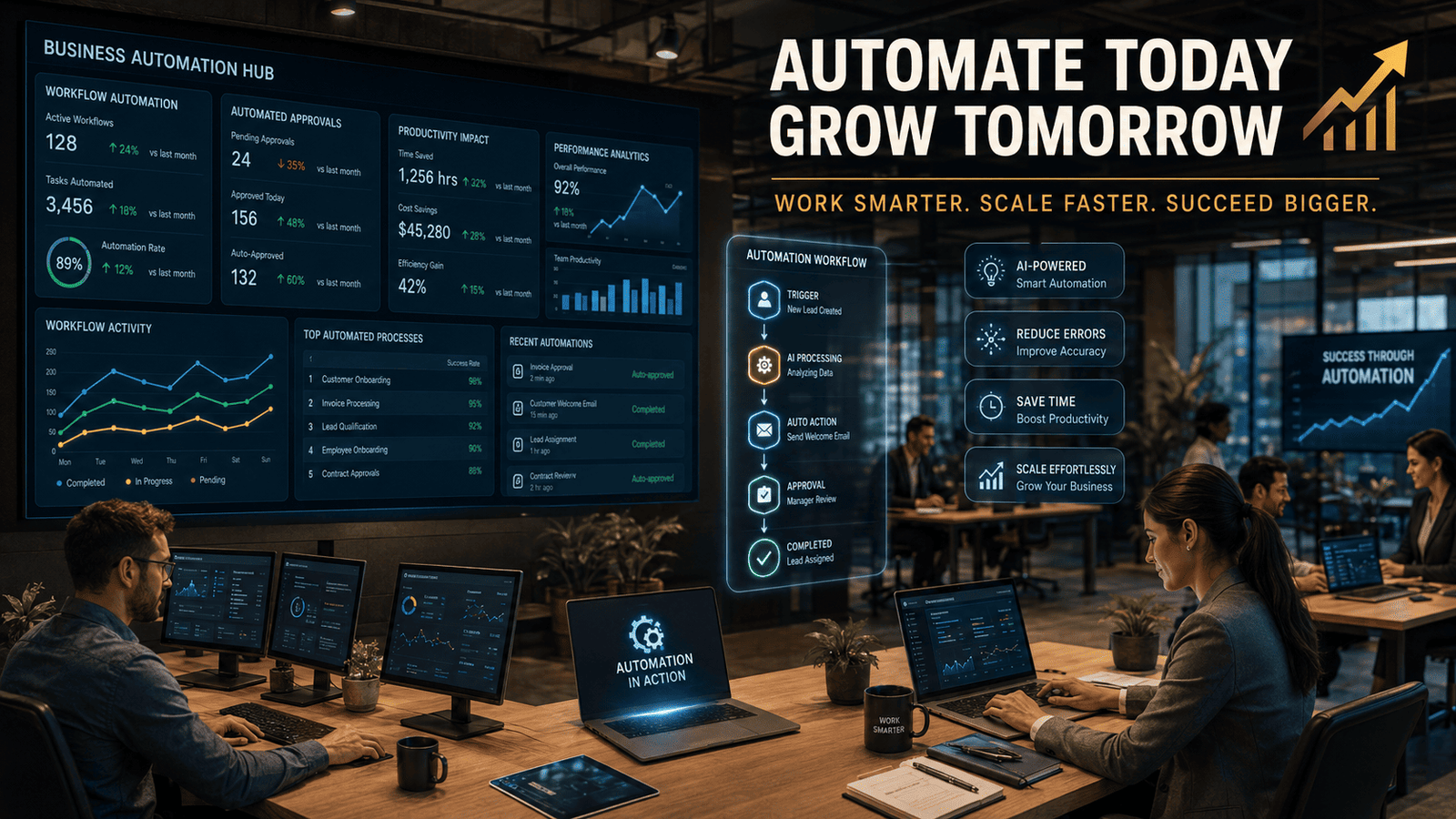
Automation removes repetitive manual effort from everyday operations.
Instead of employees spending hours on repetitive tasks, software systems handle them automatically.
This improves:
• Operational speed
• Task consistency
• Team productivity
• Workflow efficiency
Businesses become more agile and scalable.
1. Reduced Manual Work
One of the biggest advantages of automation is reducing repetitive tasks.
Automation can handle:
• Form processing
• Data entry
• Email notifications
• Invoice generation
• Customer follow-ups
• Workflow routing
This allows employees to focus on:
• Strategy
• Creativity
• Customer relationships
• Business growth
Instead of wasting time on repetitive operations.
Why Reduced Manual Work Matters
Manual work often leads to:
• Burnout
• Mistakes
• Delays
• Reduced morale
Automation improves employee efficiency by eliminating unnecessary operational pressure.
A productive team creates stronger business outcomes.
2. Instant Approvals and Faster Decision-Making
Traditional approval systems are often slow and inefficient.
For example:
• Managers forget pending approvals
• Emails get buried
• Teams wait unnecessarily
• Projects get delayed
Automation solves this through:
• Instant notifications
• Automated workflows
• Smart approval routing
• Real-time tracking
This significantly improves operational speed.
Faster Decisions Improve Business Agility
Businesses that move faster:
• Deliver quicker
• Respond faster to clients
• Adapt rapidly
• Scale more efficiently
Automation reduces operational bottlenecks and accelerates execution.
3. Higher Operational Efficiency
Automation improves consistency across business operations.
Automated systems:
• Follow predefined rules
• Reduce dependency on memory
• Standardize workflows
• Improve accountability
This creates smoother internal operations.
Teams become more organized, productive, and efficient.
Examples of High-Efficiency Automation
Modern software solutions automate:
• CRM management
• Inventory tracking
• Employee onboarding
• Attendance systems
• Lead nurturing
• Project management
• Financial reporting
Automation allows businesses to operate with better structure and visibility.
4. Lower Operational Costs
One of the biggest business benefits of automation is cost reduction.
Automation helps reduce:
• Manual labor costs
• Operational delays
• Error correction expenses
• Administrative workload
Over time, businesses save significant resources.
More importantly, automation creates scalable systems without requiring proportional increases in manpower.
Automation Is About Scalability
A business cannot scale efficiently if every process depends on manual intervention.
Automation enables businesses to:
• Handle larger workloads
• Manage more customers
• Operate faster
• Maintain consistency
without dramatically increasing operational complexity.
How Automation Improves Customer Experience
Customers expect:
• Faster service
• Real-time updates
• Quick support
• Smooth interactions
Automation improves customer experience through:
• Instant responses
• Automated communication
• Faster issue resolution
• Better workflow management
Happy customers lead to:
• Better retention
• More referrals
• Stronger brand reputation
Industries Rapidly Adopting Automation
Automation is transforming industries including:
• Healthcare
• Finance
• Ecommerce
• Logistics
• Education
• Real Estate
• SaaS
• Manufacturing
Every modern business is becoming increasingly software-driven.
Signs Your Business Needs Automation
Warning Signs You Should Not Ignore
• Teams spending too much time on repetitive work
• Slow approvals delaying operations
• Frequent human errors
• Lack of workflow visibility
• Growing operational chaos
• Difficulty scaling processes
If these problems exist consistently, automation is no longer optional.
The Future of Business Is Automated
Businesses that adopt automation early gain:
• Competitive advantage
• Faster growth
• Better scalability
• Improved customer satisfaction
• Higher productivity
Companies that ignore automation risk falling behind more efficient competitors.
Conclusion
Automation is not about replacing people.
It is about empowering businesses to:
• Operate smarter
• Move faster
• Scale efficiently
• Improve productivity
• Reduce operational friction
Modern software solutions help businesses eliminate repetitive tasks, streamline approvals, improve workflows, and build scalable operational systems.
In 2026 and beyond, businesses that automate intelligently will outperform those still trapped in manual processes.
Because growth today is no longer driven only by effort.
It is driven by systems, speed, and operational efficiency.
FAQ Section
What is business automation?
Business automation refers to using software and digital systems to automate repetitive tasks, workflows, approvals, communication, and operational processes.
How does automation improve business growth?
Automation improves speed, efficiency, productivity, and accuracy while reducing manual work, operational costs, and delays.
What processes can businesses automate?
Businesses can automate:
• Approvals
• Customer communication
• CRM workflows
• HR operations
• Billing and invoicing
• Inventory management
• Lead management
• Reporting and analytics
Does automation reduce operational costs?
Yes. Automation reduces human errors, repetitive manual work, processing delays, and inefficient workflows, helping businesses save time and money.
Why are companies investing in automation in 2026?
Modern businesses need faster operations, better scalability, improved customer experience, and higher productivity. Automation helps achieve all of these efficiently.





Comments (10)
By Rahul Sharma
Jun 26, 2026Thanks for sharing such valuable information.
By Priya Verma
Jun 26, 2026Great work! Looking forward to more articles like this.
By Arjun Patel
Jun 26, 2026Fantastic read, highly recommended.
By Ananya Kapoor
Jun 26, 2026Very informative and engaging article.
By Michael Johnson
Jun 26, 2026Keep publishing such quality blogs.
By Emily Carter
Jun 26, 2026Thanks for sharing such valuable information.
By Daniel Kim
Jun 26, 2026Great work! Looking forward to more articles like this.
By Sophia Martinez
Jun 26, 2026Fantastic read, highly recommended.
By Liam Wilson
Jun 26, 2026Very informative and engaging article.
By Neha Singh
Jun 26, 2026Keep publishing such quality blogs.