Introduction
Education has rapidly evolved beyond traditional classrooms. Today's schools are expected to provide high-quality education while efficiently managing thousands of daily administrative tasks. Admissions, attendance, examinations, fee collection, transportation, library management, communication with parents, teacher records, payroll, and academic reporting all require seamless coordination.
Unfortunately, many schools still rely on manual registers, spreadsheets, disconnected software, and paper-based processes. These outdated methods increase administrative workload, create data duplication, delay decision-making, and often result in errors.
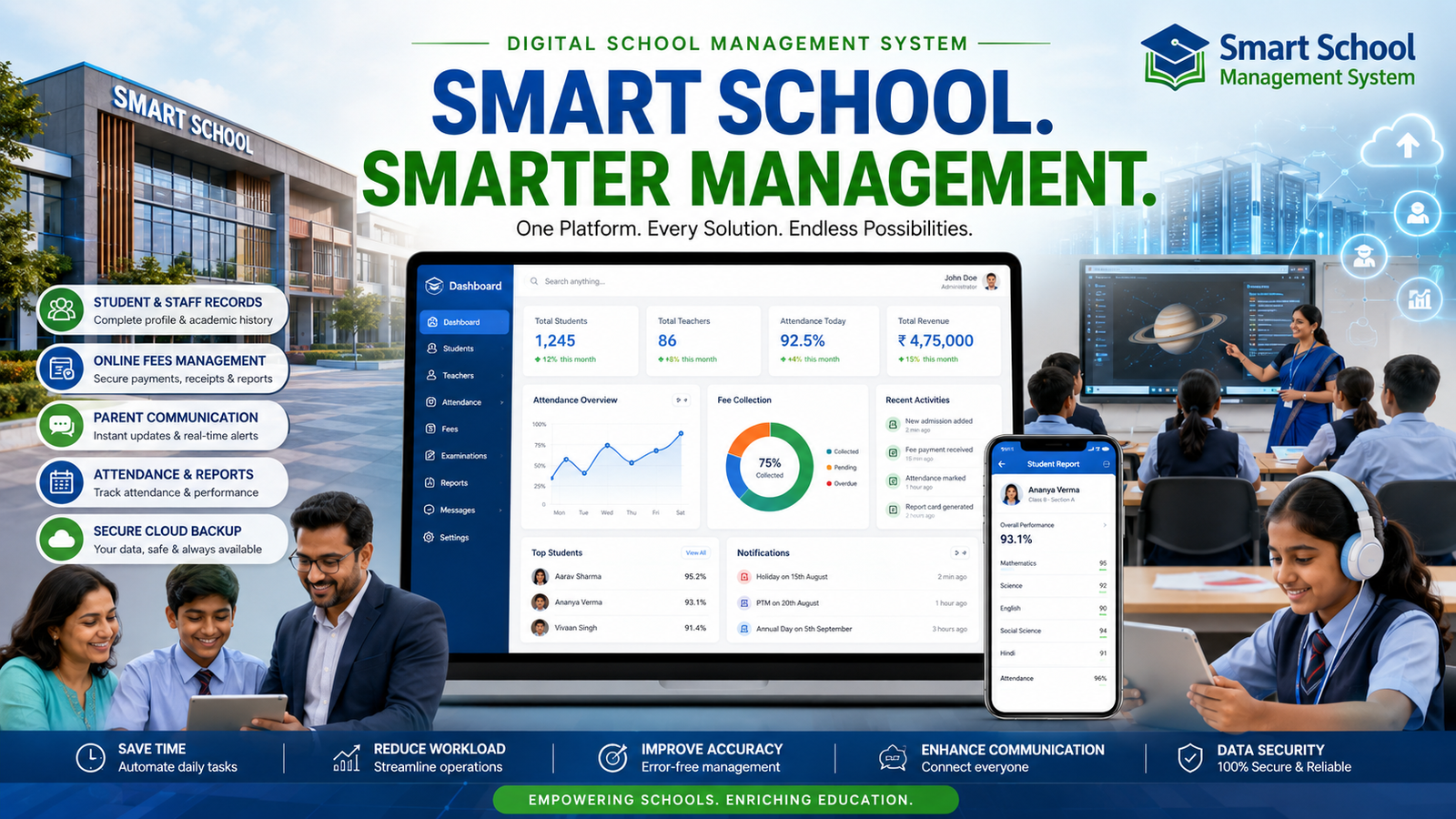
A School Management System (SMS), also known as School ERP Software, addresses these challenges by centralizing every academic and administrative function into one integrated digital platform.
Whether you're managing a primary school, higher secondary institution, coaching center, college, or university, a cloud-based School Management System simplifies operations, improves transparency, enhances communication, and creates a better educational experience for students, teachers, administrators, and parents.
This guide explores everything you need to know about School Management Systems, including features, benefits, implementation strategies, costs, ROI, and future trends.
What Is a School Management System?
A School Management System is a centralized software platform designed to automate and manage educational institution operations.
Instead of maintaining separate systems for admissions, attendance, examinations, fee collection, and communication, schools can manage everything through a single platform.
Typical modules include:
Why This Matters For Educational Institutions
Educational institutions manage thousands of activities every day.
Without automation, administrators face challenges such as:
-
Manual paperwork
-
Delayed reporting
-
Fee collection issues
-
Communication gaps
-
Attendance inaccuracies
-
Data duplication
A School ERP eliminates these inefficiencies.
| Traditional School |
Smart School Management |
| Paper Registers |
Digital Records |
| Manual Attendance |
Automated Attendance |
| Cash Fee Collection |
Online Payments |
| Phone Calls |
Parent Mobile App |
| Manual Reports |
Real-Time Analytics |
| File Storage |
Secure Cloud Backup |
Common Problems Schools Face
Most educational institutions struggle with:
1. Paper-Based Administration
Manual records consume time and increase errors.
2. Attendance Management
Tracking daily attendance manually is inefficient.
3. Fee Collection
Manual fee tracking causes payment delays.
4. Parent Communication
Important updates often fail to reach parents on time.
5. Report Generation
Preparing examination reports manually requires significant effort.
6. Data Security
Physical records are vulnerable to loss or damage.
Signs Your School Needs a Management System
Your institution should consider School ERP software if:
-
Student records are maintained manually.
-
Attendance consumes administrative time.
-
Fee collection is difficult to manage.
-
Parent communication lacks consistency.
-
Examination reporting is time-consuming.
-
Staff management is fragmented.
-
Multiple software systems are used independently.
-
School operations are becoming increasingly complex.
Benefits Of Implementing a School Management System
Increased Administrative Efficiency
Automation reduces repetitive work.
Improved Communication
Parents, teachers, and administrators remain connected.
Better Student Management
Centralized academic and personal records.
Faster Decision-Making
Real-time reports improve planning.
Enhanced Data Security
Cloud-based storage protects sensitive information.
Paperless Operations
Reduce paperwork and operational costs.
Improved Parent Satisfaction
Transparent communication builds trust.
Detailed Explanation Of Student & Staff Records
Managing student and employee information manually becomes increasingly difficult as institutions grow.
A School Management System maintains centralized digital records including:
Student Records
-
Admissions
-
Personal Information
-
Academic History
-
Medical Information
-
Attendance
-
Examination Results
-
Certificates
Staff Records
-
Teacher Profiles
-
Departments
-
Qualifications
-
Payroll
-
Leave Management
-
Performance Reports
Benefits
-
Easy access
-
Faster administration
-
Reduced paperwork
-
Better record accuracy
Detailed Explanation Of Online Fees Management
Fee management is one of the most important administrative functions.
A School ERP automates:
-
Fee Collection
-
Online Payments
-
Due Reminders
-
Receipt Generation
-
Scholarships
-
Discounts
-
Payment History
Benefits
-
Faster payments
-
Reduced accounting workload
-
Better financial transparency
-
Improved parent convenience
Parents can securely pay using:
-
UPI
-
Credit Cards
-
Debit Cards
-
Net Banking
-
Digital Wallets
Detailed Explanation Of Parent Communication
Strong communication improves student success.
Modern School ERP systems provide:
-
Mobile Notifications
-
Homework Updates
-
Circulars
-
Examination Results
-
Attendance Alerts
-
Fee Reminders
-
Event Announcements
-
Teacher Messaging
Benefits
Detailed Explanation Of Attendance & Reports
Attendance tracking becomes effortless through automation.
Schools can manage:
-
Student Attendance
-
Staff Attendance
-
Leave Applications
-
Biometric Integration
-
QR Code Attendance
-
RFID Attendance
Reports include:
-
Daily Attendance
-
Monthly Reports
-
Examination Performance
-
Fee Collection Reports
-
Academic Analytics
Administrators gain instant visibility into institutional performance.
Detailed Explanation Of Secure Cloud Backup
Educational institutions manage highly sensitive data.
Cloud backup protects:
-
Student Information
-
Academic Records
-
Financial Data
-
Examination Results
-
Employee Records
Benefits
Even during hardware failures, school operations continue uninterrupted.
Real Business Example
A private K-12 school managed over 2,000 students using spreadsheets and manual registers.
Challenges included:
-
Slow attendance processing
-
Delayed fee reconciliation
-
Parent communication gaps
-
Manual report preparation
After implementing a School Management System:
-
Administrative workload reduced significantly
-
Attendance became digital
-
Fee collection improved
-
Parents received instant notifications
-
Report generation became automated
Startup Example
A newly established international school implemented a cloud-based School ERP before opening admissions.
The system included:
-
Online admission forms
-
Student portal
-
Parent app
-
Fee management
-
Attendance tracking
This allowed the institution to scale efficiently while maintaining professional administration from day one.
Enterprise Example
A large educational group managing multiple campuses deployed an integrated School ERP.
Modules included:
-
Multi-campus management
-
HR & Payroll
-
Finance
-
Transport
-
Hostel
-
Learning Management
-
Analytics Dashboard
The centralized platform enabled standardized operations across every campus while improving reporting and decision-making.
Step By Step Implementation Guide
Step 1: Analyze School Requirements
Identify administrative and academic processes.
Step 2: Define Required Modules
Select modules such as:
-
Admissions
-
Attendance
-
Fees
-
Examinations
-
HR
-
Library
-
Transport
Step 3: Customize the Software
Configure workflows according to institutional requirements.
Step 4: Import Existing Data
Migrate student and staff information securely.
Step 5: Train Users
Train administrators, teachers, and support staff.
Step 6: Launch the Platform
Deploy the system with testing and validation.
Step 7: Monitor & Improve
Continuously optimize based on feedback.
Common Mistakes To Avoid
Schools often make mistakes such as:
-
Choosing software without customization.
-
Ignoring staff training.
-
Delaying data migration planning.
-
Weak backup strategies.
-
Poor parent onboarding.
-
Lack of security policies.
-
Not planning for future expansion.
Best Practices
-
Centralize all school operations.
-
Automate repetitive tasks.
-
Use cloud infrastructure.
-
Enable role-based access.
-
Secure sensitive information.
-
Regularly back up data.
-
Monitor system performance.
-
Keep parents engaged through mobile communication.
Tools And Technologies Used
Modern School Management Systems commonly use:
Frontend
Backend
Databases
Cloud Platforms
Integrations
-
Payment Gateways
-
SMS APIs
-
Email Services
-
Biometric Devices
-
Mobile Notifications
Cost Considerations
| Module |
Investment Level |
| Student Management |
Medium |
| Fee Management |
Medium |
| Attendance System |
Medium |
| Parent Portal |
Medium |
| Mobile Apps |
Medium |
| Cloud Hosting |
Variable |
| Maintenance |
Ongoing |
The total investment depends on institution size, number of students, modules, and customization requirements.
ROI And Business Impact
Schools implementing School ERP systems commonly experience:
-
Reduced administrative workload
-
Faster fee collection
-
Better parent engagement
-
Improved operational efficiency
-
Lower paperwork costs
-
Higher staff productivity
Primary ROI Drivers
-
Administrative automation
-
Digital fee collection
-
Paperless operations
-
Improved communication
-
Better decision-making
-
Reduced operational costs
Future Trends
AI-Powered Education
Personalized learning recommendations.
Learning Analytics
Student performance prediction.
Smart Attendance
Facial recognition and biometric systems.
Mobile-First Education
Complete school management through mobile applications.
Digital Classrooms
Integrated LMS and virtual learning.
Predictive Reporting
AI-driven academic and administrative insights.
Why Choose NetSwap Technologies
NetSwap Technologies develops custom School Management Systems tailored to the unique needs of educational institutions. Our solutions include admissions, student information management, attendance, fee collection, examination management, parent communication, staff administration, cloud infrastructure, mobile applications, analytics, and secure data management. Every platform is built for scalability, security, and long-term digital transformation.
Our Education Technology Expertise
-
School ERP Development
-
College Management Systems
-
Student Information Systems
-
Learning Management Systems (LMS)
-
Parent & Teacher Mobile Apps
-
Online Examination Platforms
-
Attendance Management
-
Fee Management
-
Cloud-Based Education Solutions
-
Custom Education Software
NetSwap Technologies partners with schools, colleges, universities, and educational organizations to build reliable, secure, and future-ready digital education platforms.
Frequently Asked Questions
What is the purpose of a School Management System?
It automates academic and administrative operations, improving efficiency, transparency, and communication.
Can parents use the software?
Yes. Parents can access attendance, report cards, fee details, homework, announcements, and communicate with teachers.
Is online fee collection secure?
Yes. Modern systems integrate encrypted payment gateways and secure transaction processing.
Can the software manage multiple campuses?
Yes. Multi-campus management is supported through centralized administration.
Is cloud backup included?
Yes. Cloud-based School ERP systems provide secure backups, disaster recovery, and remote accessibility.
Can the system be customized?
Absolutely. Features, modules, reports, and workflows can be tailored to your institution's requirements.
Final Thoughts
Education is becoming increasingly digital, and institutions that embrace technology are better positioned to deliver exceptional learning experiences while simplifying administration.
A modern School Management System transforms paperwork into productivity, manual processes into automation, and disconnected operations into one intelligent ecosystem.
By investing in a scalable, secure, and cloud-based School ERP, educational institutions can improve operational efficiency, strengthen parent engagement, support teachers, and create a smarter future for students.
Contact NetSwap Technologies
Need a Custom School Management System?
NetSwap Technologies helps educational institutions build:
-
School ERP Software
-
Student Information Systems
-
Learning Management Systems (LMS)
-
Parent & Teacher Mobile Apps
-
Online Examination Platforms
-
Fee Management Systems
-
Attendance Management
-
Cloud-Based Education Platforms
-
Custom Education Software
-
Digital Transformation Solutions
Whether you're launching a new institution, upgrading existing software, or managing multiple campuses, our team can build a secure, scalable, and fully customized School Management System tailored to your educational goals.
Contact Us Today
Let's build a smarter, paperless, and future-ready education management platform that empowers administrators, teachers, students, and parents alike.
FAQ Section
What is a School Management System?
A School Management System is software that digitizes academic, administrative, financial, and communication processes within an educational institution.
Who can use a School Management System?
Schools, colleges, coaching institutes, universities, training centers, and educational organizations of all sizes.
Can parents access the system?
Yes. Parents can receive attendance updates, fee reminders, report cards, homework, announcements, and communicate with teachers through dedicated portals or mobile apps.
Is online fee collection secure?
Modern School ERP systems integrate secure payment gateways with encrypted transactions and automatic receipt generation.
Can the software be customized?
Yes. Custom School Management Systems can be tailored according to your school's workflows, academic structure, examination process, and reporting requirements.





Comments (0)