
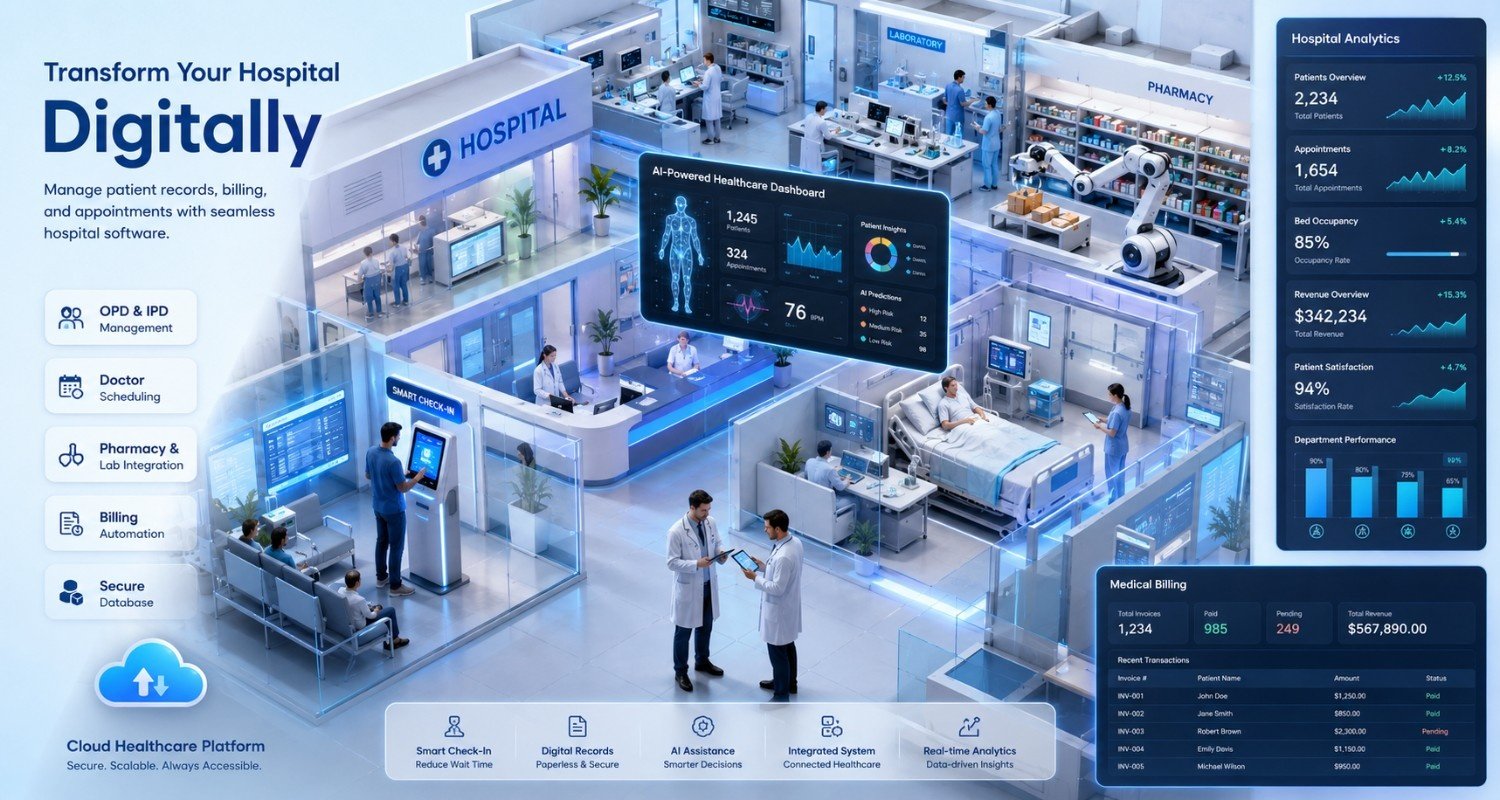
Transform Your Hospital Digitally with a Smart Hospital Management System
Healthcare is no longer just about treating patients—it is about delivering exceptional patient experiences, improving operational efficiency, and making informed decisions through technology. As hospitals continue to handle increasing patient volumes, complex medical records, insurance claims, laboratory reports, pharmacy inventories, and administrative processes, relying on manual systems has become both inefficient and risky.
A modern Hospital Management System (HMS) helps hospitals digitize every stage of patient care while improving communication between departments. From patient registration and doctor appointments to billing, laboratory management, pharmacy operations, and administrative reporting, an integrated healthcare management platform transforms how hospitals operate.
Whether you run a multi-specialty hospital, a diagnostic center, a specialty clinic, or a healthcare network, investing in digital healthcare technology is no longer optional—it's essential for sustainable growth.
Organizations planning enterprise healthcare software often combine Hospital Management Systems with broader CRM & ERP Solutions, allowing hospitals to manage administration, finance, inventory, HR, and patient relationships from a centralized platform. Similarly, custom workflows can be developed through Custom Software Development Services to match the unique operational requirements of every healthcare organization.
Why Digital Transformation Is Revolutionizing Healthcare
Modern patients expect healthcare services to be fast, transparent, and accessible. Long waiting times, misplaced medical records, delayed laboratory reports, billing errors, and disconnected departments negatively impact patient satisfaction and hospital efficiency.
Digital transformation addresses these challenges by creating a connected healthcare ecosystem where every department works together seamlessly.
Instead of maintaining separate systems for appointments, billing, pharmacy, and laboratory management, hospitals can operate through one centralized platform where information flows securely and instantly.
For example:
-
A patient books an appointment online.
-
The doctor instantly accesses previous medical records.
-
Laboratory reports are uploaded automatically.
-
Pharmacy receives digital prescriptions.
-
Billing is generated in real time.
-
Administrators monitor hospital performance through interactive dashboards.
This integrated approach reduces paperwork, eliminates duplicate data entry, minimizes human errors, and significantly improves the overall quality of healthcare delivery.
Healthcare providers looking to build scalable digital ecosystems often integrate their HMS with API & System Integration Services, enabling seamless communication with insurance providers, payment gateways, laboratory equipment, biometric systems, SMS services, and third-party healthcare platforms.
What Is a Hospital Management System?
A Hospital Management System is a comprehensive software solution designed to automate and manage daily hospital operations from a single centralized platform.
Instead of relying on multiple disconnected applications or manual paperwork, hospitals can manage every department digitally.
Typical modules include:
• Patient Registration
• OPD Management
• IPD Management
• Appointment Scheduling
• Doctor Management
• Pharmacy Management
• Laboratory Management
• Billing & Invoicing
• Insurance Management
• Inventory Management
• Staff Management
• Electronic Medical Records (EMR)
• Reporting & Analytics
• Multi-Branch Administration
• Secure Role-Based Access
By connecting these modules into one platform, hospitals improve collaboration between departments while ensuring accurate and timely access to critical patient information.
Hospitals that plan long-term digital expansion frequently adopt Cloud & DevOps Solutions to ensure their Hospital Management System remains scalable, secure, and highly available across multiple locations.
OPD & IPD Management
One of the most important components of any Hospital Management System is efficient patient management. Both outpatient (OPD) and inpatient (IPD) services require smooth coordination between medical staff, administrative teams, laboratories, pharmacies, and billing departments.
Without an integrated digital platform, hospitals often experience delays, duplicated records, and communication gaps.
Our Hospital Management System simplifies these processes by providing a centralized workflow that allows every department to access relevant patient information in real time.
OPD Management
Outpatient services represent the first interaction many patients have with a hospital. A smooth OPD experience significantly improves patient satisfaction while reducing administrative workload.
With digital OPD management, hospitals can streamline patient registration, appointment scheduling, doctor consultations, prescriptions, and follow-up visits from a single dashboard.
Key capabilities include:
-
Quick patient registration with digital records
-
Online and offline appointment booking
-
Doctor-wise consultation scheduling
-
Digital prescription management
-
Patient medical history tracking
-
Automated follow-up reminders
-
Queue management to reduce waiting times
-
Department-wise patient routing
-
Consultation summary generation
-
Real-time patient status updates
The result is a faster consultation process, improved doctor productivity, and a significantly better experience for patients.
Hospitals can further enhance patient convenience by integrating mobile applications developed through Mobile App Development Services, allowing patients to book appointments, access prescriptions, receive notifications, and communicate with healthcare providers directly from their smartphones.
IPD Management
Managing admitted patients requires significantly more coordination than outpatient care.
Every inpatient generates a continuous stream of information, including room allocation, nursing observations, treatment plans, laboratory requests, medication schedules, surgeries, dietary instructions, billing records, and discharge summaries.
An integrated IPD Management module ensures that every department has access to the latest patient information without relying on paper files or manual communication.
The system supports:
-
Digital admission process
-
Bed and ward allocation
-
Room availability management
-
Nursing workflow management
-
Daily treatment tracking
-
Medication administration records
-
Surgery scheduling
-
Consultant visit management
-
Progress notes
-
Discharge summary generation
-
Patient transfer management
-
Automated billing updates
This centralized workflow minimizes delays, improves collaboration between departments, and helps hospitals deliver safer and more efficient inpatient care.
Doctor Scheduling & Appointment Management
Doctors are among the busiest resources within any healthcare organization. Managing their availability manually often leads to scheduling conflicts, long waiting times, missed appointments, and inefficient utilization of hospital resources.
A smart Doctor Scheduling module eliminates these challenges through intelligent appointment management.
Hospitals can define consultation timings, doctor availability, specialties, holidays, emergency schedules, and multiple consultation locations—all from a centralized dashboard.
The system enables:
-
Doctor calendar management
-
Shift scheduling
-
Department-wise doctor allocation
-
Online appointment booking
-
Emergency consultation management
-
Automatic appointment reminders
-
Queue optimization
-
Follow-up appointment scheduling
-
Teleconsultation scheduling
-
Availability management across multiple branches
Patients benefit from shorter waiting times, while doctors gain better control over their schedules and hospitals improve resource utilization.
Hospitals expanding into telemedicine or AI-assisted healthcare can also leverage AI & Automation Solutions to introduce intelligent appointment routing, virtual assistants, predictive scheduling, automated reminders, and conversational patient support, creating a more responsive digital healthcare experience.
Continuing seamlessly from Response 2A:
Pharmacy & Laboratory Integration
A hospital operates efficiently only when every department communicates in real time. Among the most critical departments are the pharmacy and laboratory, as they directly impact diagnosis, treatment, and patient safety.
Traditional hospitals often face delays because prescriptions are handwritten, laboratory reports are manually delivered, and pharmacy inventory is updated separately. These disconnected workflows increase waiting times, create opportunities for medication errors, and reduce operational efficiency.
A modern Hospital Management System eliminates these bottlenecks by integrating the pharmacy and laboratory into a single digital platform.
When a doctor prescribes medication, the prescription is instantly available to the pharmacy. Similarly, laboratory tests requested during consultation are automatically forwarded to the laboratory department, where technicians can process samples, upload reports, and notify doctors as soon as results are available.
This seamless communication allows doctors to make faster clinical decisions while providing patients with a significantly better healthcare experience.
Pharmacy Management
The Pharmacy Management module helps hospitals maintain complete control over medicine inventory, prescriptions, procurement, and dispensing.
Instead of manually tracking stock levels, pharmacists receive real-time inventory updates, expiry alerts, and automated reorder notifications.
The module supports:
-
Digital prescription management
-
Medicine inventory tracking
-
Batch and expiry management
-
Barcode-enabled medicine dispensing
-
Stock transfer between branches
-
Purchase order management
-
Vendor management
-
Medicine availability checking
-
Automated low-stock alerts
-
Sales and purchase reporting
This reduces medicine shortages, minimizes wastage due to expired stock, and ensures patients receive medications quickly and accurately.
Hospitals managing multiple locations can further enhance inventory visibility through scalable Cloud & DevOps Solutions, ensuring synchronized pharmacy operations across all branches.
Laboratory Management
Diagnostic services play a crucial role in modern healthcare. Laboratory Management within the Hospital Management System ensures accurate, fast, and paperless reporting.
Doctors can request laboratory investigations directly from the patient's profile, eliminating manual paperwork.
The laboratory team receives the request instantly, processes the samples, uploads digital reports, and makes them immediately accessible to both doctors and patients.
Key capabilities include:
-
Test request management
-
Sample collection tracking
-
Laboratory workflow management
-
Digital report generation
-
Result approval process
-
Historical report storage
-
Department-wise reporting
-
Automated notification to doctors
-
Patient report download
-
Integration with diagnostic equipment
This reduces turnaround time while improving diagnostic accuracy and patient satisfaction.
Healthcare organizations often integrate laboratory systems using API & System Integration Services, allowing diagnostic devices and third-party healthcare applications to exchange data automatically.
Billing Automation
Hospital billing is one of the most complex administrative functions. A single patient may generate consultation charges, laboratory fees, pharmacy purchases, room charges, surgery costs, insurance claims, and miscellaneous expenses.
Managing these calculations manually increases the risk of errors and delays.
The Billing Automation module generates invoices automatically based on the patient's treatments and services received.
As departments update their records, charges are reflected instantly in the patient's billing summary.
The system supports:
-
Consultation billing
-
OPD billing
-
IPD billing
-
Room and bed charges
-
Laboratory billing
-
Pharmacy billing
-
Surgery billing
-
Insurance claim management
-
GST and tax calculations
-
Multiple payment methods
-
Online payment integration
-
Invoice generation
-
Refund management
-
Financial reporting
Automated billing improves transparency, accelerates discharge processes, and reduces administrative overhead while providing patients with accurate and detailed invoices.
Hospitals planning digital payment ecosystems can integrate secure payment gateways and financial platforms through API & System Integration Services, creating a seamless billing experience for patients.
Secure Database & Patient Information Management
Healthcare organizations handle some of the most sensitive information imaginable. Protecting patient data is not only a legal responsibility but also essential for maintaining trust.
A secure Hospital Management System safeguards medical records through advanced security measures, ensuring only authorized personnel can access confidential information.
Modern healthcare software incorporates multiple layers of protection, including:
-
Role-based access control
-
Multi-factor authentication
-
Encrypted patient records
-
Secure cloud backups
-
Audit logs
-
Session management
-
Activity monitoring
-
Automated backup schedules
-
Disaster recovery planning
-
Secure API authentication
These security measures protect hospitals against data breaches, unauthorized access, accidental deletion, and system failures.
Organizations building enterprise-grade healthcare platforms should prioritize secure infrastructure and scalable deployment practices through Cloud & DevOps Solutions and Custom Software Development Services, ensuring both compliance and long-term reliability.
Benefits of Implementing a Hospital Management System
Digital healthcare transformation offers measurable benefits for hospitals, doctors, staff, and patients alike.
Some of the most significant advantages include:
-
Faster patient registration and reduced waiting times
-
Improved doctor productivity through intelligent scheduling
-
Better coordination between departments
-
Paperless medical record management
-
Accurate and transparent billing
-
Enhanced pharmacy and laboratory workflows
-
Real-time reporting and analytics
-
Better inventory management
-
Reduced operational costs
-
Improved patient satisfaction
-
Stronger data security
-
Easier regulatory compliance
-
Scalable infrastructure for future growth
-
Centralized management for multi-branch hospitals
These improvements enable hospitals to focus more on patient care while technology handles repetitive administrative tasks.
Why Choose NetSwap Technologies for Hospital Management Software Development?
At NetSwap Technologies, we understand that every healthcare organization operates differently. A hospital, specialty clinic, diagnostic center, or healthcare chain has unique workflows, compliance requirements, and operational goals.
Instead of delivering generic software, we develop custom Hospital Management Systems tailored specifically to your organization's needs.
Our healthcare software development expertise includes:
-
Hospital Management Systems
-
Electronic Medical Records (EMR)
-
Healthcare CRM Solutions
-
Multi-Hospital Management Platforms
-
Laboratory Information Systems
-
Pharmacy Management Software
-
Appointment Booking Platforms
-
Telemedicine Applications
-
Mobile Healthcare Apps
-
Healthcare Analytics Dashboards
-
AI-powered Healthcare Automation
-
API Integrations
-
Cloud-Based Healthcare Platforms
-
Role-Based Access Management
As part of a complete digital transformation strategy, we also provide Custom Software Development, CRM & ERP Solutions, Mobile App Development, AI & Automation Solutions, SaaS Development, and Cloud & DevOps Services, helping healthcare organizations build scalable, secure, and future-ready digital ecosystems.
Frequently Asked Questions
What is a Hospital Management System?
A Hospital Management System is software that digitizes hospital operations such as patient registration, appointments, billing, pharmacy, laboratory management, medical records, and administrative reporting.
Can Hospital Management Software be customized?
Yes. Every hospital has unique operational requirements, and a custom-built Hospital Management System can be tailored to specific workflows, departments, integrations, and compliance needs.
Is Hospital Management Software suitable for small clinics?
Absolutely. Modern solutions are scalable and can support individual clinics, specialty centers, multi-specialty hospitals, and large healthcare networks.
Can Hospital Management Software integrate with existing systems?
Yes. Through APIs and third-party integrations, the software can connect with payment gateways, laboratory equipment, insurance providers, biometric devices, SMS services, and other healthcare platforms.
Does the software support multiple branches?
Yes. Multi-branch management allows centralized administration while maintaining separate operational controls for each location.
How secure is patient information?
Patient information is protected using encryption, role-based access control, secure authentication, audit logs, regular backups, and cloud security best practices.
How long does it take to develop a Hospital Management System?
Development timelines vary depending on project complexity, required modules, integrations, and customization. A detailed consultation helps determine the appropriate implementation plan.
Why choose NetSwap Technologies?
NetSwap Technologies specializes in building scalable, secure, and customized healthcare software solutions that improve operational efficiency, enhance patient care, and support long-term digital growth.
Ready to Transform Your Hospital Digitally?
The future of healthcare belongs to organizations that embrace technology to improve patient care, streamline operations, and make smarter business decisions. A modern Hospital Management System is more than software—it is the foundation of a connected, efficient, and patient-centric healthcare ecosystem.
Whether you're planning a new healthcare platform, upgrading legacy systems, or integrating advanced technologies such as AI, cloud infrastructure, mobile applications, and business automation, NetSwap Technologies can help you build a solution tailored to your hospital's unique needs.
Get in touch with our team today to discuss your healthcare software requirements and take the first step toward delivering faster, smarter, and more efficient healthcare services.



Login to comment
To post a comment, you must be logged in. Please login. Login
Comments (0)