Introduction
Data has become one of the most valuable assets for modern businesses. Customer records, financial transactions, employee information, intellectual property, contracts, business strategies, and operational data are all critical components of an organization's success.
However, as businesses become increasingly digital, cyber threats continue to evolve. Data breaches, ransomware attacks, phishing campaigns, insider threats, and unauthorized access incidents are becoming more common across industries.
The financial and reputational impact of a security breach can be devastating. Organizations may face legal penalties, customer distrust, operational disruption, and significant revenue losses.
This is where data encryption becomes essential.
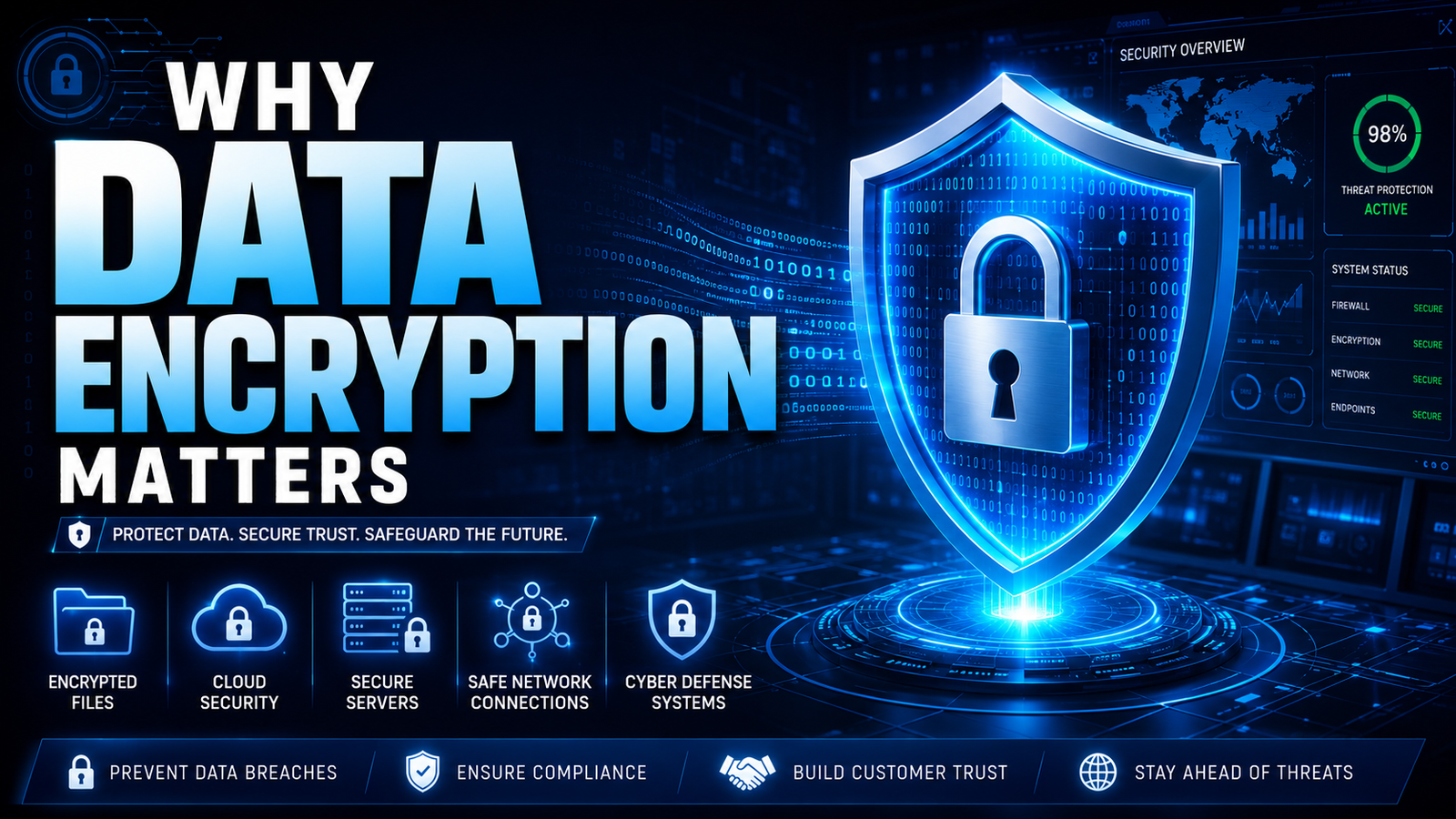
Encryption transforms sensitive information into unreadable code, ensuring that even if attackers gain access to data, they cannot understand or use it without the proper decryption keys.
From startups and small businesses to multinational enterprises, encryption is no longer optional—it is a fundamental requirement for cybersecurity, compliance, and business continuity.
In this comprehensive guide, we will explore why data encryption matters, how it works, its business benefits, implementation strategies, and future security trends.
What Is Data Encryption?
Data encryption is a cybersecurity process that converts readable information (plaintext) into encoded information (ciphertext) using cryptographic algorithms.
Only authorized users with the correct encryption key can decrypt and access the original data.
Simply put:
Without Encryption:
Customer Data → Readable → Vulnerable
With Encryption:
Customer Data → Encrypted → Protected
Encryption protects:
-
Customer records
-
Financial information
-
Passwords
-
Medical records
-
Intellectual property
-
Business communications
-
Cloud data
-
Internal documents
Why This Matters For Businesses
Modern organizations handle large amounts of sensitive information daily.
This includes:
-
Payment information
-
Employee records
-
Contracts
-
Sales data
-
Client information
-
Trade secrets
If this data falls into the wrong hands, the consequences can include:
| Risk |
Impact |
| Data Breach |
Financial Loss |
| Ransomware |
Operational Disruption |
| Insider Threats |
Information Theft |
| Compliance Violations |
Legal Penalties |
| Reputation Damage |
Customer Loss |
| Unauthorized Access |
Security Risks |
Encryption significantly reduces these risks.
Common Problems Businesses Face
1. Increasing Cyber Attacks
Hackers constantly target businesses of all sizes.
Common attacks include:
-
Malware
-
Ransomware
-
Credential theft
-
Phishing attacks
2. Remote Workforce Risks
Remote employees access business systems from multiple devices and locations.
This increases attack surfaces.
3. Cloud Security Concerns
Businesses store critical information in cloud environments.
Without encryption, cloud data becomes vulnerable.
4. Insider Threats
Employees, contractors, or partners may accidentally or intentionally expose data.
5. Compliance Requirements
Organizations must comply with regulations regarding customer data protection.
Signs You Need This Solution
Your business should prioritize encryption if:
-
Customer information is stored digitally.
-
Employees access systems remotely.
-
Cloud platforms are used.
-
Financial data is processed.
-
Sensitive business documents are shared online.
-
Regulatory compliance is required.
-
Multiple departments access business systems.
-
Cybersecurity risks are increasing.
Benefits Of Implementing Data Encryption
Stronger Data Security
Encrypted information remains unreadable to attackers.
Compliance Readiness
Supports regulatory requirements.
Improved Customer Trust
Customers expect businesses to protect their information.
Reduced Financial Risk
Helps minimize losses from security incidents.
Better Business Continuity
Protects data during unexpected events.
Secure Collaboration
Allows teams to share information safely.
Protection Across Devices
Secures data on laptops, smartphones, servers, and cloud platforms.
Detailed Explanation Of End To End Encryption
What Is End To End Encryption?
End-to-End Encryption (E2EE) ensures that data remains encrypted from the moment it leaves the sender until it reaches the intended recipient.
No intermediate party can access the information.
How It Works
-
Data is encrypted on the sender's device.
-
Data travels securely.
-
Only the recipient can decrypt the information.
Benefits
-
Prevents interception
-
Protects communications
-
Enhances privacy
-
Reduces attack exposure
Business Example
A financial company exchanges sensitive customer information between offices using encrypted communication channels.
Even if traffic is intercepted, attackers cannot read the data.
Detailed Explanation Of Encrypted Backups
What Are Encrypted Backups?
Encrypted backups store business data in a protected format.
Even backup files remain inaccessible without authorization.
Benefits
Example
A company experiences a ransomware attack.
Instead of paying attackers, encrypted backups allow secure recovery of operations.
Detailed Explanation Of Secure Data Transfer
What Is Secure Data Transfer?
Secure data transfer protects information while moving between systems, devices, applications, and users.
Common technologies include:
-
SSL/TLS Encryption
-
HTTPS Protocols
-
VPN Connections
-
Secure APIs
Benefits
Example
An ecommerce website encrypts customer payment information during checkout.
Sensitive data remains protected throughout the transaction process.
Detailed Explanation Of Zero Trust Access
What Is Zero Trust Security?
Zero Trust follows a simple principle:
"Never Trust, Always Verify."
Every user, device, and request must be verified before access is granted.
Key Components
Benefits
Example
An employee attempts to access financial records.
The system verifies:
-
Identity
-
Device
-
Location
-
Permissions
before granting access.
Real Business Example
A healthcare provider stored patient records across multiple systems.
Challenges:
After implementing encryption:
-
Patient records became protected
-
Compliance improved
-
Security incidents decreased
-
Customer confidence increased
Startup Example
A SaaS startup handled customer subscription data.
Instead of waiting until growth occurred, the company implemented:
Result:
Enterprise Example
A multinational enterprise operated across multiple countries.
The organization implemented:
Results included:
Step By Step Implementation Guide
Step 1: Identify Sensitive Data
Locate:
-
Customer records
-
Financial information
-
Employee data
-
Business documents
Step 2: Classify Information
Categorize data based on sensitivity.
Step 3: Implement Encryption Standards
Protect:
-
Databases
-
Files
-
Backups
-
Communications
Step 4: Secure Access Controls
Use:
-
MFA
-
Role-based permissions
-
Identity verification
Step 5: Encrypt Data Transfers
Implement:
-
HTTPS
-
SSL/TLS
-
Secure APIs
Step 6: Enable Monitoring
Track:
-
User activity
-
Access attempts
-
Security incidents
Step 7: Test Regularly
Perform:
Common Mistakes To Avoid
Many organizations make security mistakes such as:
-
Encrypting only stored data.
-
Ignoring backup protection.
-
Weak password policies.
-
Excessive user permissions.
-
Poor key management.
-
Lack of employee training.
-
Outdated encryption standards.
Avoiding these mistakes significantly improves protection.
Best Practices
Encrypt Data Everywhere
Protect:
-
Data at rest
-
Data in transit
-
Data in use
Implement Multi-Factor Authentication
Reduce unauthorized access.
Follow Zero Trust Principles
Continuously verify users and devices.
Maintain Backup Security
Always encrypt backups.
Monitor Continuously
Identify threats early.
Train Employees
Human error remains a major security risk.
Tools And Technologies Used
Modern encryption strategies often utilize:
Security Protocols
-
SSL/TLS
-
HTTPS
-
VPN Technologies
Authentication Systems
Cloud Security Platforms
-
AWS Security Services
-
Azure Security Solutions
-
Google Cloud Security
Monitoring Tools
-
SIEM Platforms
-
Threat Detection Systems
-
Security Analytics
Cost Considerations
| Security Investment |
Business Value |
| Encryption Setup |
High |
| Security Monitoring |
High |
| MFA Deployment |
Medium |
| Compliance Management |
High |
| Backup Security |
High |
While security investments require resources, the cost of a breach is often significantly higher.
ROI And Business Impact
Organizations implementing strong encryption often achieve:
-
Reduced breach risks
-
Lower compliance penalties
-
Increased customer confidence
-
Improved operational resilience
-
Stronger brand reputation
ROI is generated through:
-
Risk reduction
-
Compliance readiness
-
Customer retention
-
Reduced incident recovery costs
-
Improved business continuity
Future Trends
The future of data protection includes:
AI-Powered Threat Detection
Automated identification of suspicious behavior.
Quantum-Resistant Encryption
Preparing for next-generation computing threats.
Zero Trust Expansion
Broader adoption across enterprises.
Cloud-Native Security
Security integrated directly into cloud infrastructure.
Automated Compliance Monitoring
Continuous regulatory compliance verification.
Privacy-First Architectures
Security built into software from the beginning.
Why Choose NetSwap Technologies
NetSwap Technologies develops secure, scalable, and business-focused digital solutions including custom software, cloud applications, CRM systems, ERP platforms, APIs, SaaS products, and enterprise applications. Security and data protection are integrated into every stage of development to help businesses reduce risk and protect critical information.
Our Security-Focused Expertise
-
Secure Software Development
-
Cloud Security Implementation
-
SaaS Platform Development
-
API Security
-
CRM & ERP Solutions
-
Business Automation Systems
-
Data Protection Strategies
-
Enterprise Security Architecture
NetSwap Technologies helps organizations build reliable and secure digital platforms while maintaining scalability and business efficiency.
Frequently Asked Questions
Is encryption necessary for small businesses?
Yes. Small businesses are increasingly targeted by cybercriminals and need strong protection.
What data should be encrypted?
Customer records, financial data, employee information, backups, and sensitive business documents.
Does encryption affect system performance?
Modern encryption technologies have minimal performance impact while providing significant security benefits.
What is the difference between encryption and authentication?
Encryption protects data, while authentication verifies identities.
Is Zero Trust suitable for all businesses?
Yes. Organizations of all sizes can benefit from Zero Trust principles.
How often should encryption systems be reviewed?
Security reviews should occur regularly, with ongoing monitoring and periodic audits.
Final Thoughts
Data encryption has become a fundamental requirement for modern business security. As cyber threats continue to evolve, organizations must protect sensitive information through comprehensive security strategies that include end-to-end encryption, encrypted backups, secure data transfer, and Zero Trust access controls.
Businesses that prioritize data protection not only reduce security risks but also strengthen customer trust, improve compliance readiness, and create a resilient foundation for future growth.
Investing in encryption today is an investment in long-term business stability, reputation, and success.
Contact NetSwap Technologies
Need Help With Data Security & Secure Software Development?
NetSwap Technologies helps businesses build:
-
Secure Web Applications
-
SaaS Platforms
-
CRM Systems
-
ERP Solutions
-
Cloud Applications
-
Business Automation Tools
-
API Integrations
-
Enterprise Software
-
Data Protection Frameworks
-
Secure Digital Infrastructure
Whether you need a secure business platform, encrypted cloud application, or enterprise-grade software solution, our team can help design and develop systems that prioritize both growth and security.
Contact Us Today
Let's discuss how secure technology solutions can protect your business and support long-term digital growth.
FAQ Section
What is data encryption?
Data encryption is the process of converting readable information into coded data that can only be accessed using a decryption key.
Why is encryption important for businesses?
Encryption protects sensitive business information from cybercriminals, unauthorized users, insider threats, and accidental exposure.
What is end-to-end encryption?
End-to-end encryption ensures data remains encrypted throughout transmission and can only be decrypted by the intended recipient.
Are encrypted backups necessary?
Yes. Encrypted backups protect stored data from unauthorized access and help businesses recover securely after cyber incidents.
What is Zero Trust Access?
Zero Trust is a security model that assumes no user or device should be trusted automatically, requiring continuous verification before granting access.





Comments (10)
By Rahul Sharma
Jun 26, 2026Keep publishing such quality blogs.
By Priya Verma
Jun 26, 2026Thanks for sharing such valuable information.
By Arjun Patel
Jun 26, 2026Great work! Looking forward to more articles like this.
By Ananya Kapoor
Jun 26, 2026Fantastic read, highly recommended.
By Michael Johnson
Jun 26, 2026Very informative and engaging article.
By Emily Carter
Jun 26, 2026Keep publishing such quality blogs.
By Daniel Kim
Jun 26, 2026Thanks for sharing such valuable information.
By Sophia Martinez
Jun 26, 2026Great work! Looking forward to more articles like this.
By Liam Wilson
Jun 26, 2026Fantastic read, highly recommended.
By Neha Singh
Jun 26, 2026Very informative and engaging article.