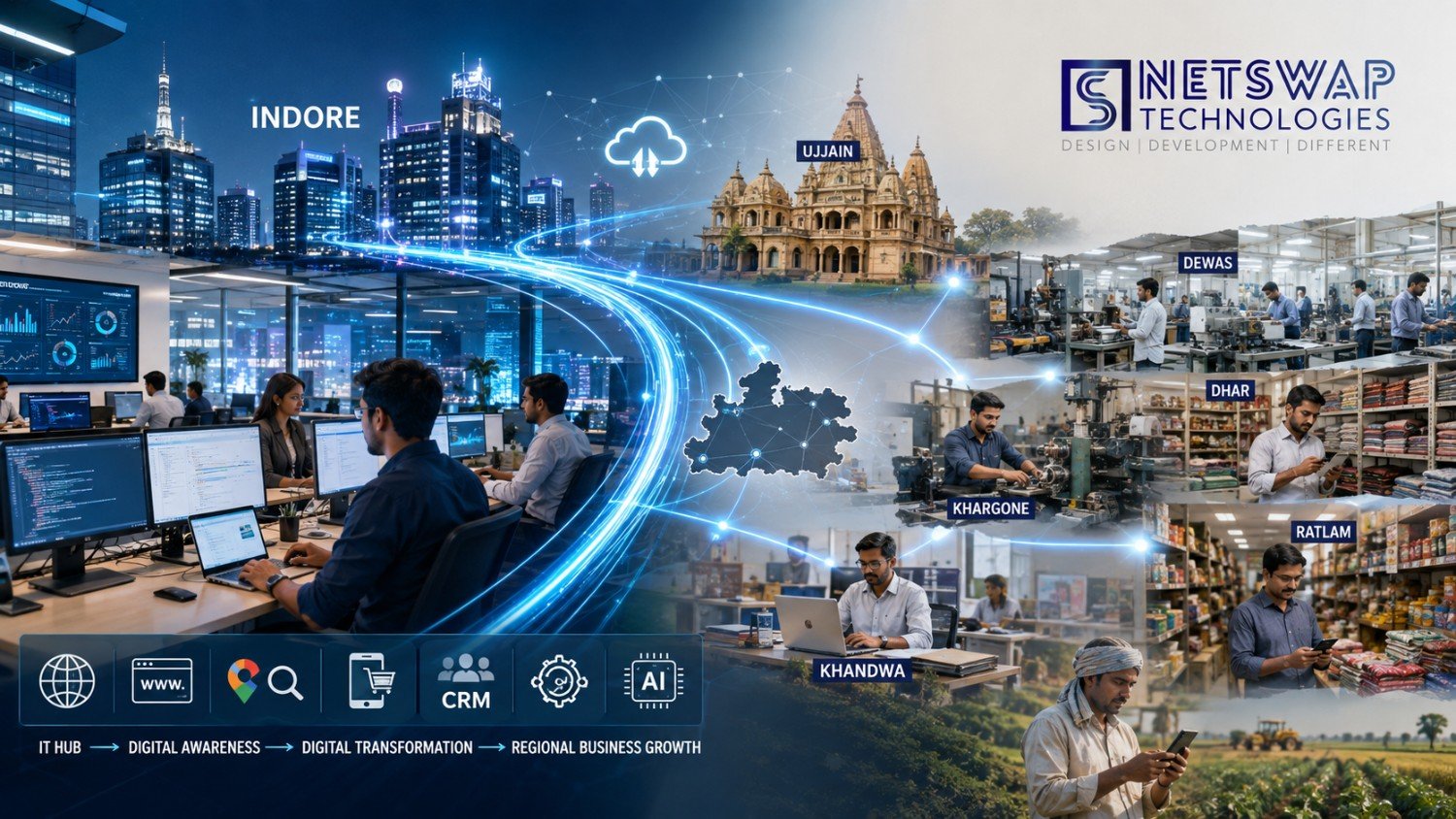
Indore's IT Boom Is Growing, But Is Digital Transformation Reaching Businesses Across Malwa and Nimar?
Indore has rapidly emerged as one of Central India's most important technology and business hubs.
With a growing IT and ITES ecosystem, established technology companies, educational institutions,
startups, industrial clusters, and a strong regional workforce, the city is increasingly becoming
a technology destination for Madhya Pradesh.
But an interesting question remains:
If Indore has such a strong IT ecosystem, why are many businesses in nearby districts still at an early stage of digital transformation?
The answer is more complicated than simply saying that businesses outside Indore are not aware of technology.
The real gap is between digital access and digital business adoption.
A business owner in Dewas, Dhar, Ujjain, Khargone, Khandwa, Ratlam, Barwani, or another nearby district
may already use WhatsApp, Instagram, Google Search, UPI, and smartphones every day. However, that does not
necessarily mean the business itself has a professional website, Google Business presence, digital catalogue,
CRM, online lead-generation system, eCommerce platform, or business automation.
This creates a significant opportunity for technology companies in Indore.
The opportunity is not simply to sell websites.
It is to help traditional businesses understand how technology can generate measurable business outcomes.
Indore's IT Ecosystem Has Already Created a Regional Technology Hub
Indore is no longer only the commercial capital of Madhya Pradesh. Government initiatives have increasingly
positioned Madhya Pradesh as a growing IT, ITES, and ESDM destination, with Indore playing an important role
in this ecosystem.
The state's IT and ITES ecosystem includes technical institutions, technology companies, startups,
innovation initiatives, and organizations such as TCS, Infosys, and Impetus.
Indore's growing technology ecosystem has also created opportunities for companies specializing in
web development,
mobile application development,
custom software development,
cloud infrastructure, automation, AI, and SaaS.
NetSwap Technologies, for example, operates across multiple areas of digital product development,
from software engineering and web platforms to
AI and automation solutions.
The broader Indian market also continues to create demand for technology companies capable of delivering
scalable solutions. Businesses looking beyond their local market can explore the role of a
software development company in India
for long-term digital product development.
This means that the technology supply side is already developing.
- There are developers.
- There are software companies.
- There are digital marketers.
- There are IT professionals.
- There are engineering colleges.
- There are startups.
- There are technology service providers.
But technology supply is only one side of the equation.
The bigger question is whether the surrounding business ecosystem is adopting that technology at the same speed.
The Digital Opportunity Around Indore Is Much Bigger Than Indore
The surrounding districts should not be viewed as small or insignificant markets.
They contain thousands of businesses across manufacturing, services, trading, agriculture, logistics,
retail, professional services, and other sectors.
Districts such as Dewas, Dhar, Ujjain, Khargone, Khandwa, Ratlam, Barwani, Mandsaur,
Burhanpur, Chhindwara, and Sagar form an important economic network around Indore and
the wider Madhya Pradesh market.
For businesses operating in different parts of Madhya Pradesh, localized technology solutions can become
an important growth channel. NetSwap has also developed location-focused technology resources for markets
such as
Sagar,
Ratlam,
Burhanpur,
Chhindwara,
and
Khandwa.
The market for digital transformation does not stop at Indore's city limits.
In fact, the next phase of regional technology growth may come from helping traditional businesses
in surrounding districts move from offline operations to digitally discoverable and digitally scalable businesses.
The Real Problem Is Not Internet Access
It is tempting to assume that businesses in smaller cities and districts are not digitally aware because
they lack access to technology.
That assumption is increasingly outdated.
People across India already use smartphones, WhatsApp, YouTube, Instagram, Google Search,
digital payments, and other online services.
Digital consumer ≠ digital business.
A business owner may use WhatsApp every day but still have no structured WhatsApp Business strategy.
A business owner may use Google every day but may not realize that customers can discover their own
business through Google Search and Google Maps.
A business owner may use Instagram but may not have a professional website or conversion-focused landing page.
A business owner may accept UPI payments but still manage customer records and follow-ups manually.
Does this business understand how digital technology can improve revenue, customer acquisition, operations, and scalability?
That is the real digital awareness gap.
Indian MSMEs Still Face a Digital Adoption Gap
Research from the India SME Forum provides an important perspective on the wider MSME ecosystem.
Its research has highlighted that a significant portion of MSMEs still remain at an early stage
of digital adoption, while many businesses also struggle to identify which digital tools are actually
relevant to their requirements.
The challenge is therefore not simply that businesses do not want technology.
Many businesses do not know:
- Which technology they actually need
- What problem the technology will solve
- How much they should invest
- How they can measure the return
- Which technology provider they can trust
- How website, SEO, Google, WhatsApp, CRM, and automation work together
This is why simply selling software or website development services may not be enough.
Businesses first need digital education.
Why a Traditional Business Owner Asks "Website Se Milega Kya?"
Imagine a traditional manufacturer in Dewas.
The business already has customers, suppliers, distributors, and a physical location.
It may have operated successfully for decades.
Now a technology company approaches the owner and says:
"Sir, website banwa lijiye."
The natural response may be:
"Website se kya milega?"
That question is completely reasonable.
The business owner does not necessarily need a website.
The business owner needs:
more customers, better visibility, more enquiries, better operations,
stronger credibility, and sustainable growth.
The website is only one component of the solution.
This is why modern
web development
should be connected with SEO, lead generation, analytics, CRM, and business objectives rather than
being treated as an isolated design project.
"Aapke city ke bahar jo customer Google par aapka product search karta hai,
agar usse aapka business nahi milta, to enquiry kisi competitor ke paas ja sakti hai."
Now the website has a purpose.
It becomes part of a customer acquisition system.
The Technology Industry Also Needs to Change Its Message
Technology companies themselves may contribute to the digital awareness gap when they communicate
primarily in technical language.
A business owner says:
"Mujhe customer chahiye."
The technology company responds:
"We provide React development, APIs, CRM integration, cloud deployment, SEO,
automation, and responsive web solutions."
Technically, the services may be excellent.
But the communication is disconnected from the customer's actual problem.
The better conversation is:
"Aapke business ko Google par discoverable banayenge, enquiries capture karenge,
customer follow-up automate karenge aur aapko digital growth ka measurable system denge."
This is the difference between selling technology and
selling digital transformation.
Digital Transformation Should Happen in Stages
Businesses outside major technology hubs do not necessarily need to jump directly into expensive
enterprise software.
A practical digital transformation journey can happen step by step.
Stage 1: Digital Awareness
The business first needs to understand:
- What a website does
- Why Google visibility matters
- What Google Business Profile is
- Why professional email matters
- How WhatsApp Business can support customers
- What an online catalogue does
- How social media can contribute to business growth
Objective: Understand technology in business terms.
Stage 2: Digital Presence
Once the business understands the opportunity, the next step is establishing a professional online presence.
- Business website
- Google Business Profile
- Professional email
- WhatsApp Business
- Social media profiles
- Digital product catalogue
- Online enquiry forms
Objective: Make the business professionally discoverable online.
Stage 3: Digital Acquisition
The next step is generating measurable demand.
- Local SEO
- Search Engine Optimization
- Google Ads
- Social media campaigns
- Landing pages
- Lead-generation forms
- WhatsApp campaigns
- Content marketing
Businesses looking to build a long-term organic acquisition channel can explore
digital growth and SEO services.
Objective: Generate enquiries and customers.
Stage 4: Digital Automation
Once enquiries start coming in, businesses can improve their internal processes.
- CRM
- Lead tracking
- WhatsApp automation
- Automated follow-ups
- Quotation management
- Invoice integrations
- Customer databases
- Sales pipelines
- Reporting dashboards
Businesses requiring centralized customer and operational workflows can consider
CRM and ERP solutions,
while intelligent repetitive workflows can be supported through
AI and automation.
Objective: Operate more efficiently.
Stage 5: Digital Scale
Finally, businesses can move toward advanced digital infrastructure.
- eCommerce
- B2B portals
- Dealer portals
- Mobile applications
- ERP systems
- Business intelligence
- AI automation
- SaaS platforms
- International digital sales
Companies building scalable digital products can explore
SaaS development,
while businesses selling products online can explore
eCommerce development.
Objective: Scale beyond the traditional market.
Why Dewas Could Be an Important Digital Transformation Market
Dewas is particularly interesting because of its proximity to Indore and its industrial ecosystem.
Businesses in Dewas operate across manufacturing, trading, services, and other sectors, while the district's
economic relationship with Indore creates opportunities for technology companies based in the larger IT hub.
For a manufacturing business, digital transformation may not necessarily mean launching a consumer eCommerce store.
Its priorities could instead be:
B2B website + product catalogue + Google visibility + SEO + enquiry generation + distributor acquisition.
A manufacturer that wants to reach buyers outside Madhya Pradesh may benefit more from a professionally
structured digital presence than from a generic social media campaign.
This is where localized digital strategy becomes important.
Dhar and Pithampur Represent Another Major Opportunity
Dhar has an important industrial connection through the Pithampur industrial area.
For businesses operating in industrial and manufacturing environments, digital transformation can focus
heavily on B2B visibility.
- Industrial website
- Product and capability catalogue
- Search engine optimization
- B2B lead generation
- Dealer and distributor acquisition
- Inquiry management
- CRM
- Export-oriented digital presence
Businesses requiring complex integrations between websites, CRM, ERP, payment systems,
or third-party platforms can also benefit from
API and system integration.
The objective is not simply to make the company "look modern."
The objective is to make its capabilities discoverable to potential buyers beyond its existing network.
Ujjain Has a Different Digital Opportunity
Not every district requires the same technology strategy.
Ujjain has a different economic mix that includes tourism, education, healthcare, retail,
hospitality, and services.
For these businesses, local digital discovery becomes particularly important.
- Google Business Profile optimization
- Local SEO
- Google Maps visibility
- Professional website
- Online booking
- WhatsApp communication
- Customer reviews
- Digital advertising
A hotel, clinic, restaurant, educational institution, or local service provider has different
customer acquisition requirements from an industrial manufacturer.
This is why district-specific digital strategies are more effective than one generic "website package."
Khargone, Khandwa, Ratlam and Other Districts Need Localized Digital Strategies
The same principle applies across the wider Malwa and Nimar region.
Businesses in Khargone, Khandwa, Ratlam, Barwani, Mandsaur, Neemuch,
Burhanpur, and other surrounding districts have different industrial, agricultural,
trading, service, and commercial structures.
Their digital transformation requirements can therefore vary significantly.
For some businesses:
Google + Website + Local SEO
For others:
Digital Catalogue + B2B Lead Generation + WhatsApp
For another business:
eCommerce + Online Payments + CRM
And for a growing enterprise:
ERP + CRM + Automation + AI
Businesses can choose technology based on their actual business problem rather than adopting
technology simply because it is available.
Digital transformation should start with the business problem, not the technology product.
Indore's IT Workforce Can Become a Regional Digital Bridge
One of the most interesting characteristics of the Indore ecosystem is its relationship with the surrounding region.
Indore attracts talent from across the wider Malwa and Nimar region, while nearby industrial areas such as
Pithampur, Dewas, and other locations generate demand for skilled workers.
This creates an unusual opportunity.
A technology professional working in Indore may have family, friends, or professional networks in a nearby district.
That network can become a bridge between the IT ecosystem and traditional businesses.
Consider a simple example.
A developer works in Indore.
His family lives in Dewas.
His family operates a manufacturing or trading business.
That developer understands technology, while the family understands the business.
Together, they can digitalize the traditional business.
The "Bring Digital Home" Opportunity
You are building technology in Indore. Why not take that technology back to your hometown?
Technology professionals could help their hometown businesses with:
- Digital audits
- Website development
- Google presence
- Online catalogues
- CRM
- Automation
- eCommerce
- Digital marketing
This creates a natural technology diffusion model:
Indore IT Ecosystem → Regional Professionals → Hometowns → Local Businesses → Digital Growth
The impact can extend far beyond individual websites.
A Digital Business Clinic Could Accelerate Adoption
Technology companies can take a more educational approach instead of waiting for businesses
to search for an IT company.
A concept such as a Digital Business Clinic could organize district-level awareness sessions.
For example:
Dewas:
"How Can a Dewas Business Get Customers from Google?"
Dhar:
"How Can Traditional Businesses in Dhar Reach Buyers Outside Madhya Pradesh?"
Ujjain:
"Website + Google + WhatsApp: A Digital Growth Strategy for Local Businesses"
Khandwa:
"How Can Local Businesses Expand Beyond Their Traditional Market?"
Khargone:
"From Traditional Business to Digital Business"
The purpose would not be to sell immediately.
The first objective would be education.
Trust comes before transformation.
Free Digital Audits Can Turn Awareness Into Action
A digital awareness campaign becomes more powerful when business owners can see their current position.
A simple Digital Business Audit can evaluate:
- Website
- Google presence
- Social media
- WhatsApp Business
- Online catalogue
- SEO
- Customer reviews
- Lead capture
- CRM
- Automation
A business could receive a simple digital maturity score.
Digital Business Score: 28/100
"Your business currently has a digital score of 28.
Here are the five areas where potential customers may be getting lost."
This makes the problem visible and gives the business owner a practical roadmap rather than
an abstract technology proposal.
The Future Opportunity Is Bigger Than Website Development
The regional opportunity should therefore not be framed as:
"More businesses need websites."
That is too narrow.
The larger opportunity is:
Traditional Businesses → Digitally Visible Businesses →
Digitally Acquiring Businesses → Digitally Automated Businesses →
Digitally Scalable Businesses
A website may be the first step.
But it should not be the final destination.
What This Means for NetSwap Technologies
For a technology company such as NetSwap Technologies, this creates an opportunity to build a strong
regional positioning around digital transformation.
We help traditional and growing businesses become digitally visible,
discoverable, automated, and scalable.
Instead of positioning purely as a website or software development company, the broader proposition
can connect technology directly with measurable business outcomes.
NetSwap can combine:
into a complete digital transformation journey.
Businesses looking for tailored technology solutions can explore
Custom Software Development Services,
while organizations that need centralized business operations can explore
CRM & ERP Solutions.
Companies planning mobile-first customer experiences can leverage
Mobile App Development Services,
while businesses connecting multiple platforms can use
API & System Integration Services.
For scalable infrastructure, organizations can explore
Cloud & DevOps Solutions.
Businesses looking to introduce intelligent workflows can also consider
AI & Automation Solutions.
For businesses building subscription-based digital products,
SaaS Development Services
can provide the technology foundation for scalable platforms.
Businesses operating in specialized sectors can also explore
FinTech Solutions,
while companies building modern online commerce platforms can consider
eCommerce Development.
Local SEO Can Become the Bridge Between Indore and Nearby Districts
This regional opportunity also creates a strong local SEO strategy.
Instead of targeting only:
"Software Development Company in Indore"
a technology company can build useful, genuinely localized content around:
However, these pages should not simply replace the city name in the same template.
Each location should have genuinely useful information about:
- Local industries
- Business needs
- Digital adoption challenges
- Relevant services
- Local customer behavior
- Nearby industrial areas
- Business opportunities
- Local examples
- District-specific solutions
That creates a much stronger local search footprint than producing hundreds of near-identical location pages.
Build Topic Clusters Around Each District
A strong local SEO strategy can combine service pages, location pages, and educational content.
For example, instead of only creating:
Software Development Company in Dewas
create a connected content ecosystem:
Software Development Company in Dewas
→ Web Development for Dewas Businesses
→ Local SEO for Dewas Businesses
→ Digital Transformation for Dewas Manufacturers
→ CRM Software for Dewas Businesses
→ eCommerce Development for Dewas Businesses
→ ERP Software for Dewas Manufacturers
→ How Dewas Businesses Can Get Customers Outside Madhya Pradesh
These pages can naturally connect with each other and establish topical relevance.
The same framework can then be adapted for Dhar, Ujjain, Khargone, Khandwa, Ratlam, Barwani,
and other priority markets.
Local SEO Should Follow Business Geography
The strongest strategy is not to create pages for every city simply because the city exists.
Instead, identify where there is a genuine relationship between:
Business density + industry + digital opportunity + geographic proximity + NetSwap's service capability.
That is where location-focused content becomes commercially meaningful.
Indore can serve as the technology hub.
Dewas and Pithampur can represent industrial and manufacturing opportunities.
Ujjain can represent tourism, healthcare, education, hospitality, and local services.
Dhar and surrounding areas can provide industrial and regional business opportunities.
Khargone and Khandwa can provide opportunities across trading, agriculture-linked businesses,
services, and local enterprises.
The strategy becomes:
One regional ecosystem. Multiple localized business solutions.
The Digital Divide Is Changing
The digital divide in India is no longer simply about whether people have internet access.
The more important divide is becoming:
Digital Consumer vs Digital Business
A person can use Instagram every day without knowing how Instagram can generate qualified business enquiries.
A business can accept UPI without having an automated financial workflow.
A company can use WhatsApp without having a CRM.
A manufacturer can have excellent products without being discoverable by buyers outside its existing network.
This is where digital transformation creates real value.
From Websites to Complete Digital Business Systems
Digital transformation also becomes more valuable when multiple business systems work together.
A business may start with a website but eventually need CRM, ERP, payment integration,
automation, analytics, eCommerce, or customer applications.
For example, an online seller may begin with a
single-vendor eCommerce platform
and eventually expand into a
multi-vendor marketplace.
A growing company may require a
SaaS sales CRM
to manage leads and sales operations, while another organization may require
warehouse and inventory management software.
Businesses in specialized industries can also require solutions such as
hospital management systems,
educational CRM platforms,
real estate CRM systems,
or
HR and payroll management systems.
The important point is that technology should evolve with the business.
Real-World Technology Shows What Digital Transformation Can Look Like
The concept becomes easier to understand when businesses can see how digital systems work in practice.
Examples of technology projects across eCommerce, SaaS, CRM, education, logistics, real estate,
fintech, and other sectors can demonstrate how a traditional business requirement can become a scalable
digital platform.
For example, businesses can explore projects such as
World E-Kart's multi-vendor eCommerce platform,
a
shipping and fulfillment management platform,
or a
real-estate CRM and tenant automation platform.
Technology can also be applied to learning and business operations through platforms such as
LMS and CRM systems.
These examples reinforce an important idea:
digital transformation is not one product.
It is the process of designing technology around a specific business model.
The Bigger Opportunity for Madhya Pradesh
Indore's technology ecosystem provides a strong foundation.
The surrounding districts provide a substantial business ecosystem.
The workforce connects the two.
The missing layer is digital education, trust, implementation, and measurable business outcomes.
That creates an opportunity to build a regional digital transformation ecosystem where technology
developed and delivered from Indore reaches businesses across Malwa, Nimar, and eventually the wider
Madhya Pradesh market.
The journey can be simple:
Digital Awareness
↓
Digital Presence
↓
Digital Acquisition
↓
Digital Automation
↓
Digital Scale
Conclusion: Indore Can Become More Than an IT Hub
Indore's technology growth is an important development for Madhya Pradesh.
But the next opportunity may not simply be about attracting more technology companies into Indore.
It may be about taking the technology ecosystem that already exists in Indore and connecting it
with the businesses that power the surrounding region.
Dewas. Dhar. Ujjain. Khargone. Khandwa. Ratlam. Barwani. Mandsaur. Neemuch.
Burhanpur. Chhindwara. Sagar.
And many other towns and districts have businesses with products, expertise, customers,
and growth ambitions.
What many of them need is not another technical presentation.
What can technology actually do for my business?
That is where the next stage of digital transformation begins.
For technology companies, the opportunity is therefore much bigger than selling websites or software.
It is about building trust, educating businesses, solving real problems, and helping traditional
businesses become digitally visible, digitally discoverable, and digitally scalable.
Indore can be the technology hub.
But the real opportunity is to build a
regional digital ecosystem connecting Indore's technology talent with the businesses of Malwa,
Nimar, and beyond.
And that transformation can turn local businesses into businesses that are visible not only in their
own cities, but across Madhya Pradesh, India, and eventually the global market.
Related Insights on Digital Transformation, Technology and Business Growth
Businesses and founders exploring digital transformation can also read:
Frequently Asked Questions About Digital Transformation in Indore and Nearby Districts
Why is Indore considered an IT hub in Madhya Pradesh?
Indore has developed a strong IT and ITES ecosystem supported by technology companies,
educational institutions, startups, skilled professionals, government initiatives, and innovation ecosystems.
Why is digital transformation still a challenge for businesses around Indore?
The primary challenge is not necessarily internet availability. Many businesses already use smartphones,
WhatsApp, Google, social media, and digital payments. The bigger challenge is understanding how these
technologies can be connected to business outcomes such as customer acquisition, operational efficiency,
automation, and scalability.
Which nearby districts can benefit from digital transformation?
Businesses in Dewas, Dhar, Ujjain, Khargone, Khandwa, Ratlam, Barwani, Mandsaur, Neemuch,
Burhanpur, Chhindwara, Sagar, and other surrounding districts can benefit from localized digital
transformation strategies based on their industries, customer segments, and business models.
What digital services do traditional businesses usually need first?
The starting point depends on the business, but common requirements include a professional website,
Google Business Profile, WhatsApp Business, digital catalogue, local SEO, online enquiry forms,
social media presence, and customer review management.
Is a website enough for digital transformation?
No. A website is only one component of digital transformation. A complete strategy may include
digital presence, local SEO, lead generation, CRM, automation, eCommerce, mobile applications,
analytics, AI, and other technologies depending on the business requirements.
Why should businesses in Dewas and Dhar focus on B2B digital marketing?
Industrial and manufacturing businesses often serve distributors, dealers, procurement teams,
and other businesses rather than individual consumers. A strong B2B website, product catalogue,
SEO strategy, lead-generation system, and CRM can help such companies become discoverable to buyers
outside their traditional networks.
How can local SEO help businesses in smaller cities?
Local SEO helps businesses become more discoverable when potential customers search for relevant
products or services in a specific geographic area. A strong strategy can combine Google Business
Profile optimization, location-focused content, reviews, website optimization, and relevant local
search queries.
Should a company create separate SEO pages for every city?
Location pages should be created only where there is genuine business relevance and useful localized
information. Simply replacing city names in identical pages can create low-value content. Strong local
SEO pages should provide unique information about local industries, business requirements, customer needs,
services, and regional opportunities.
What is the biggest digital transformation opportunity around Indore?
A major opportunity exists in connecting Indore's technology ecosystem with the large traditional and
growing business base across surrounding districts. The focus should be on digital education, trust,
measurable business outcomes, and practical implementation rather than simply selling websites or software.
How can NetSwap Technologies help businesses with digital transformation?
NetSwap Technologies can support businesses through a combination of custom software development,
CRM and ERP solutions, mobile applications, API integrations, cloud infrastructure, AI and automation,
SaaS development, websites, eCommerce, and digital transformation services tailored to specific
business requirements.
Ready to Take Your Business From Local to Digital?
If your business is based in Indore, Dewas, Dhar, Ujjain, Khargone, Khandwa, Ratlam, Barwani,
Mandsaur, Neemuch, Burhanpur, Chhindwara, Sagar, or another growing city in Madhya Pradesh,
the next step in your growth may be digital transformation.
Start by understanding where your business currently stands, identify the digital gaps,
and build a practical roadmap based on your actual business goals.
Don't build technology just because it is available.
Build technology because it solves a business problem.
Explore
Custom Software Development,
CRM & ERP Solutions,
Mobile App Development,
API & System Integration,
Cloud & DevOps,
AI & Automation,
SaaS Development,
and
eCommerce Development
to build a digital foundation designed for long-term growth.
Indore can be the technology hub. Together, we can help businesses across Malwa,
Nimar, Madhya Pradesh, and beyond become digitally visible, discoverable,
automated, and scalable.





Comments (0)