
OPINION | TECHNOLOGY | SOCIETY | GEN Z
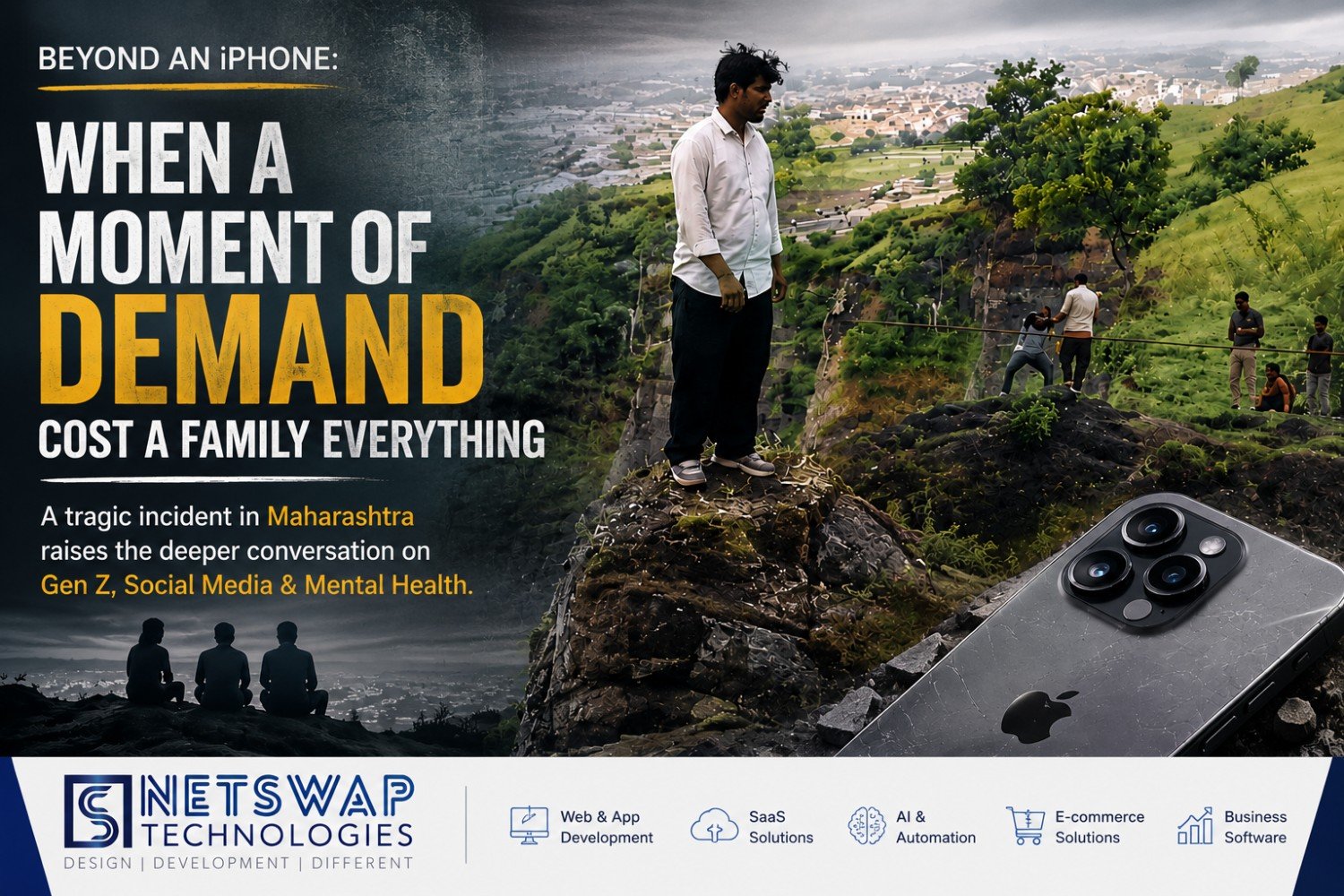
Beyond an iPhone: When a Moment of Demand Cost a Family Everything
A reported tragedy in Maharashtra raises uncomfortable questions about instant gratification, social-media comparison, EMI culture, parenting, mental health and the responsibility of the technology industry.
Published: 23 August 2026 | By: Swapnil Karma, Founder & CEO, NetSwap Technologies
Some news stories are consumed in seconds. We read the headline, watch a few seconds of video, scroll down and move on.
And then there are stories that make you stop.
The reported tragedy from Maharashtra is one of those stories.
According to reports and videos circulating about the incident, a young man from Chhatrapati Sambhajinagar reportedly went to a hill area following a dispute with his parents connected with an iPhone and its payment/EMI. For hours, family members, local people, police and fire personnel reportedly tried to persuade him to return to safety.
The situation ended tragically, with the deaths of the young man and both his parents.
Different reports and video transcripts have presented slightly different details, including the young man's age and the exact sequence of events. Therefore, this article does not attempt to establish a definitive cause of the tragedy. It reflects on the larger social and technological questions raised by the reported incident.
The iPhone may have been part of the argument. But the real story is much bigger than a phone.The Phone Was Never the Real Problem
It would be easy to turn this into another anti-iPhone story.
That would be the wrong lesson.
An iPhone is a product. EMI is a financial mechanism. Technology is a tool.
None of these things, by themselves, explain the emotional weight that a product can sometimes acquire in a young person's mind.
The deeper question is:
When did a product stop being something we own and start becoming something we believe defines us?A phone can become a status symbol. A car can become a status symbol. Clothes can become a status symbol. Followers can become a status symbol. Even the number of likes on a photograph can become a measurement of social acceptance.
And once material possessions become connected with identity, losing access to those possessions can feel much bigger than losing a product.
We Are Living in the Age of “I Want It Now”
Previous generations were forced to wait.
If you wanted something expensive, you saved for it. If you could not afford it, you waited. If your family could not buy it, you accepted it.
Today, technology has removed enormous amounts of friction from everyday life.
- Hungry? Order food.
- Bored? Open a streaming platform.
- Want clothes? Buy them online.
- Want attention? Post a reel.
- Want validation? Wait for likes.
- Want an expensive product? Financing and EMI options may be available.
This convenience is one of the greatest achievements of modern technology. But there is another side to it.
We are becoming increasingly uncomfortable with waiting.
And waiting is not a useless inconvenience. Waiting teaches patience. Saving teaches discipline. Failure teaches resilience. Rejection teaches emotional strength.
Real life does not have a “Buy Now” button for everything.
Social Media Did Not Invent Comparison. It Industrialised It.
Every generation has compared itself with others.
But the scale of comparison has changed dramatically.
A teenager no longer compares himself or herself only with classmates, neighbours or relatives.
Today, the comparison can be with the entire internet.
Open Instagram and someone is in Dubai. Someone is travelling to the Maldives. Someone is showing a new car. Someone is showing the latest smartphone. Someone is posting a luxury restaurant. Someone is celebrating a business success. Someone is displaying an apparently perfect relationship.
But there is one thing social media rarely shows:
- The EMI behind the lifestyle.
- The debt behind the purchase.
- The anxiety behind the photograph.
- The failures behind the success story.
- The loneliness behind the smile.
- The hours of work behind the “overnight success”.
We see someone else's highlight reel and compare it with our entire life.
That is not a fair comparison.
I have previously written about this larger attention economy in The Hidden Economy of Attention . The problem is not simply screen time. It is what constant exposure to curated lives can do to our expectations, attention and perception of success.
When “I Don't Have It” Becomes “I Am Not Enough”
This is perhaps the most dangerous psychological shift.
There is nothing inherently wrong with wanting a better phone, better clothes, a better car or a better lifestyle.
Ambition is not the enemy.
The problem begins when possessions become measurements of personal worth.
“My phone.” “My followers.” “My clothes.” “My car.” “My income.” “My lifestyle.” “My relationship.” “My popularity.”
And slowly, the brain begins to translate:
I don't have this → therefore I am behind → therefore I am not enough.That conclusion is false.
But in a highly competitive digital environment, it can feel very real.
The “Instant Gratification” Generation?
We should be careful about calling an entire generation weak or spoiled.
Not every Gen Z person behaves this way. Not every teenager is obsessed with brands. Not every young person measures success through social media.
But we cannot ignore the environment in which today's young people are growing up.
Swipe. Scroll. Like. Buy. Watch. Repeat.
If a video is boring, swipe. If a post is uncomfortable, scroll. If something does not entertain you, replace it.
But real life does not work like an algorithm.
You cannot swipe away a failed exam. You cannot swipe away financial pressure. You cannot swipe away rejection. You cannot swipe away heartbreak. You cannot swipe away career uncertainty.
Sometimes you have to sit with discomfort. Understand it. Process it. Ask for help. And continue.
Parenting Needs a New Conversation About Money
It is tempting to blame young people.
It is equally tempting to blame social media.
But parents also have an important role.
Many parents work extremely hard to protect their children from financial stress. That intention comes from love.
But sometimes protection becomes complete insulation from reality.
A child says: “Everyone has it.”
The parent thinks: “My child should not feel left out.”
Then comes the credit card. Then EMI. Then another adjustment.
The product arrives. But the child may never understand what it cost the family financially.
They may not know:
- How much the household earns.
- How much the family spends.
- How much existing debt exists.
- Why savings matter.
- What interest means.
- What an EMI actually represents.
- Why every affordable purchase is not necessarily a wise purchase.
This is why financial literacy should start much earlier than adulthood.
Teach Children to Wait
Sometimes the most valuable thing a parent can say is:
“Not now. Let's plan for it.”Let children save. Let them earn small things. Let them understand trade-offs. Let them experience disappointment.
Not because children should suffer.
Because children need to learn that disappointment is survivable.
If they learn this at 15, they may be better prepared for the realities of 25, 30 and 40.
Life will eventually say “no”. Parents cannot permanently protect their children from that word.
They can, however, teach them how to handle it.
Financial Literacy Is Only Half the Solution
Understanding money is important. But emotional literacy may be equally important.
When someone is going through intense emotional distress, friends and family are often the first people they approach.
That support can be incredibly valuable. But friends are not necessarily trained mental-health professionals.
Sometimes people respond with:
- “Forget it.”
- “Move on.”
- “Don't overthink.”
- “Be strong.”
- “It's not a big deal.”
What feels like a simple problem to one person can feel overwhelming to another.
This is why professional mental-health support should not be treated as a sign of weakness.
We do not feel ashamed of visiting a doctor when our body is unwell. Mental health deserves the same seriousness.
If Someone Says They Don't Want to Live, Take It Seriously
This is perhaps the most important message in this entire article.
If a young person says something like: “I don't want to live.”
Do not automatically dismiss it as drama.
Do not mock them. Do not challenge them. Do not shame them. Do not leave them alone in an unsafe situation.
Stay with them. Involve a trusted adult. Move them away from immediate danger. Seek appropriate professional help.
In a crisis, proving who was right can wait.
Keeping the person safe comes first.Technology Has a Responsibility Too
As a technology founder, this is where I cannot look away.
The technology industry talks constantly about:
- Artificial Intelligence
- Automation
- Algorithms
- Engagement
- Retention
- Personalisation
- Conversion
- Growth
But there is another metric we need to talk about:
Human impact.If an algorithm is powerful enough to understand what keeps someone watching, we should also ask whether technology can become better at recognising vulnerability, protecting younger users and encouraging healthier digital behaviour.
Technology should not simply make everything faster.
Sometimes the better product is the one that helps people make a better decision, not simply a faster one.
As AI Gets Smarter, Human Responsibility Becomes More Important
We are entering a world where AI will increasingly influence how we work, learn, communicate, shop and make decisions.
At NetSwap Technologies , we work on AI and automation because we believe technology can genuinely improve the way businesses operate.
But technology should strengthen human capability—not weaken human connection.
AI can provide information. Software can automate work. Algorithms can personalise experiences. Systems can process enormous amounts of data.
But a parent provides belonging. A teacher provides guidance. A friend provides human connection. A psychologist provides professional support. A family provides emotional safety.
Technology should help these relationships work better. It should never convince us that we no longer need them.
The Founder Perspective: What Kind of Technology Are We Building?
Running a technology company has taught me one thing repeatedly: technology itself is neither good nor bad. What matters is how we design it, how we deploy it and what problem we choose to solve.
At NetSwap Technologies , our focus is on building technology around real business needs.
That includes custom software, SaaS platforms, web development, mobile applications, CRM and ERP systems, fintech solutions, eCommerce development, and API and system integrations.
Our broader technology services are designed around a simple principle: technology should solve a real problem and create measurable value.
A local business should be able to compete better because of technology. A growing company should be able to automate repetitive processes. A founder should be able to make decisions using better information. A business should be able to build digital systems that actually fit its workflow.
That is the kind of technology I want to build.
Technology Should Reduce Business Friction, Not Human Value
There is a difference between building technology that creates value and building technology that creates dependency.
A good business application reduces unnecessary work. A good CRM improves customer relationships. A good ERP gives businesses better visibility. A good eCommerce platform removes barriers between businesses and customers. A good automation system gives people time back.
That is the positive side of technology.
The challenge begins when technology starts convincing people that their value depends on what they own, how they look, how many followers they have, or how quickly they can consume.
Technology should expand human potential. It should not shrink human self-worth.
Maybe the Question Should Not Be “Why Do You Want an iPhone?”
Imagine a parent hearing:
“I need that phone. Everyone has it.”The obvious response is: “Why do you need it?”
But perhaps the better question is:
“Why is having that phone so important to you?”The answer could reveal something much deeper.
“My friends have it.”
“I don't want to feel embarrassed.”
“Everyone online has it.”
“I don't want to feel inferior.”
“I want people to respect me.”
And suddenly, the conversation is no longer about a smartphone.
It is about identity. Belonging. Validation. Confidence. Comparison. Self-worth.
Don't Blame Gen Z. Understand Gen Z.
I do not believe the answer is to label an entire generation as weak.
Every generation has faced different pressures.
But today's young people are growing up with something previous generations never experienced at this scale: a device in their pocket constantly showing them how other people appear to be living.
Someone is richer. Someone is more attractive. Someone is more successful. Someone is travelling more. Someone has more followers. Someone has a better relationship. Someone is launching a company. Someone is buying a luxury car.
The comparison never ends.
That does not mean social media is automatically evil. It means digital literacy must become as important as digital access.
We cannot simply give young people technology and expect them to automatically understand its psychological impact.
Parents Need to Teach More Than Success
We often tell children:
“Study hard.” “Get good marks.” “Get a good job.” “Become successful.”
But we also need to teach:
- What to do when you fail.
- What to do when someone rejects you.
- What to do when you don't have enough money.
- What to do when someone becomes more successful than you.
- What to do when social media makes you feel behind.
- What to do when a relationship ends.
- What to do when life does not go according to plan.
Success is one lesson. Learning how to survive failure is another.
Both are necessary.
The Business World Has a Lesson Here Too
As founders, marketers and technology companies, we should also examine how we sell.
There is a huge difference between saying:
“This product can solve your problem.”and:
“You are not good enough without this product.”The first creates value. The second creates insecurity.
Responsible marketing should create aspiration without manufacturing shame.
Businesses should help customers become better, not make them feel incomplete so they will buy more.
We Also Need Better Digital Products
This is why I believe product development cannot be only about features.
It must also consider behaviour.
When we build a digital product or MVP , the question should not only be: “Can we build it?”
We should also ask:
- Why are we building it?
- Who will use it?
- What behaviour will it encourage?
- What problem does it genuinely solve?
- What happens when users depend on it?
- Can it be designed more responsibly?
These questions become increasingly important as AI, automation and behavioural personalisation become part of everyday products.
The Digital Future Needs Digital Responsibility
India is rapidly becoming a technology-driven economy.
Businesses are moving online. Payments are becoming digital. AI is entering workplaces. Automation is transforming operations. SaaS is changing how companies buy software. eCommerce is changing how customers shop.
At NetSwap Technologies, our work spans technology solutions, business solutions and digital capabilities.
But the bigger opportunity is not simply to digitise everything.
It is to digitise responsibly.
For Young People: You Are Not Behind
If someone on Instagram has a luxury car and you do not, you are not behind.
If someone has the latest iPhone and you do not, you are not behind.
If someone has 500,000 followers and you have 500, you are not behind.
If someone is earning money at 21 and you are still figuring out your career, you are not behind.
If someone is travelling internationally while you are building your life slowly, you are not behind.
You are seeing a snapshot of somebody else's life.
You are not seeing their complete reality.
Your life does not need to look impressive at 18.
It needs to be yours.
You are not your phone. You are not your followers. You are not your bank balance.For Parents: Give Children Comfort, But Also Courage
Give your children love.
But also give them boundaries.
Give them opportunities.
But also give them responsibility.
Give them technology.
But also give them digital literacy.
Give them pocket money.
But also teach them financial literacy.
And most importantly: listen when they talk.
A problem that looks small to an adult can feel enormous to a young person.
Sometimes the most powerful parenting sentence is not: “I know better.”
It is: “Tell me what is really bothering you.”
For Founders: Build Technology That Deserves Trust
The next decade will produce incredible technology.
AI agents. Intelligent automation. Personalised systems. Digital commerce. Connected devices. Advanced SaaS. Financial technology.
But the strongest companies of the future will not only ask: “What can technology do?”
They will also ask: “What should technology do?”
That distinction matters.
At NetSwap Technologies, our philosophy is captured in our simple line:
Design | Development | DifferentFor us, “different” should not simply mean visually different. It should mean thinking differently about the problem, the user, the business and the impact of the technology we build.
A Phone Can Be Replaced. A Life Cannot.
This is perhaps the simplest lesson from the tragedy.
A phone can be replaced.
An EMI can potentially be renegotiated.
Money can be earned again.
A career can be rebuilt.
A failed exam can be attempted again.
A business can fail and start again.
A rejected opportunity can be replaced by another.
A bad day can become a better tomorrow.
But a human life cannot simply be restarted.
No product should ever become more valuable than the person holding it.This Should Not Become Just Another Viral Story
Today, tragedy becomes content extremely quickly.
A video gets millions of views. People debate. Comment sections fill up. Creators make reaction videos. News cycles move on.
Then tomorrow, another story replaces it.
But if this tragedy is going to mean anything, perhaps it should leave behind something more useful than views.
It should start conversations.
Between parents and children.
Between schools and students.
Between technology companies and policymakers.
Between founders and users.
And between young people and themselves.
The Real Upgrade We Need
Maybe the next generation does not need another smartphone upgrade.
Maybe we need a human upgrade.
- Better financial literacy.
- Better emotional literacy.
- Better digital literacy.
- Better parenting conversations.
- Better mental-health awareness.
- Better technology ethics.
- Better digital-wellbeing practices.
- Better responsible product design.
We should build a culture where success is not measured only through possessions, followers, likes and lifestyle.
Because ultimately:
- Your phone is a device.
- Your followers are numbers.
- Your money is a resource.
- Your car is a machine.
- Your clothes are material.
- Your job is a role.
- Your business is an organisation.
None of these things completely define you.
You are a human being before you are a consumer.A Message to Gen Z
Don't let the internet convince you that your life is late.
Don't let somebody else's vacation make your home feel small.
Don't let somebody else's car make your journey feel worthless.
Don't let somebody else's followers decide your value.
Don't let an expensive product become the measurement of your identity.
You have time.
You are allowed to start slowly.
You are allowed to fail.
You are allowed to change your career.
You are allowed to not have what everyone else has.
And you are allowed to ask for help.
Your story is much bigger than your current situation.One Final Question
The next time a child says:
“I want this now.”Maybe we should not immediately ask: “Can we afford it?”
Maybe we should also ask:
“Why does having it right now matter so much to you?”That question may lead to a conversation about money.
Or comparison.
Or peer pressure.
Or insecurity.
Or loneliness.
Or simply a desire to belong.
Whatever the answer is, listen.
Because sometimes the product being demanded is not really the thing the person needs.
Why This Matters to Me as a Technology Founder
I run a technology company. I build software. My team works with businesses that want to digitise, automate and grow.
You can explore our technology portfolio to see the kind of systems we build, from eCommerce and SaaS platforms to business automation and specialised software.
But technology is not valuable merely because it is technologically impressive.
It is valuable when it improves human and business outcomes.
That is why I believe the next generation of founders should think beyond: “Can we build this?”
We should ask: “Should we build it this way?”
The future needs faster technology. But it also needs wiser technology.
And that is the future I want NetSwap Technologies to be part of.
If you are building a business and looking for technology around software, SaaS, AI, automation, eCommerce, CRM, ERP or digital transformation, you can connect with NetSwap Technologies and discuss your requirement.
Technology Should Make Life Better. Life Will Always Be More Valuable Than Technology.
The reported Maharashtra tragedy should not be remembered simply as “the iPhone incident”.
It should make us question the culture we are creating.
A culture of instant gratification. A culture of comparison. A culture of status. A culture of constant digital validation. A culture where young people can sometimes confuse what they own with who they are.
Let us teach children that wanting something is normal. Waiting is normal. Failure is normal. Rejection is normal. Not having something is normal. Asking for help is normal.
And most importantly: life is bigger than any temporary problem.
A phone can be replaced. Money can be earned again. Plans can change. Careers can restart. Businesses can rebuild.
But a human life cannot be replaced.
No phone. No EMI. No follower count. No rejection. No exam. No business failure. Nothing temporary is worth giving up a life that still has chapters left to be written.About the Author
Swapnil Karma is the Founder & CEO of NetSwap Technologies , a technology company focused on software development, SaaS, AI, automation, eCommerce, business systems and digital transformation.
About NetSwap Technologies | Services | Products | Portfolio | More Articles | Contact
NetSwap Technologies
Design | Development | Different
Editorial note: This article discusses a recently reported tragedy. The incident's complete circumstances and motivations should be established through responsible investigation. This article does not claim that an iPhone, EMI or any single factor alone caused the deaths. It uses the reported incident as a starting point for a broader discussion about technology, social behaviour, parenting, financial literacy and mental health.



Login to comment
To post a comment, you must be logged in. Please login. Login
Comments (0)