
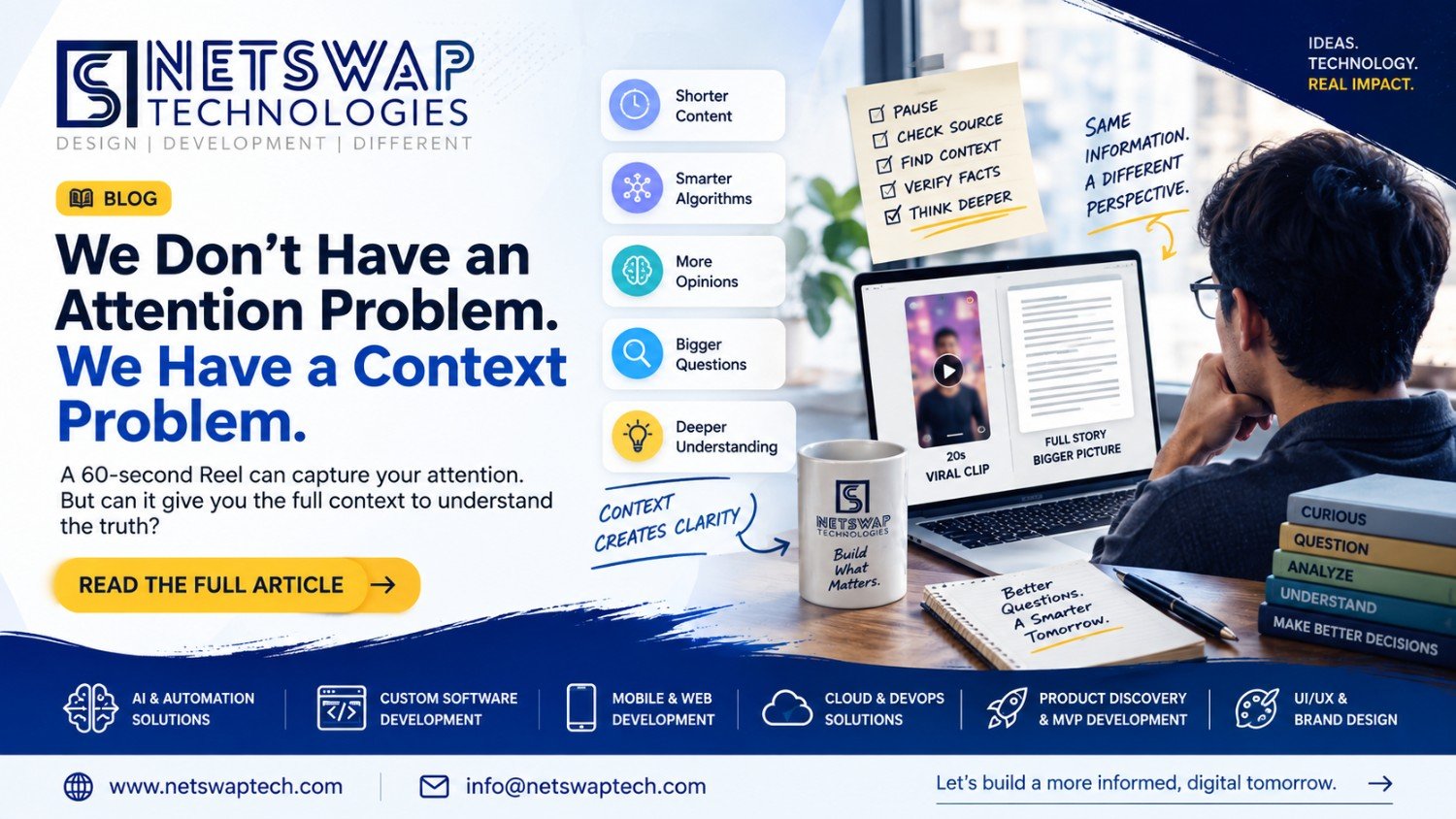
We Don’t Have an Attention Problem. We Have a Context Problem.
A 20-second Reel can change your opinion about a person, an event, a company, a political statement, or even a historical fact. But can 20 or 60 seconds really provide enough information to understand a complex issue?
In most cases, probably not.
Short-form content is excellent at capturing attention. The challenge begins when we confuse capturing attention with creating understanding.
In an internet environment shaped by algorithms, artificial intelligence, personalised feeds and endless scrolling, the ability to stop, verify and understand context is becoming more important than ever.
Can You Really Understand a Complex Issue in 60 Seconds?
The short answer is: sometimes, but not always.
A short video can explain a simple fact, introduce an idea or point you toward a subject worth exploring. However, complicated subjects often require background information, multiple perspectives, original sources and historical or technical context.
A 60-second video may tell you what someone wants you to notice. It may not tell you everything you need to know.
That distinction is becoming increasingly important because modern digital platforms are designed to make information consumption incredibly fast.
Why Short-Form Content Is So Powerful
Short-form content removes friction.
You don't need to read a long report. You don't need to watch a documentary. You don't need to listen to a 30-minute discussion.
You simply swipe.
One video becomes another. Another becomes another. Eventually, you may consume hundreds of pieces of content without spending enough time with any single subject to understand its complete context.
This is one reason the modern attention economy deserves serious discussion.
Attention has become an important resource in the digital world. Platforms compete for it, creators compete for it, advertisers compete for it, and digital products are increasingly designed around retaining it.
The Difference Between Information and Understanding
Information and understanding are not the same thing.
Information tells you something.
Understanding helps you interpret what that information means.
Consider a 20-second clip from a longer conversation. You may hear a powerful sentence, but you may not know what question was asked, what was said immediately before it, or what followed afterward.
The clip may be completely real while still creating an incomplete impression.
This is why context matters as much as content.
How Context Can Change the Meaning of a Video
Imagine someone says:
“This technology doesn't work.”That sentence sounds definitive.
But what if the complete statement was:
“This technology doesn't work for this particular use case, but it can be extremely effective in another environment.”The words are similar.
The meaning is completely different.
This is the fundamental weakness of consuming complex subjects through isolated fragments.
A clipped statement can be technically authentic while the conclusion drawn from it can still be misleading.
Your Social Media Feed Is Not the Entire Internet
Another important factor is recommendation algorithms.
When you repeatedly watch content about a particular topic, platforms can recommend more content around similar subjects.
After a while, your feed can become highly personalised.
You may begin seeing the same arguments, opinions and narratives repeatedly.
This can create an interesting psychological effect: repetition can feel like consensus.
But seeing something repeatedly doesn't automatically make it universally accepted or factually correct.
The larger question of who really controls the algorithm therefore goes beyond technology. It is also about how information reaches people and how digital systems influence what receives our attention.
Are Algorithms Changing How We Form Opinions?
Algorithms are designed to predict what content users are likely to engage with.
That is useful for discovering relevant information, but it can also create information bubbles.
If every interaction reinforces the previous interaction, users may receive less exposure to opposing viewpoints or additional context.
This doesn't mean algorithms automatically manipulate every person.
It means we should understand that personalisation is not the same as completeness.
A personalised feed is optimised for relevance and engagement. It is not necessarily designed to provide a complete investigation of every issue.
Technology Is Not the Enemy
It is easy to blame social media, smartphones or algorithms.
But technology itself is not necessarily the problem.
The same smartphone that shows you a misleading video can help you find the original interview.
The same internet that spreads an incomplete narrative can give you access to research, long-form discussions, original documents and multiple perspectives.
The difference is how we use the technology.
This principle is particularly relevant as businesses increasingly adopt AI and automation solutions.
Technology can process information faster, automate repetitive tasks and improve productivity. But human judgement remains essential when information is incomplete, ambiguous or potentially misleading.
AI Makes the Context Problem Even More Important
Artificial intelligence is changing the way information is created.
Text can be generated quickly. Images can be created from simple prompts. Audio and video can increasingly be synthesised. Businesses can automate workflows and build systems capable of processing large amounts of information.
This creates enormous opportunities.
It also creates a new challenge:
When information becomes easier to generate, verification becomes more important.
AI systems can help organisations analyse information and automate decision-making workflows, including through AI agent development.
But an intelligent system still needs appropriate data, context, validation and human oversight.
The future of AI isn't simply about generating more answers.
It is also about knowing when an answer should be questioned.
Why Verification Is Becoming a Digital Skill
Digital literacy used to mean knowing how to use a computer, search the internet or operate software.
Today, it increasingly means something more:
Knowing how to evaluate the information technology puts in front of you.
Before believing or sharing a viral claim, consider asking:
- What is the original source?
- Is this the complete video?
- What happened before this clip?
- What happened afterward?
- Who is making the claim?
- What evidence supports it?
- Can another independent source confirm it?
- Am I accepting this because it is accurate or because I already agree with it?
These questions don't make us negative or distrustful.
They make us better information consumers.
Cross-Checking Doesn't Mean Distrusting Everyone
There is a significant difference between saying:
“I don't believe you.”and saying:
“Let me verify this myself.”The second approach is much more productive.
We should be willing to verify information regardless of who presents it—whether it comes from a politician, influencer, journalist, expert, company, creator, friend or someone whose opinions we normally agree with.
Otherwise, fact-checking can become selective.
We verify information we dislike and automatically accept information that supports our existing beliefs.
That's not critical thinking.
That's confirmation bias.
The Same Problem Exists in Business Technology Decisions
Interestingly, the same mistake happens when companies choose technology.
A business hears about AI and decides it needs AI.
Another company sees a competitor launching a mobile application and immediately decides it needs an app.
Another business hears about SaaS and assumes a SaaS platform must be the right solution.
But good technology decisions don't start with trends.
They start with problems.
A business may need custom software development because existing tools don't fit its workflow.
Another may need a mobile application.
Another may benefit from API and system integrations that connect systems already in use.
And another business may discover that it doesn't need new software at all.
The correct solution depends on the actual problem.
Understand First. Build Second.
This is why product discovery matters.
Before investing heavily in development, businesses should understand the users, workflow, problem, objectives and expected outcome.
Product discovery and MVP development can help organisations validate an idea before committing significant resources to a complete product.
The philosophy is simple:
Understand the problem before choosing the solution.The same philosophy should apply to information.
Understand the context before forming the conclusion.Digital Product Design Can Influence Human Behaviour
Every digital product makes choices about how information is presented.
What appears first?
What receives the most visual attention?
What notification appears?
What requires another click?
What happens automatically?
These decisions influence how users interact with information.
That's why UI/UX design is not simply about making an application look attractive.
Good interfaces can make complex information easier to understand, reduce confusion and help users make better decisions.
Short Content Isn't the Enemy
It is important not to overcorrect.
Short-form content has genuine value.
It can introduce new subjects to people.
It can make technical concepts easier to approach.
It can spark curiosity.
It can encourage someone to research a subject they had never considered before.
The problem isn't short content.
The problem is treating short content as complete context.
A Reel should ideally create a question.
It shouldn't automatically create certainty.
What Should You Do Before Sharing a Viral Reel?
- Pause. Don't immediately react emotionally.
- Find the source. Look for the original video, statement or document.
- Check the context. Understand what happened before and after the highlighted section.
- Compare sources. Look beyond a single post or creator.
- Separate facts from interpretation. Ask what is actually demonstrated versus what someone wants you to conclude.
- Then decide. Form your opinion after investigation rather than before it.
Why This Matters More in the Age of AI
The volume of digital information is not going to decrease.
If anything, AI will make information faster and cheaper to create.
That means our biggest challenge may no longer be finding information.
It may be determining which information deserves our trust and attention.
Businesses are already building increasingly sophisticated digital systems around AI, automation, cloud infrastructure and data.
Modern cloud and DevOps solutions can help organisations scale digital systems, while automation can reduce repetitive work and improve operational efficiency.
But technology should always remain connected to a clear business objective.
More technology does not automatically mean better outcomes.
The Future Needs Better Technology and Better Thinking
Technology is becoming faster.
Content is becoming shorter.
Algorithms are becoming more sophisticated.
AI is making information easier to generate.
In response, our thinking needs to become more deliberate.
We don't need to reject technology.
We need to become better at using it.
We don't need to stop watching short videos.
We need to recognise when a short video isn't enough.
We don't need to distrust everything online.
We need to verify what matters.
Frequently Asked Questions
Is 60 seconds enough to understand a complex issue?
Usually, 60 seconds is better suited to introducing an issue than fully explaining it. Complex subjects often require context, original sources, supporting evidence and multiple perspectives.
Why can short videos be misleading?
A short video may contain genuine footage or statements while still omitting important context. Editing, selective clips, captions and emotional framing can influence how viewers interpret the information.
Do social media algorithms influence what people see?
Recommendation systems personalise content based on user behaviour and engagement signals. As a result, two people can have very different information environments even when using the same platform.
Should people stop watching Reels and Shorts?
Not necessarily. Short-form content can be useful for discovery and education. The important distinction is between using short content as a starting point and treating it as the complete truth.
How can I verify information from a viral video?
Find the original source, watch the complete video where possible, check the surrounding context, compare independent sources and distinguish verifiable facts from interpretation or commentary.
Why is context becoming more important with AI?
AI can dramatically increase the speed at which information is created. As the volume of generated content increases, the ability to evaluate sources, context, accuracy and relevance becomes increasingly important.
The Final Question
The next time a Reel makes you angry, excited, shocked or completely certain about something, stop for a moment.
Ask yourself:
“Do I actually know this—or did I just watch 60 seconds of it?”That small pause can make a significant difference.
Because being fast at consuming information is not the same as being good at understanding it.
And in a world where artificial intelligence can generate information faster than ever before, the ability to slow down, question, verify and think independently may become one of our most valuable digital skills.
60 seconds can capture your attention.
Context helps you understand it.
Verification helps you trust it.
Thinking for yourself helps you decide what to believe.
Technology Should Solve Problems, Not Just Follow Trends
At NetSwap Technologies, we believe the same principle applies to building technology.
Whether a business is exploring AI, automation, web platforms, mobile applications, SaaS or custom business software, the starting point should be the problem—not simply the latest technology trend.
From web development and mobile app development to custom software, AI automation and digital products, the right technology is the one that creates a meaningful business outcome.
If you're exploring a digital product, automation initiative or software idea, connect with NetSwap Technologies to discuss the problem, the opportunity and the technology that actually makes sense for your business.
Think before you share. Verify before you believe. Understand before you decide.




Login to comment
To post a comment, you must be logged in. Please login. Login
Comments (0)