
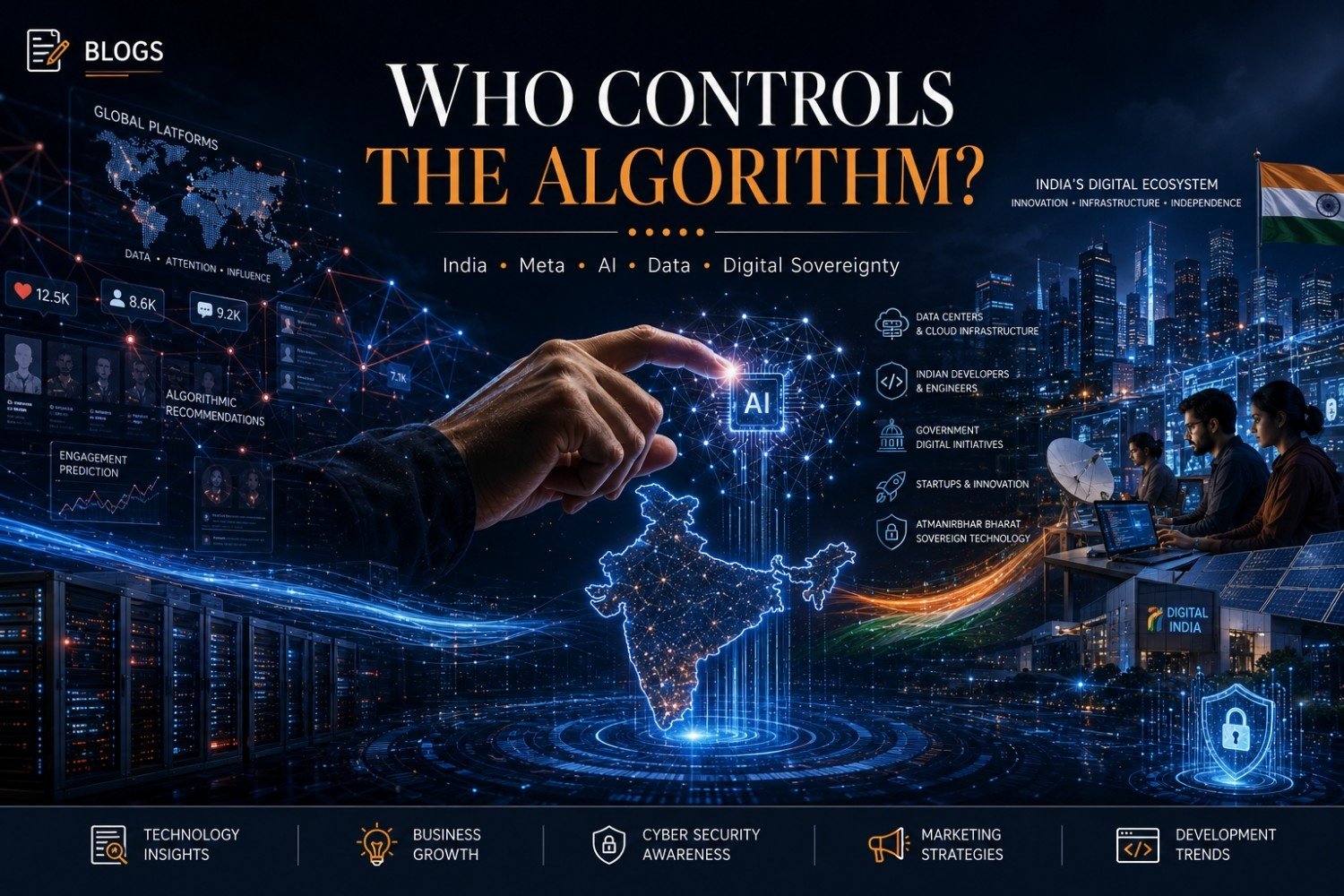
Digital Sovereignty: Who Really Controls the Algorithm?
India, Meta, AI, social media and the hidden architecture of digital influence
The biggest technology battle of the coming decade may not be fought over smartphones, cloud servers or artificial intelligence models.
It may be fought over something much less visible:
Who controls the systems that decide what people see, what they believe is important, what they buy, what they fear, and what they ignore?
That question sits at the heart of India's increasingly complicated relationship with global technology platforms.
The recent confrontation involving Meta, content moderation, a temporarily removed post associated with Prime Minister Narendra Modi, questions around deepfakes, algorithmic amplification and regulatory accountability is therefore much bigger than a disagreement between a government and a technology company.
It represents a deeper shift.
For years, the internet was largely presented as an open digital space where people could publish, communicate and discover information.
Today, much of that experience is mediated by algorithms.
We do not simply choose what to consume.
Increasingly, systems choose what is presented to us.
And that changes everything.
The Meta Controversy Is Only the Surface
The immediate controversy surrounding Meta involves a series of concerns raised in India around content moderation, the temporary removal of a Modi video, manipulated or AI-generated political content, platform accountability and the company's obligations under India's regulatory framework.
The Indian Express reference associated with this discussion describes parliamentary scrutiny of Meta following the removal of the video, alongside concerns involving deepfakes, harmful content, moderation systems and the possible consequences of losing intermediary protections under India's IT framework.
But focusing only on the deleted video would be a mistake.
The deeper question is:
When a platform has the power to determine the visibility of information at massive scale, can it still describe itself as merely a neutral intermediary?
That question has implications far beyond Meta.
It applies to:
-
social media,
-
search engines,
-
video platforms,
-
advertising networks,
-
app stores,
-
AI platforms,
-
recommendation engines,
-
and increasingly, enterprise software.
The digital economy is moving from a world where platforms merely host information to one where algorithms increasingly rank, filter, predict, personalize and distribute information.
That creates power.
And power inevitably creates accountability questions.
The Algorithm Is No Longer Just Code
When most people hear the word "algorithm", they imagine mathematics running somewhere inside a server.
But recommendation algorithms increasingly function as decision-making systems.
They influence:
-
which post appears first,
-
which video is recommended,
-
which creator receives visibility,
-
which advertisement follows you,
-
which news story becomes prominent,
-
which products appear in front of you,
-
and which topics repeatedly occupy your attention.
The algorithm does not necessarily have to tell you what to think.
It can simply influence what you think about.
That distinction is crucial.
If ten million people are repeatedly exposed to one topic while another ten million rarely encounter it, the information environment itself has changed.
This is why the debate around algorithms is ultimately a debate about attention.
The Real Currency of the Internet Is Attention
The modern internet runs on an extremely valuable resource:
human attention.
Every notification, recommendation, advertisement, short video, thumbnail and headline competes for a tiny portion of that resource.
Platforms measure behaviour constantly.
They can observe signals such as:
-
what you click,
-
how long you watch,
-
what you skip,
-
what you share,
-
what you search,
-
what you follow,
-
what you repeatedly return to,
-
and what generates a reaction.
These signals help create personalized experiences.
Personalization is not inherently harmful.
It is one of the reasons modern digital products are so effective.
But the same mechanism can create a powerful feedback loop:
Interaction → Data → Prediction → Recommendation → Interaction
The more you interact, the more the system learns.
The more the system learns, the more precisely it can recommend.
And the more precisely it recommends, the more likely you may be to interact again.
The loop becomes increasingly optimized around your behaviour.
Your Feed Is Not the Internet
This is one of the most important distinctions every digital user should understand.
Your feed is not the internet.
It is a filtered representation of the internet.
Two people can open the same platform at the same time and see completely different information.
One person may see:
-
politics,
-
outrage,
-
geopolitical content,
-
breaking news.
Another may see:
-
entrepreneurship,
-
technology,
-
fitness,
-
entertainment.
A third may see:
-
spirituality,
-
astrology,
-
finance,
-
lifestyle.
All three may walk away believing:
"This is what everyone is talking about."
But it may simply be what their respective recommendation systems have learned to prioritize.
This creates a subtle psychological effect.
We can confuse algorithmic visibility with social reality.
Engineered Virality: What Actually Makes Something Explode?
Not every viral post is manipulated.
Some content becomes viral because it is genuinely useful, entertaining, emotional or culturally relevant.
But virality is rarely just about content quality.
It also depends on distribution.
A simplified model looks like this:
Content → Initial Engagement → Recommendation → More Exposure → More Engagement → Further Recommendation
Once a piece of content generates strong signals, the system has an incentive to test it with larger audiences.
That can produce an acceleration effect.
A post with a small initial audience can suddenly reach millions.
The result may look completely organic from the outside.
But behind that visibility is a complex system of ranking, recommendation and behavioural prediction.
This does not mean:
"Every viral post is fake."
It means something more important:
Virality is partly an engineering problem.
And whoever understands the engineering understands a significant part of the attention economy.
Outrage Is Extremely Powerful
Human beings naturally react more strongly to certain types of information.
Anger.
Fear.
Shock.
Controversy.
Humiliation.
Conflict.
Threat.
These emotions can produce strong engagement.
And engagement is an important signal for many digital platforms.
This creates an uncomfortable economic question.
If content that provokes outrage generates more interaction than content that encourages reflection, which type of content is more likely to receive additional distribution?
The answer does not require assuming that a platform is deliberately trying to manipulate society.
The system may simply be optimizing the metric it was designed to optimize.
That is the deeper issue.
Sometimes the most dangerous systems are not malicious.
They are simply optimized for the wrong objective.
The Algorithmic Reinforcement Loop
Imagine someone watches several videos about a controversial political issue.
The system observes the behaviour.
It recommends more related content.
The user watches again.
The system becomes more confident that this topic is relevant.
More similar content appears.
Eventually, the person's feed becomes heavily concentrated around the same subject.
The person may then encounter fewer competing perspectives.
This is an example of an algorithmic reinforcement loop.
The user's behaviour influences the system.
The system influences the user's future information environment.
The future environment influences the user's behaviour again.
And the cycle continues.
That does not mean algorithms control human beings like puppets.
Human agency remains real.
But it does mean that the environment surrounding human decisions can be algorithmically shaped.
And environments matter.
The Psychology of the Infinite Feed
There is another design decision that deserves more attention:
the infinite feed.
Traditional media generally has natural stopping points.
A newspaper has pages.
A television programme ends.
A book has a final chapter.
A movie has credits.
An infinite-scroll platform can continue indefinitely.
There is always another:
-
video,
-
post,
-
recommendation,
-
notification,
-
story,
-
advertisement.
This changes the relationship between people and information.
The question becomes less:
"What do I want to consume?"
and more:
"What will the system show me next?"
That is a fundamental shift in digital behaviour.
From Content Consumption to Behavioural Prediction
Modern platforms do not only understand what you consume.
They increasingly try to predict what you will consume next.
That predictive capability is extremely valuable.
For advertisers, it can improve targeting.
For content creators, it can improve distribution.
For platforms, it can improve engagement.
For businesses, similar predictive technology can improve:
-
sales forecasting,
-
customer segmentation,
-
recommendation engines,
-
fraud detection,
-
automation,
-
personalization,
-
and decision support.
This is why the same technological principles behind social-media recommendation systems are also becoming important in enterprise software.
The technology is not inherently good or bad.
The objective and governance determine how it is used.
Data Is the Invisible Layer Behind the Experience
Every digital interaction can generate information.
A website visit.
A search.
A purchase.
A login.
A location request.
A product view.
An abandoned cart.
A support request.
A mobile application event.
An API call.
A social interaction.
Individually, these actions may appear insignificant.
Collectively, they can create an extraordinarily detailed behavioural picture.
That is why data has become one of the most strategic assets in the digital economy.
But data creates responsibility.
Businesses need to know:
-
What are we collecting?
-
Why are we collecting it?
-
Where is it stored?
-
Who can access it?
-
Which vendors receive it?
-
How long is it retained?
-
Can it be exported?
-
Can it be deleted?
-
What happens after a breach?
Data strategy is therefore no longer simply an IT concern.
It is a business strategy concern.
Digital Sovereignty Is Not the Same as Digital Adoption
This may be the most important idea in the entire discussion.
A country can be highly digitized without being digitally sovereign.
A business can use dozens of sophisticated SaaS products without controlling its technology infrastructure.
A school can have smart classrooms without owning its critical data architecture.
A company can use AI every day without understanding where its data goes.
Digital adoption answers:
"Are we using technology?"
Digital sovereignty asks:
"How much control do we have over the technology we depend on?"
Those are completely different questions.
Who Controls the Data?
Imagine a company whose:
-
customer database,
-
sales history,
-
employee records,
-
analytics,
-
documents,
-
communication,
-
workflows
are all stored across external platforms.
Everything works perfectly.
Until one day:
-
pricing changes,
-
API access is restricted,
-
an account is suspended,
-
a vendor exits the market,
-
a product is discontinued,
-
data export becomes difficult,
-
or a critical service becomes unavailable.
Suddenly, technology dependency becomes business dependency.
That is why digital sovereignty is not just a geopolitical concept.
It is also a vendor-risk and business-continuity concept.
SaaS Is Powerful—But Dependency Needs to Be Managed
SaaS has transformed software adoption.
Businesses can now access sophisticated capabilities without building everything from scratch.
That is enormously valuable.
But every SaaS product introduces another dependency.
The answer is not to reject SaaS.
The answer is to build a sensible architecture around it.
Businesses should evaluate:
Data portability
Can you export your data?
API access
Can the system integrate with other platforms?
Security
How is access protected?
Scalability
Can the platform support your growth?
Vendor stability
Will the company likely support the product long term?
Exit strategy
What happens if you need to leave?
A good technology strategy does not eliminate dependencies.
It understands and manages them.
APIs Are Part of Digital Independence
APIs are often treated as technical plumbing.
They are much more important than that.
A well-designed API architecture allows systems to communicate.
CRM can communicate with ERP.
Website can communicate with payment systems.
Mobile application can communicate with backend services.
AI systems can connect with business workflows.
Analytics platforms can consume structured information.
This interoperability reduces the risk of creating isolated technology islands.
Businesses that want flexibility should therefore think carefully about integration architecture and data portability.
Custom Software Has a Strategic Role
There are situations where generic software is exactly the right choice.
There are also situations where a company's competitive advantage exists inside its workflows.
In those cases, forcing the business into a generic platform can create long-term limitations.
Custom software can provide greater control over:
-
workflows,
-
data models,
-
integrations,
-
automation,
-
user roles,
-
business logic,
-
reporting,
-
scalability.
But custom development also creates responsibilities around:
-
maintenance,
-
security,
-
infrastructure,
-
documentation,
-
testing,
-
upgrades,
-
disaster recovery.
The correct question is not:
"Should everything be custom?"
It is:
"Which parts of our technology are strategically important enough to justify greater control?"
That is a far more mature approach to software architecture.
Education Is Becoming a Digital Sovereignty Issue
The technology dependency problem becomes even more significant in education.
A modern school may use separate systems for:
-
attendance,
-
examinations,
-
transportation,
-
homework,
-
student records,
-
teacher management,
-
parent communication,
-
learning,
-
payments.
Each product may solve one problem.
Together, they can create a fragmented ecosystem.
Now consider the information involved:
-
student identities,
-
academic records,
-
attendance,
-
parent information,
-
communication,
-
behavioural information,
-
payment data.
This is not ordinary business data.
Educational institutions therefore need to ask difficult questions before adopting technology.
Who owns the data?
Where is it stored?
Who can access it?
Can the school export everything?
What happens when the vendor changes?
How are integrations secured?
What happens if the platform shuts down?
Technology procurement in education should not be driven only by attractive dashboards.
It should be driven by architecture, security and long-term ownership.
AI Makes Digital Sovereignty Even More Important
Artificial intelligence changes the equation.
AI can now generate:
-
articles,
-
images,
-
audio,
-
videos,
-
advertisements,
-
code,
-
synthetic voices,
-
personalized messages.
This dramatically lowers the cost of producing digital content.
That is an extraordinary opportunity.
But it also means that convincing synthetic information can be produced at unprecedented scale.
The challenge is therefore no longer simply:
"Can we identify fake content?"
It is increasingly:
"Can our information ecosystem maintain trust when synthetic content becomes cheap and abundant?"
This is going to affect:
-
journalism,
-
education,
-
politics,
-
advertising,
-
customer service,
-
recruitment,
-
cybersecurity,
-
financial services.
AI Does Not Remove the Need for Human Judgment
There is a dangerous assumption that AI makes human judgment unnecessary.
In reality, AI often makes human judgment more important.
Suppose an automated system makes a decision.
Who checks it?
Who audits it?
Who handles exceptions?
Who investigates unusual behaviour?
Who is responsible when it is wrong?
A system that can automate one decision can potentially automate thousands.
That means a small design mistake can become a large operational problem.
The principle should therefore be:
Automate execution.
Govern decisions.
The AI Feedback Loop
The relationship between AI and digital platforms can also create new feedback loops.
User behaviour generates data.
Data trains models.
Models influence recommendations.
Recommendations influence behaviour.
Behaviour generates new data.
The cycle continues.
This creates increasingly adaptive systems.
Again, that is not automatically negative.
Adaptive systems can be extremely useful.
But businesses and policymakers need to understand the implications.
If the feedback loop rewards:
-
engagement over accuracy,
-
speed over verification,
-
emotion over context,
the system can become increasingly optimized around those behaviours.
The question is therefore not simply:
"How intelligent is the AI?"
It is:
"What is the AI being optimized to achieve?"
The Battle for Attention Is Also a Battle for Narrative
Information does not exist in isolation.
People interpret events through narratives.
A narrative connects:
Event → Meaning → Emotion → Identity → Action
This is why competing narratives can become so powerful online.
Two people can see the same event and interpret it completely differently.
The digital environment can then reinforce whichever interpretation receives stronger engagement.
This is where cognitive bias becomes important.
People naturally prefer information that confirms existing beliefs.
Algorithms can potentially reinforce those preferences because the content users engage with becomes a signal for future recommendations.
The result can be a self-reinforcing information environment.
Do Not Confuse Familiarity With Truth
Repeated exposure creates familiarity.
Familiarity can feel like credibility.
If someone repeatedly sees the same claim from:
-
different videos,
-
different accounts,
-
different headlines,
-
different creators,
the claim can begin to feel established.
But repetition does not equal evidence.
This is why digital literacy increasingly requires a simple discipline:
Separate exposure from verification.
Ask:
-
What is the original source?
-
What evidence exists?
-
Is the claim independently confirmed?
-
Is the headline stronger than the underlying evidence?
-
Is the image authentic?
-
Could the content have been generated or manipulated?
-
Is someone financially or politically incentivized to promote the claim?
These questions are becoming basic digital survival skills.
Influence Is Not the Same as Credibility
The creator economy has introduced another important confusion.
A person can have millions of followers without being an expert.
A person can have thousands of followers and possess extraordinary expertise.
A post can receive millions of views and still be inaccurate.
A technical article can receive very little traffic while containing information that is extremely valuable.
Therefore:
Reach ≠ Expertise
Engagement ≠ Truth
Popularity ≠ Authority
Virality ≠ Value
This distinction is especially important for businesses.
Brands that optimize exclusively for reach can accidentally build visibility without trust.
The Marketing Industry Should Pay Attention
Modern marketing increasingly operates inside the same attention economy.
Marketers optimize:
-
impressions,
-
clicks,
-
engagement,
-
watch time,
-
conversions,
-
retargeting,
-
audience segmentation.
These are valuable metrics.
But businesses should also measure:
-
trust,
-
customer quality,
-
retention,
-
brand perception,
-
authority,
-
repeat engagement,
-
long-term customer value.
A campaign that produces 10 million views but damages trust may be less valuable than a campaign that reaches 100,000 highly relevant people and creates lasting authority.
The smartest marketing strategy is therefore not:
"How do we become viral?"
It is:
"How do we become valuable enough that people want to remember us?"
Silence Can Also Be a Strategy
The attention economy creates another trap.
Not every controversy deserves a response.
Responding to every criticism can create:
-
more visibility,
-
more comments,
-
more arguments,
-
more screenshots,
-
more algorithmic distribution.
Sometimes the platform rewards the conflict itself.
For businesses and public figures, the better process is:
-
Verify the claim.
-
Assess its relevance.
-
Determine who is affected.
-
Decide whether a response adds value.
-
Respond with evidence.
-
Avoid unnecessary escalation.
Not every trending conversation deserves your participation.
The Generational Divide Is Also a Technology Divide
Every generation has experienced cultural influence.
But the scale has changed.
Earlier generations consumed culture primarily through:
-
radio,
-
newspapers,
-
cinema,
-
television,
-
magazines.
Later generations experienced:
-
cable television,
-
gaming,
-
early internet communities,
-
blogs,
-
forums.
Today's generation lives inside:
-
smartphones,
-
social feeds,
-
short-form video,
-
influencers,
-
recommendation engines,
-
AI assistants,
-
gaming ecosystems,
-
creator platforms.
The key difference is not simply that young people use more technology.
It is that technology is increasingly personalized, continuous and predictive.
Stop Blaming the Generation. Understand the Environment.
Young people are often described with simplistic labels.
Too distracted.
Too angry.
Too dependent on phones.
Too influenced by social media.
Too politically polarized.
Too disconnected.
Such labels rarely explain the full picture.
A better question is:
What digital environment is shaping their daily experience?
What are they shown?
What incentives govern those platforms?
What role do schools play?
What role do parents play?
How strong is digital literacy?
What alternatives exist?
The environment matters.
And so does agency.
Young people should not be treated merely as passive victims of technology.
They should be taught how technology works.
Digital Literacy Should Mean More Than "Use the Internet Safely"
Digital literacy in the AI era should include understanding:
-
recommendation algorithms,
-
advertising systems,
-
privacy,
-
digital footprints,
-
AI-generated content,
-
misinformation,
-
phishing,
-
manipulation,
-
online identity,
-
data ownership,
-
cybersecurity.
A child should eventually understand not only:
"This app is showing me videos."
but:
"This app is learning from my behaviour to predict what I may want to see next."
That one realization can fundamentally change how someone interacts with technology.
Parents Need Digital Literacy Too
The responsibility cannot be placed entirely on children.
Parents also need to understand:
-
what platforms their children use,
-
what information is collected,
-
how recommendation systems work,
-
how online communities operate,
-
how advertisements influence behaviour,
-
how AI-generated content looks,
-
and how scams are constructed.
Digital parenting is becoming as important as traditional parenting in an increasingly connected world.
Technology Is Not the Enemy
This distinction matters.
The answer to algorithmic manipulation is not:
"Reject technology."
Technology has created enormous benefits.
AI can improve productivity.
Digital payments can improve access.
Cloud platforms can reduce infrastructure costs.
Social media can connect communities.
Software can automate repetitive work.
Online education can expand access to knowledge.
Technology can create extraordinary opportunities.
The challenge is not technology itself.
The challenge is technology without sufficient awareness, governance or accountability.
Digital Sovereignty Does Not Mean Isolation
A technologically sovereign India does not need to become technologically isolated.
India can:
-
collaborate with global technology companies,
-
adopt international platforms,
-
participate in global markets,
-
use foreign cloud infrastructure,
-
integrate international APIs,
while simultaneously building stronger domestic capabilities.
The objective should be:
Strategic independence without technological isolation.
That means understanding which capabilities are critical enough to require greater domestic control.
India Has a Unique Opportunity
India has several advantages:
-
a massive developer ecosystem,
-
a young workforce,
-
a huge digital consumer base,
-
strong startup activity,
-
expanding AI capabilities,
-
digital public infrastructure,
-
fintech innovation,
-
multilingual markets,
-
and increasingly sophisticated SaaS businesses.
But the next stage should not be defined only by how many Indians use technology.
It should be defined by:
How many Indians build it?
How many own the infrastructure?
How many create globally competitive products?
How many develop AI systems?
How many design secure architectures?
How many create alternatives to technology dependencies?
How many build platforms rather than merely becoming users of platforms?
That is where digital sovereignty becomes meaningful.
From Digital Consumer to Digital Builder
There is a major difference between knowing how to use technology and understanding how technology works.
A student who uses AI is a consumer.
A student who learns how AI systems work becomes a builder.
A business owner who uses SaaS is a consumer.
A business owner who understands architecture, APIs, data and vendor dependency becomes a technology strategist.
A marketer who follows algorithmic trends is a participant.
A marketer who understands recommendation systems, audience psychology and content economics becomes a strategic operator.
The transition from:
Consumer → User → Builder → Owner
is one of the most important transformations India can make.
The Backend Is Where Control Becomes Real
Technology has a visible side.
Websites.
Apps.
Dashboards.
Social feeds.
Buttons.
Interfaces.
But behind them exists another world:
-
databases,
-
APIs,
-
authentication,
-
cloud infrastructure,
-
automation,
-
logs,
-
permissions,
-
analytics,
-
AI models,
-
integrations.
Users experience the interface.
Businesses depend on the infrastructure.
That is why technology sovereignty ultimately becomes an architectural question.
Who controls the backend?
Who owns the database?
Who controls authentication?
Who owns the APIs?
Who can access the logs?
Who controls the deployment?
Who can restore the system?
Who can migrate the data?
Those questions matter far more than how attractive the interface looks.
Cybersecurity Is Part of Digital Sovereignty
Control without security is meaningless.
A business may technically own its infrastructure while leaving it exposed through:
-
weak passwords,
-
poor access control,
-
insecure APIs,
-
outdated software,
-
misconfigured servers,
-
vulnerable third-party dependencies.
Digital sovereignty therefore requires security.
At the application level:
-
secure authentication,
-
authorization,
-
input validation,
-
secure APIs.
At the infrastructure level:
-
monitoring,
-
patching,
-
network security,
-
backups,
-
disaster recovery.
At the organizational level:
-
policies,
-
employee awareness,
-
vendor assessment,
-
incident response.
Security must be designed into the system.
It cannot simply be added after deployment.
The Attack Surface Is Expanding
The modern enterprise no longer has one application.
It may have:
-
websites,
-
mobile apps,
-
APIs,
-
SaaS platforms,
-
payment gateways,
-
cloud services,
-
AI tools,
-
employee devices,
-
IoT devices,
-
third-party integrations.
Every connection introduces another potential dependency.
The attack surface is therefore becoming the entire digital ecosystem.
This is why cybersecurity must evolve from a product-based mindset into an architectural mindset.
The Biggest AI Risk May Be Scale
Human beings make mistakes.
AI systems can make mistakes too.
The difference is scale.
A human employee may make one incorrect decision.
An automated system can potentially repeat the same decision thousands of times.
That makes governance essential.
Businesses deploying AI should establish:
-
clear objectives,
-
human oversight,
-
audit trails,
-
access controls,
-
data governance,
-
testing,
-
monitoring,
-
escalation procedures.
The principle should be simple:
Never automate accountability.
Automate tasks.
Automate workflows.
Automate repetitive decisions where appropriate.
But maintain clear responsibility for outcomes.
What Businesses Should Learn From the Meta Debate
The lessons extend far beyond social media.
1. Technology risk is business risk
An algorithmic failure can become a reputation problem.
A security problem can become a financial problem.
A regulatory conflict can become an operational problem.
Technology and business can no longer be treated as separate worlds.
2. Data ownership matters
Know where your critical data lives.
Know who can access it.
Know how to export it.
Know what happens if your vendor disappears.
3. Vendor dependency should be measured
Every critical external platform creates some degree of dependency.
Identify the systems where failure would stop your business.
4. APIs are strategic infrastructure
Good integrations create flexibility.
Poor integrations create technology silos.
5. Automation requires governance
An automated process without accountability can scale mistakes.
6. AI needs oversight
AI should improve human decision-making, not become an excuse to eliminate responsibility.
7. Security must be architectural
Security cannot be treated as an optional feature.
8. Virality should not be the ultimate marketing goal
Attention without trust is fragile.
9. Digital literacy is becoming a competitive advantage
Organizations that understand technology will make better technology decisions.
10. Have an exit strategy
Every critical technology dependency should have an answer to:
"What happens if we need to leave?"
A Digital Sovereignty Checklist for Founders
Before adopting any major technology platform, ask:
Data
-
What data are we giving the platform?
-
Where is it stored?
-
Can we export it?
Security
-
How is the data protected?
-
Who has access?
-
What happens during a security incident?
Integration
-
Are APIs available?
-
Can the system communicate with our existing architecture?
Scalability
-
Can it support our future growth?
Vendor dependency
-
How difficult would it be to migrate away?
AI
-
Is our data used for AI training?
-
Can automated decisions be audited?
Compliance
-
What legal and regulatory requirements apply?
Continuity
-
What happens if the service goes offline?
Ownership
-
Who ultimately controls our critical information?
Exit
-
Can we realistically leave the platform?
If these questions cannot be answered, the technology decision is not complete.
What Policymakers Need to Understand
The answer to digital sovereignty cannot simply be blocking foreign platforms.
Nor should governments assume that every large technology company is inherently harmful.
The challenge is balance.
India needs a framework that protects:
Innovation + competition + privacy + security + free expression + accountability + national interests
Regulation should be informed by technical understanding.
Policymakers need expertise in:
-
AI,
-
cloud computing,
-
cybersecurity,
-
recommendation systems,
-
data governance,
-
digital advertising,
-
software architecture,
-
platform economics.
Technology regulation without technology understanding can create unintended consequences.
What Technology Companies Need to Understand
The responsibility does not belong only to governments.
Technology companies operating at enormous scale also need to recognize that:
Scale creates responsibility.
When a platform influences the information environment of hundreds of millions of people, moderation mistakes are not merely technical bugs.
They can have social consequences.
That does not mean every algorithm should be controlled by governments.
It means large platforms need stronger systems for:
-
transparency,
-
moderation,
-
appeals,
-
AI-content detection,
-
child safety,
-
privacy,
-
security,
-
regulatory compliance,
-
and accountability.
The Future Will Belong to Responsible Technology
The next decade will not simply be about who builds the most powerful AI.
It will also be about who can build trustworthy systems.
The winners will increasingly be organizations that can combine:
AI + Security + Data Governance + Human Oversight + Business Value
That is a much harder challenge than simply adding AI to a product.
But it is also a much more valuable one.
The Three Battles of Digital Sovereignty
Ultimately, the digital sovereignty debate can be understood through three connected battles.
The Cognitive Battle
Who controls attention?
Algorithms, platforms, creators and advertisers compete for human attention.
The Commercial Battle
Who captures the economic value of data and digital networks?
Businesses compete for customers, information, infrastructure and market access.
The Architectural Battle
Who controls the technology underneath?
Infrastructure, APIs, databases, cloud platforms, AI models and software systems determine how much independence an organization actually has.
These three battles are connected.
Control attention, and you influence markets.
Control data, and you improve your ability to build.
Control infrastructure, and you gain strategic independence.
The Most Important System Is Still Human Judgment
After all the discussion around Meta, algorithms, AI, social media and data, the most important conclusion may actually be simple.
Technology can:
-
predict,
-
recommend,
-
automate,
-
classify,
-
personalize,
-
generate,
-
optimize,
-
distribute.
But technology cannot independently answer the most important question:
Should we?
That remains a human decision.
So, Who Really Controls the Algorithm?
Perhaps the answer is more complicated than "Meta".
The algorithm is controlled by:
-
engineers,
-
product teams,
-
business incentives,
-
data,
-
recommendation objectives,
-
advertisers,
-
users,
-
regulators,
-
and ultimately the architecture of the platform itself.
Users influence algorithms through their behaviour.
Businesses influence them through objectives.
Engineers influence them through design.
Governments influence them through regulation.
And society influences them through what it accepts, rewards and demands.
The algorithm is therefore not some mysterious force operating independently of society.
It is a reflection of the systems we build around it.
India’s Real Opportunity
India's digital future should not be defined by whether it can defeat one technology platform.
It should be defined by whether India can build the capabilities necessary to make strategic technology decisions independently.
That means:
building software, not just consuming it.
owning data, not merely generating it.
understanding AI, not merely using it.
designing infrastructure, not merely depending on it.
creating global products, not merely becoming global customers.
And most importantly:
developing people who understand how digital systems actually work.
That is the foundation of digital sovereignty.
Conclusion: Digital Sovereignty Begins With Awareness
The biggest mistake would be to look at the Meta controversy and conclude that the story is simply about one company, one government, or one deleted post.
The larger story is about power.
Power over attention.
Power over data.
Power over infrastructure.
Power over algorithms.
Power over narratives.
Power over digital markets.
And increasingly, power over the systems through which people experience reality.
India does not need less technology.
It needs more technological understanding.
Businesses do not need to abandon global platforms.
They need to understand their dependencies.
Parents do not need to fear every digital product.
They need digital literacy.
Young people do not need to reject AI.
They need to understand how AI works.
Governments do not need to control every algorithm.
They need technically informed regulation.
And technology companies do not need to stop innovating.
They need to recognize that innovation without accountability eventually creates distrust.
The future will not belong simply to those who use the most technology.
It will belong to those who understand it deeply enough to make informed decisions about what to adopt, what to build, what to control and what not to surrender.
That is the real meaning of digital sovereignty.
Because the most important question is no longer:
"Are we online?"
It is:
"Who controls the systems that shape our online world—and how much control do we have over our own digital future?"
The answer to that question will shape not only India's technology industry, but its businesses, institutions, education system, economy and society for years to come.
Tagged with:
Digital Sovereignty
India Technology
Meta India
AI
Artificial Intelligence
Social Media Algorithms
Algorithmic Influence
Data Privacy
Data Sovereignty
Digital Transformation
Technology Strategy
Cybersecurity
AI Governance
Digital Marketing
Business Technology
SaaS
Custom Software Development
API Integration
Technology Dependency
Digital India
Tech Policy
Platform Accountability
Data Governance
Future of Technology
IT Industry



Login to comment
To post a comment, you must be logged in. Please login. Login
Comments (0)