UI vs UX: The Difference Most Founders Miss
Introduction
Many startup founders and business owners make a costly mistake when building websites, applications, and digital products.
They focus almost entirely on making things look beautiful.
They invest in:
• Premium colors
• Stunning animations
• Modern layouts
• Trendy design elements
And then wonder why users leave.
The reason is simple:
A beautiful interface does not automatically create a great experience.
This is where understanding the difference between UI and UX becomes critical.
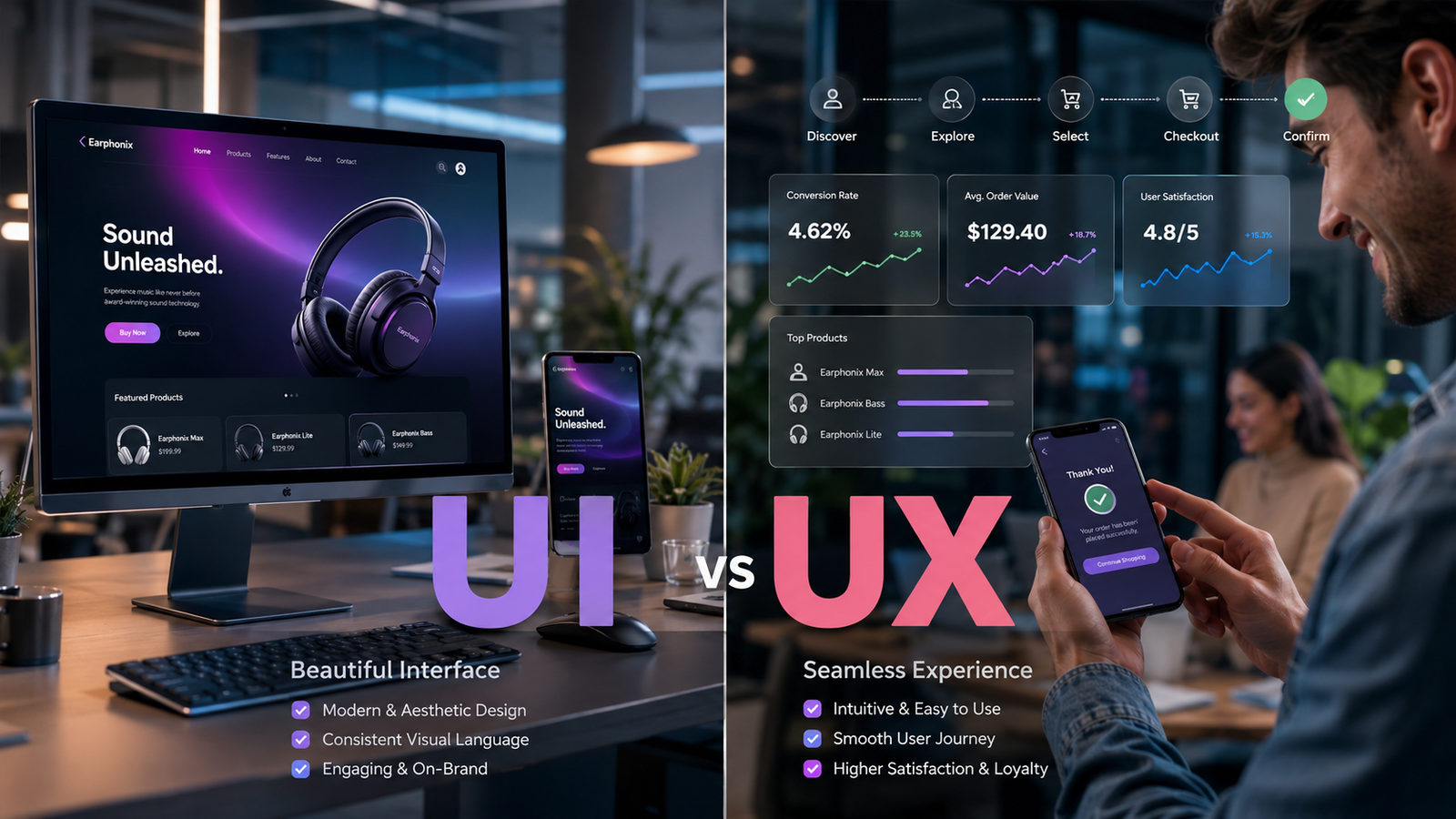
While UI attracts users visually, UX determines whether they stay, engage, trust your product, and eventually convert into customers.
The most successful digital products combine both.
What Is UI (User Interface)?
UI refers to the visual elements users interact with.
This includes:
• Buttons
• Colors
• Typography
• Icons
• Layouts
• Images
• Design systems
UI is essentially the look and feel of a digital product.
It shapes the first impression users have when visiting your website or application.
The Purpose of Good UI
Good UI helps:
• Create visual appeal
• Strengthen brand identity
• Improve consistency
• Guide user attention
• Enhance professionalism
A modern and polished interface builds trust quickly.
However, appearance alone is not enough.
What Is UX (User Experience)?
UX focuses on how users experience and interact with a product.
It answers questions like:
• Is navigation easy?
• Can users find information quickly?
• Are actions intuitive?
• Is the journey smooth?
• Does the product solve user problems efficiently?
UX is about usability, functionality, and overall satisfaction.
It determines whether users enjoy using your product.
Why UX Matters More Than Most Founders Realize
Users do not visit websites to admire design.
They visit to:
• Solve problems
• Find information
• Purchase products
• Book services
• Complete tasks
If the experience feels difficult, users leave regardless of how attractive the design looks.
This is why UX often has a greater impact on business outcomes than visual design alone.
UI vs UX: Understanding the Difference
| UI (User Interface) |
UX (User Experience) |
| Focuses on appearance |
Focuses on usability |
| Visual design elements |
User journey and interactions |
| Creates first impressions |
Creates lasting impressions |
| Enhances aesthetics |
Improves satisfaction |
| Attracts users |
Retains users |
| Supports branding |
Supports conversions |
Both work together.
A successful product needs strong UI and strong UX.
The Common Mistake Founders Make
Many founders believe:
"If the website looks modern, users will love it."
Unfortunately, that assumption often leads to poor performance.
A website can look beautiful and still suffer from:
• High bounce rates
• Low engagement
• Poor conversions
• Frustrated users
Because usability problems outweigh visual appeal.
Four UX Problems That Destroy Performance
1. Complicated Navigation
Navigation is one of the most important aspects of UX.
Users should instantly understand:
• Where they are
• What the business offers
• How to find information
• What action to take next
Poor navigation creates confusion.
Signs of Bad Navigation
• Too many menu options
• Hidden pages
• Complex dropdown structures
• Unclear labels
• Inconsistent navigation patterns
When users cannot find what they need quickly, they leave.
Why Simple Navigation Wins
The best websites prioritize clarity.
Good navigation helps users:
• Reach goals faster
• Explore confidently
• Stay engaged longer
Simplicity reduces friction.
2. Inconsistent Layouts
Consistency is a key principle of UX design.
Users develop expectations as they navigate a website.
When layouts constantly change, users become confused.
Examples of Inconsistency
• Different button styles
• Changing menu positions
• Inconsistent spacing
• Unpredictable interactions
Consistency creates familiarity and trust.
Inconsistency creates uncertainty.
3. Low Readability
Even valuable content becomes ineffective if users struggle to read it.
Readability affects:
• Engagement
• Comprehension
• Accessibility
• User satisfaction
Poor readability drives visitors away.
Common Readability Issues
• Small fonts
• Low contrast colors
• Long paragraphs
• Cluttered layouts
• Poor spacing
Good UX makes information easy to consume.
Why Readability Improves Conversions
Users are more likely to take action when information feels clear and accessible.
Improved readability often leads to:
• Longer session times
• Better engagement
• Higher conversion rates
4. No User Testing
One of the biggest UX mistakes is assuming what users want.
Many businesses launch products without testing them with real users.
This creates blind spots.
What User Testing Reveals
User testing uncovers:
• Navigation issues
• Confusing workflows
• Friction points
• Unexpected behaviors
Often, users interact with products very differently than designers expect.
Why User Testing Matters
Data and assumptions are not the same.
Testing provides real-world insights that improve:
• Usability
• Engagement
• Customer satisfaction
• Conversion performance
The best products evolve through continuous feedback.
How Great UX Increases Business Growth
Strong UX contributes directly to:
• Higher customer satisfaction
• Increased retention
• Better engagement
• Improved conversion rates
• Greater customer trust
Good UX removes obstacles between users and their goals.
The easier the experience, the better the results.
Signs Your UX Needs Improvement
Watch for these warning signs:
• High bounce rates
• Low conversion rates
• Short session durations
• Frequent support requests
• Negative usability feedback
• Poor mobile engagement
These often indicate deeper UX problems.
Building Products Users Love
Successful digital products focus on:
Clarity
Make actions obvious.
Simplicity
Reduce unnecessary complexity.
Consistency
Create predictable experiences.
Accessibility
Design for all users.
Testing
Continuously improve based on feedback.
These principles form the foundation of excellent UX.
The Future of UX Design
Modern UX is evolving toward:
• Personalization
• AI-driven experiences
• Voice interfaces
• Accessibility-first design
• Behavioral analytics
• Continuous optimization
Businesses that prioritize UX gain a competitive advantage through better customer experiences.
Conclusion
UI and UX are not the same.
UI determines how a product looks.
UX determines how it feels to use.
A beautiful interface may attract users initially, but only a great experience keeps them engaged, satisfied, and willing to return.
The most successful websites and applications understand that design is more than aesthetics.
It is about helping users achieve their goals with minimal effort and maximum satisfaction.
Because in the end:
Good UI gets attention.
Great UX builds businesses.
FAQ Section
What is the difference between UI and UX?
UI (User Interface) focuses on visual design elements such as colors, buttons, typography, and layouts. UX (User Experience) focuses on how users interact with a product and how easy, efficient, and enjoyable that experience is.
Which is more important: UI or UX?
Both are important. UI attracts users visually, while UX determines whether users stay, engage, and complete desired actions.
Why do many websites fail despite having good designs?
Many websites prioritize appearance while neglecting navigation, usability, readability, mobile responsiveness, and user behavior.
What is user testing in UX design?
User testing involves observing real users interacting with a website or application to identify usability issues and improve the overall experience.
How does UX affect conversions?
A better user experience reduces friction, improves trust, increases engagement, and makes it easier for users to complete actions such as purchases, registrations, or inquiries.





Comments (10)
By Rahul Sharma
Jun 26, 2026Really helpful content for beginners and professionals alike.
By Priya Verma
Jun 26, 2026This blog answered many of my questions.
By Arjun Patel
Jun 26, 2026Loved the practical approach used in this post.
By Ananya Kapoor
Jun 26, 2026Very insightful article, learned something new today.
By Michael Johnson
Jun 26, 2026This article is clear, informative, and easy to understand.
By Emily Carter
Jun 26, 2026Really helpful content for beginners and professionals alike.
By Daniel Kim
Jun 26, 2026This blog answered many of my questions.
By Sophia Martinez
Jun 26, 2026Loved the practical approach used in this post.
By Liam Wilson
Jun 26, 2026Very insightful article, learned something new today.
By Neha Singh
Jun 26, 2026This article is clear, informative, and easy to understand.