Why Your Business Needs APIs
Introduction
Modern businesses use a variety of software tools every day.
These may include:
• CRM platforms
• Accounting software
• Ecommerce systems
• ERP solutions
• Marketing automation tools
• Mobile applications
• Customer support platforms
While each system serves a specific purpose, problems arise when these tools cannot communicate with one another.
Disconnected systems often result in:
• Duplicate work
• Data inconsistencies
• Delayed operations
• Manual processes
• Reduced productivity
This is where APIs become essential.
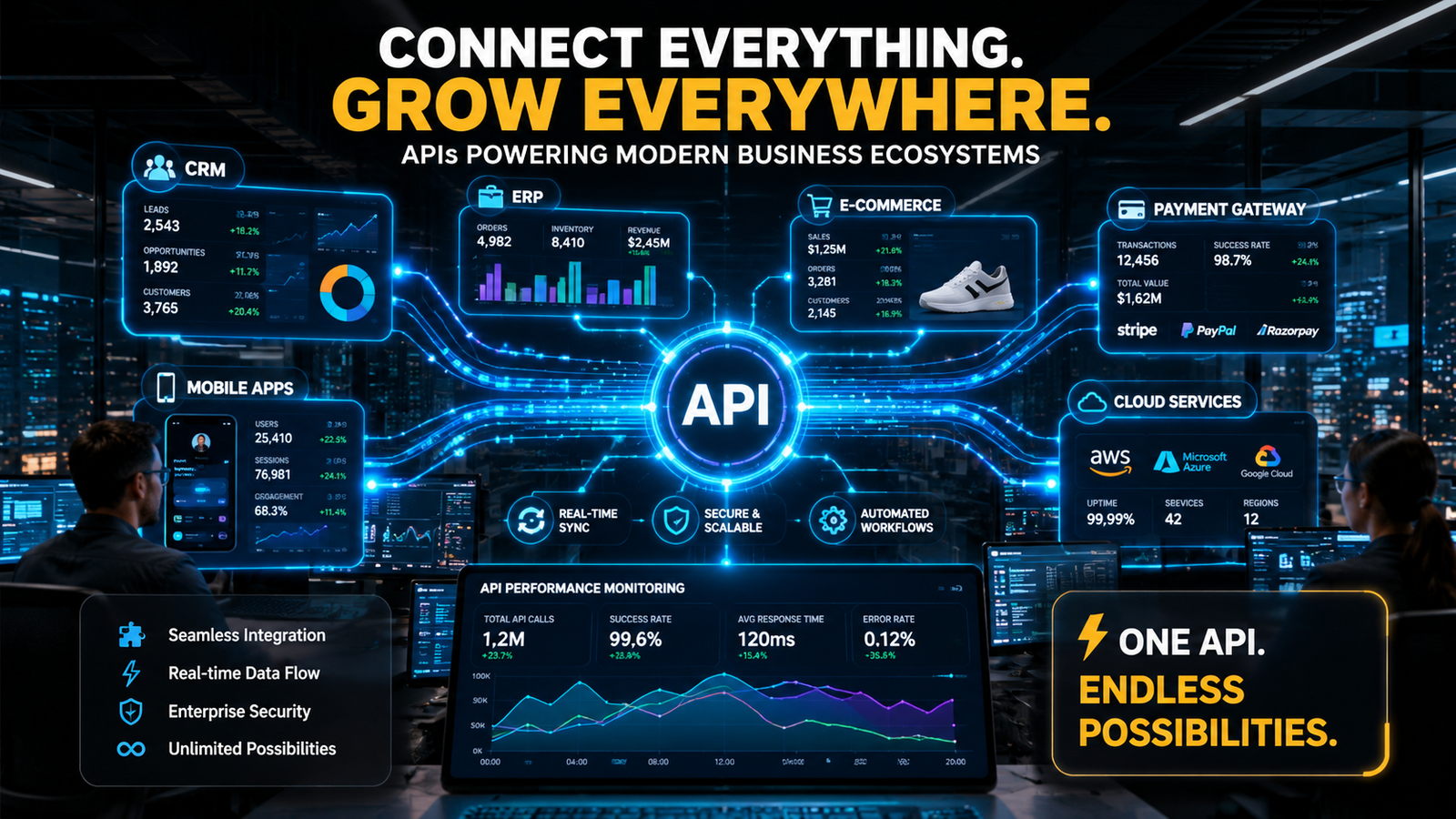
APIs act as digital bridges that allow software systems to exchange information, automate workflows, and operate as a connected ecosystem.
Today, APIs are one of the most important technologies driving digital transformation and business growth.
What Is an API?
API stands for Application Programming Interface.
In simple terms, an API allows one software application to communicate with another.
Think of an API as a messenger.
It receives a request, delivers it to the appropriate system, and returns the response.
For example:
When a customer makes a payment online:
• The website sends a request
• The payment gateway processes it
• The confirmation is returned instantly
The communication happens through APIs.
Why APIs Matter in Modern Business
Businesses today depend on speed, accuracy, and automation.
Manual processes slow operations and increase the likelihood of errors.
APIs solve these challenges by creating seamless communication between systems.
Benefits include:
• Faster operations
• Better efficiency
• Real-time data access
• Improved customer experiences
• Greater scalability
Without APIs, many modern digital services would not function efficiently.
Key Benefits of APIs for Businesses
1. Data Synchronization
One of the biggest challenges organizations face is maintaining consistent information across multiple platforms.
Without integration:
• Customer records become outdated
• Sales data differs between systems
• Reporting becomes unreliable
APIs solve this through real-time synchronization.
How Data Sync Works
When information changes in one system:
• CRM updates automatically
• ERP records are refreshed
• Reports adjust instantly
• Dashboards reflect accurate information
This ensures everyone works with the same data.
Benefits of Real-Time Data Synchronization
Businesses gain:
• Better decision-making
• Improved accuracy
• Reduced errors
• Enhanced collaboration
Data becomes more reliable and actionable.
2. Process Automation
Many business activities involve repetitive tasks.
Examples include:
• Lead assignment
• Invoice generation
• Customer notifications
• Order processing
• Report creation
Without automation, these tasks consume significant time.
How APIs Enable Automation
APIs allow systems to trigger actions automatically.
For example:
When a lead submits a website form:
• The CRM creates a new contact
• Sales teams receive notifications
• Follow-up emails are triggered
• Analytics dashboards update
All without manual intervention.
Why Automation Matters
Automation helps businesses:
• Save time
• Reduce operational costs
• Increase productivity
• Improve consistency
Employees can focus on strategic work instead of repetitive tasks.
3. Third-Party Integration
Modern businesses rarely build every feature from scratch.
Instead, they integrate specialized services.
Common examples include:
• Payment gateways
• SMS services
• Email platforms
• Mapping services
• Chat systems
• Accounting tools
APIs make these integrations possible.
Examples of API-Powered Integrations
Ecommerce Platforms
Integrate:
• Payment providers
• Shipping systems
• Inventory management
CRM Systems
Connect:
• Marketing platforms
• Customer support tools
• Communication channels
Mobile Applications
Synchronize with:
• Backend systems
• Cloud services
• Analytics platforms
APIs create seamless user experiences across platforms.
Why Third-Party Integration Saves Resources
Instead of developing every feature internally, businesses can leverage trusted external services.
This results in:
• Faster development
• Lower costs
• Improved reliability
• Faster time-to-market
Integration accelerates innovation.
4. Scalable Architecture
As businesses grow, software requirements become more complex.
Scalability is essential.
APIs support scalable architecture by allowing systems to expand independently.
What Is Scalable Architecture?
Scalable architecture enables applications to:
• Handle more users
• Process more transactions
• Support additional features
• Integrate new services
without requiring complete redevelopment.
Why APIs Support Growth
API-first systems provide:
• Flexibility
• Modularity
• Faster development cycles
• Easier maintenance
Businesses can add functionality without disrupting existing operations.
APIs Improve Customer Experience
Customers expect:
• Fast service
• Real-time updates
• Seamless transactions
• Personalized interactions
APIs help deliver these experiences.
Examples include:
• Instant payment confirmations
• Real-time order tracking
• Personalized recommendations
• Automated notifications
The result is higher customer satisfaction and loyalty.
Common Business Use Cases for APIs
CRM Integration
Synchronize customer information across platforms.
Payment Processing
Enable secure online transactions.
Ecommerce Automation
Connect products, inventory, and orders.
Marketing Automation
Automate lead nurturing and communication.
Reporting and Analytics
Aggregate data from multiple systems into unified dashboards.
These use cases demonstrate the versatility of APIs.
API Security Matters
Because APIs exchange sensitive information, security is critical.
Best practices include:
• Authentication mechanisms
• Access controls
• Encryption
• Rate limiting
• Monitoring and logging
Secure APIs protect both businesses and customers.
Signs Your Business Needs API Integration
You may benefit from APIs if:
• Employees manually transfer data between systems
• Multiple tools store duplicate information
• Workflows involve repetitive actions
• Reporting requires manual consolidation
• Teams struggle with disconnected software
These are common indicators of integration gaps.
The Future of APIs
The future of business technology is increasingly API-driven.
Emerging trends include:
• API-first development
• Cloud-native applications
• AI integrations
• Microservices architecture
• Real-time automation
Organizations embracing APIs gain greater agility and competitiveness.
Conclusion
APIs are no longer just technical tools for developers.
They are strategic business assets.
By enabling:
• Data synchronization
• Process automation
• Third-party integrations
• Scalable architecture
APIs help businesses operate more efficiently, reduce manual work, and accelerate growth.
In today's connected digital landscape, success depends on how effectively systems communicate and collaborate.
Because modern businesses do not grow through isolated software.
They grow through connected ecosystems powered by APIs.
FAQ Section
What is an API?
An API (Application Programming Interface) is a set of rules that allows different software systems, applications, or services to communicate and exchange data with each other.
Why are APIs important for businesses?
APIs help businesses automate workflows, connect systems, synchronize data, improve efficiency, and reduce manual work.
What systems can APIs connect?
APIs can connect:
• CRM platforms
• ERP systems
• Payment gateways
• Ecommerce stores
• Mobile applications
• Marketing tools
• Accounting software
• Third-party services
How do APIs improve productivity?
APIs automate data exchange and business processes, reducing repetitive tasks and allowing employees to focus on more valuable work.
Are APIs scalable?
Yes. APIs are designed to support business growth by enabling flexible integrations and allowing systems to expand without major infrastructure changes.





Comments (10)
By Rahul Sharma
Jun 26, 2026Very informative and engaging article.
By Priya Verma
Jun 26, 2026Keep publishing such quality blogs.
By Arjun Patel
Jun 26, 2026Thanks for sharing such valuable information.
By Ananya Kapoor
Jun 26, 2026Great work! Looking forward to more articles like this.
By Michael Johnson
Jun 26, 2026Fantastic read, highly recommended.
By Emily Carter
Jun 26, 2026Very informative and engaging article.
By Daniel Kim
Jun 26, 2026Keep publishing such quality blogs.
By Sophia Martinez
Jun 26, 2026Thanks for sharing such valuable information.
By Liam Wilson
Jun 26, 2026Great work! Looking forward to more articles like this.
By Neha Singh
Jun 26, 2026Fantastic read, highly recommended.