Is AGI Finally Here? What the New AI Model Could Mean for Coding, Computers, Games and Automation
Artificial intelligence has been getting better at writing code, generating images, answering questions and automating repetitive tasks for years.
But there is a much bigger question behind the latest generation of AI models:
What happens when an AI model doesn't just generate an answer, but can actually use a computer, reason through a task and complete the work?
A recent AI model demonstration has triggered exactly that conversation.
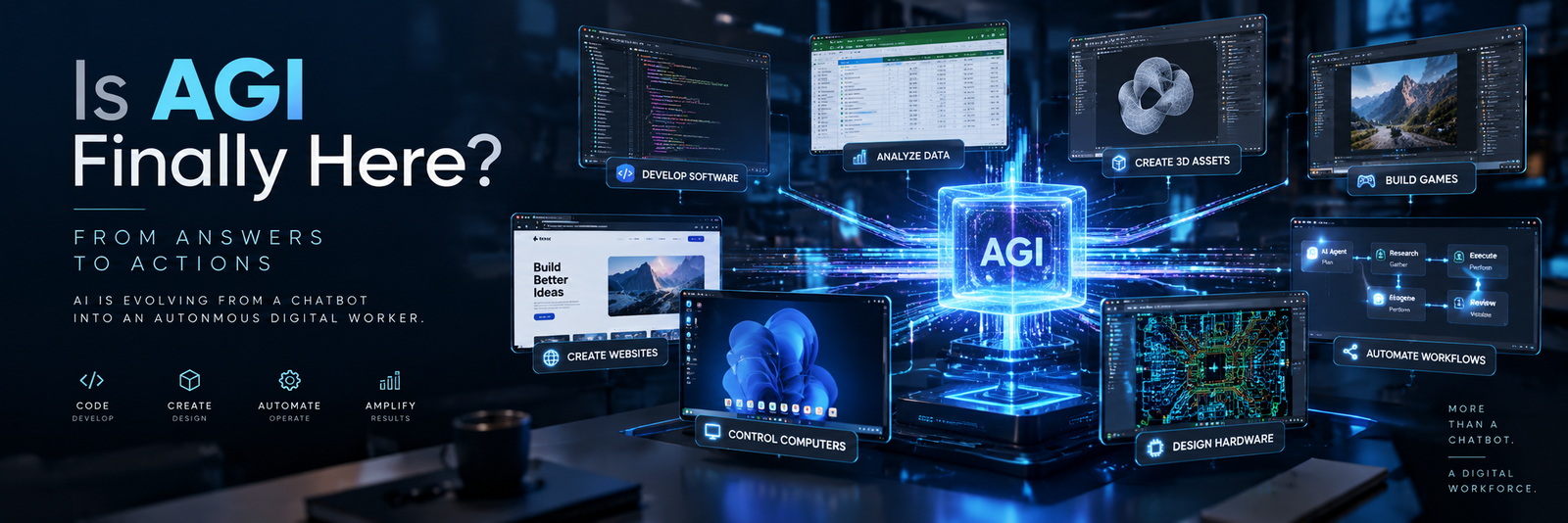
The demonstrations being discussed include computer interaction, spreadsheet work, 3D modelling, game development, circuit-board design and autonomous software creation.
Some people are already calling this a major step toward AGI.
Others are more cautious.
And that distinction matters.
Because impressive benchmark scores and impressive demonstrations do not automatically prove that artificial general intelligence has arrived.
What they can show, however, is something extremely important:
AI is moving from generating content toward operating digital environments and completing increasingly complex tasks.
The AI Conversation Is Changing
For a long time, the typical AI workflow looked like this:
Human gives instruction → AI generates output → Human checks the output.
Ask AI for code, and it writes code.
Ask it for an image, and it generates an image.
Ask it to explain something, and it explains it.
But the human remains the operator.
The human opens the application. The human moves the mouse. The human creates the project. The human uploads the files. The human runs the software. The human checks the result.
The next generation of AI is trying to change that relationship.
Instead of simply telling you how to perform a task, an AI system can increasingly attempt to perform the task itself.
That is where AI agents, computer-use systems and autonomous software workflows become particularly interesting.
Businesses already exploring AI agent development are essentially looking at this same shift: moving AI from a conversational assistant toward a system that can execute actions.
What Is the Big Deal About the New Model?
The demonstrations surrounding the model discussed in the video are interesting because they go beyond traditional text generation.
The reported demonstrations include AI interacting with computer applications, building spreadsheets, creating 3D content, developing games and working through technical design problems.
In other words, the AI is being presented not merely as a chatbot, but as a digital worker capable of interacting with software.
That distinction is enormous.
Consider the difference.
Traditional AI Assistant
“Here is the code you need.”
Computer-Using AI
“I understood the requirement, opened the development environment, created the files, ran the application, found an error, corrected it and produced the result.”
The second workflow is much closer to an autonomous software agent.
It also explains why AI and automation solutions are becoming a much broader concept than simple chatbot integration.
But Did AGI Actually Arrive?
This is where we need to slow down.
The video makes a very strong argument around benchmark performance and suggests that the model has reached levels associated with AGI.
Those claims are exciting, but a benchmark result by itself does not establish that a model has achieved human-level general intelligence across every domain.
AGI remains a broad and contested concept.
A system can be extremely capable at computer use, programming, reasoning or autonomous task execution without necessarily possessing the full range of abilities people normally associate with general intelligence.
“Did AGI officially arrive today?”
The more useful question is:
“How much more autonomous are AI systems becoming?”
And that question has a much clearer answer.
They are becoming significantly more capable of completing multi-step digital tasks.
From Chatbots to Computer-Using AI
One of the biggest changes represented by this generation of systems is computer interaction.
Instead of restricting the AI to a text box, the model can potentially interact with software interfaces.
That means the AI can conceptually work with:
- Web browsers
- Spreadsheets
- Code editors
- Design applications
- Development environments
- Games
- Business software
- Data-analysis tools
This changes the economics of automation.
Previously, automation often required developers to build explicit integrations between systems.
With increasingly capable computer-use models, some tasks could potentially be performed by an AI interacting with software in a manner closer to how a human employee does.
That doesn't eliminate the importance of API and system integration.
In fact, APIs may become even more important because reliable machine-to-machine communication remains one of the strongest foundations for production automation.
One of the Most Interesting Tests: Computer Use
Imagine telling an AI:
“Open the spreadsheet, analyse the data, create a report, build a chart and save the final version.”
A traditional AI assistant might explain how to do it.
A computer-using AI attempts to actually do it.
That is a fundamentally different capability.
It moves AI closer to a workflow executor.
This has obvious implications for custom software development, internal business applications and automation.
Software can increasingly be designed around AI agents that don't simply provide information but participate directly in business workflows.
Excel Is Suddenly an AI Playground
One of the demonstrations discussed in the video involves an Excel-style competition in which the model reportedly creates and works with spreadsheet-based tasks.
This may sound less impressive than 3D game generation.
It isn't.
Spreadsheets remain deeply embedded in business operations.
Sales teams use them. Finance teams use them. Operations teams use them. Inventory teams use them. Founders use them.
If an AI can reliably manipulate spreadsheets, analyse information and produce structured outputs, it can potentially automate a surprisingly large number of administrative workflows.
But automating a spreadsheet is not the same as replacing a properly designed business system.
For complex operations, organisations may still need CRM and ERP solutions, databases, permissions, audit trails, workflow engines and structured integrations.
AI Can Now Build Games?
Game development is another area highlighted in the demonstrations.
The video describes a 3D game reportedly created by the model in a very short period of time.
This is one of the most visually impressive examples because the output isn't simply text.
A functioning game requires multiple layers:
- Game logic
- Objects
- Interactions
- Scenes
- Characters
- Physics
- UI
- Assets
- Code
- Testing
If AI can coordinate these pieces through a computer environment, the barrier to creating software experiences becomes dramatically lower.
It also explains why game development may increasingly involve AI-assisted production rather than purely manual asset and code creation.
However, generating a playable prototype quickly is not the same as producing a commercially ready game.
Production still requires testing, optimisation, security, architecture, asset quality, performance engineering and long-term maintenance.
NetSwap's software testing and QA services are an example of why the validation layer remains important even when software generation becomes faster.
The 3D Revolution: From Text Prompt to Digital Environment
Another demonstration described in the video involves creating a 3D model through Blender.
This is particularly interesting because 3D creation normally requires interaction with a complex visual environment.
The workflow traditionally looks something like:
- Open the 3D application.
- Create or import objects.
- Modify geometry.
- Apply materials.
- Set lighting.
- Create scenes.
- Configure cameras.
- Test the result.
- Export the final asset.
If an AI can operate that environment through natural-language instructions, it changes what “software skill” means.
The human may increasingly describe the outcome while the AI handles portions of the implementation process.
This is not limited to 3D modelling.
The same idea could eventually apply to design applications, development environments, analytics platforms and business software.
What About Circuit Board Design?
The video also highlights a circuit-board design demonstration attributed to the model.
This is significant because hardware design involves constraints that go beyond generating a visually convincing image.
A real electronic design has to consider:
- Components
- Electrical connections
- Board layout
- Power requirements
- Signal integrity
- Manufacturing constraints
- Testing
- Safety
A demonstration can show that AI is capable of assisting with a design task.
It does not automatically prove that the resulting hardware design is production-ready.
Generation is not the same thing as verification.
The more powerful AI becomes, the more important validation becomes.
AI-Generated Websites Could Become Much More Sophisticated
Another example described in the video involves an interactive website designed around global environmental scenarios.
The interesting part isn't simply that AI created a website.
AI has been generating websites for some time.
The interesting part is the combination of:
- Interface design
- Interactive logic
- Visualisation
- Data presentation
- Software behaviour
- Dynamic interaction
That begins to look less like generating a webpage and more like generating an application.
This is where AI intersects directly with modern web development and SaaS development.
The future challenge may not be whether AI can create an interface.
It may be whether AI can consistently create software that is secure, scalable, maintainable and reliable enough for production.
Why This Matters for Software Developers
This is probably the question developers care about most.
If AI can write code, operate development tools, test applications and build prototypes, what happens to developers?
“Developers will disappear.”
Software engineering involves much more than typing code.
Developers have to understand:
- Business requirements
- Architecture
- Security
- Databases
- Performance
- Scalability
- APIs
- Infrastructure
- Testing
- Maintenance
- Technical trade-offs
AI can increasingly help with implementation.
But someone still needs to decide whether the implementation is correct.
This is why the distinction between AI-assisted coding and actual engineering remains important.
Our earlier discussion of vibe coding versus traditional coding explores a related shift in software development.
The emerging model is less about humans writing every line manually and more about humans directing, reviewing and validating increasingly capable AI systems.
AI Agents Are Not Automatically Obsolete
If a general-purpose model can use the computer itself, what happens to specialised AI agents?
This is an interesting question, but “agents are finished” is probably too simplistic.
Specialised agents can still be valuable because businesses often need:
- Specific permissions
- Controlled workflows
- Business rules
- Auditability
- Predictable behaviour
- System integrations
- Industry-specific knowledge
- Security boundaries
A general-purpose AI model may be extremely capable, while a specialised business agent may still be better suited to a controlled production workflow.
General intelligence and production architecture are not the same problem.
The Real Opportunity: AI That Operates Software
The most important shift may not be the benchmark itself.
It may be the combination of reasoning and computer interaction.
“Review this month's sales data, identify unusual customer behaviour, update the CRM, create a report, notify the sales manager and schedule follow-ups.”
That is not one task.
It is a workflow.
And workflows are where businesses spend enormous amounts of time.
The combination of AI reasoning, computer use, APIs and business automation could therefore become much more significant than another improvement in chatbot quality.
Businesses exploring AI-powered business automation should therefore think beyond chatbots and ask:
Which business workflows could an AI actually execute?
What Happens to Custom Software Development?
If AI can build software much faster, custom software development may not disappear.
It may actually become more accessible.
Businesses that previously couldn't justify building highly specific internal applications may be able to experiment more cheaply.
Developers may spend less time writing repetitive boilerplate and more time designing:
- Architecture
- Business workflows
- Security models
- Integrations
- Data structures
- AI orchestration
- Testing strategies
- Deployment infrastructure
This is one reason custom software development remains relevant even in an AI-first development environment.
The value gradually moves from manually producing every component toward designing the system that makes all the components work together.
AI Doesn't Remove the Need for Good Architecture
If anything, more capable AI makes architecture more important.
Imagine an AI building a complete application in an hour.
Now imagine that application has:
- Poor database design
- Weak authentication
- Insecure APIs
- Duplicated logic
- No monitoring
- No backup strategy
- No proper testing
- No maintainable architecture
You don't have a successful software project.
You have a very quickly generated problem.
AI can reduce the cost of creating software.
It does not automatically reduce the consequences of creating bad software.
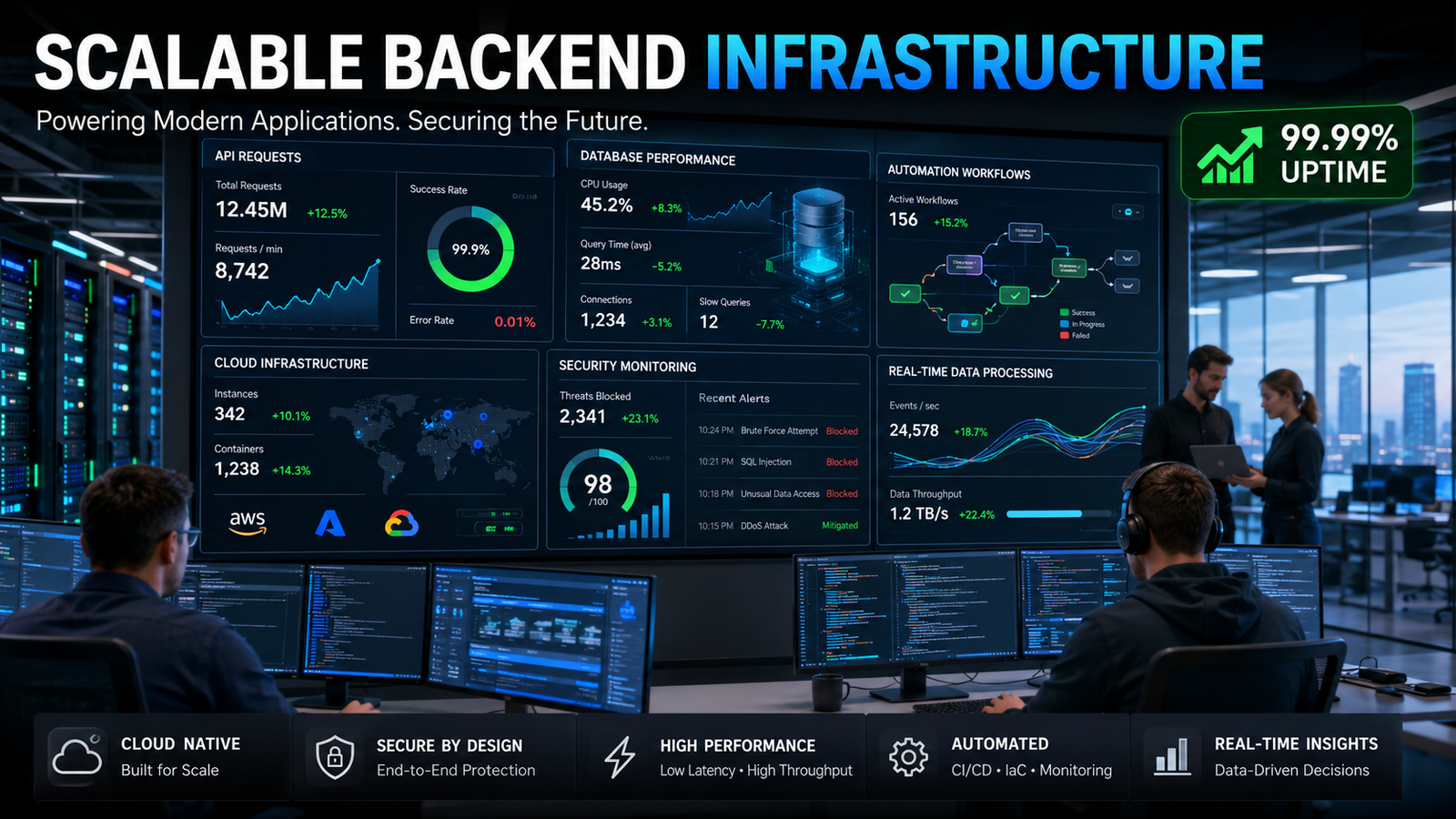
This is why production applications still require proper cloud and DevOps architecture, security, testing and monitoring.
What About Laravel, React and Modern Development Stacks?
AI-assisted development also changes how developers may use established technologies.
A developer working on a Laravel backend may increasingly use AI to generate models, controllers, APIs and tests.
A React developer may use AI to create components, interfaces and application logic.
Teams building SaaS applications may use AI throughout the development lifecycle.
NetSwap's technology ecosystem includes modern software development technologies across web, application and business-system development.
There are also dedicated Laravel development and React development capabilities for projects that require structured engineering around these technologies.
The technology stack may remain familiar.
The development workflow around it is what is changing.
AI + APIs Could Create a New Automation Layer
APIs have traditionally allowed software systems to communicate.
AI can potentially become the reasoning layer that decides what should happen next.
Customer message → AI understands intent → CRM API → Database → Business rule → Notification → Human approval
E-commerce order → AI detects exception → Inventory API → ERP → Fulfillment workflow
Support request → AI categorises issue → Creates ticket → Checks knowledge → Escalates if necessary
This is where API integration and AI can work together.
The AI doesn't have to replace every existing system.
It can become an intelligent layer sitting above the systems a business already uses.
AI Could Change SaaS Products Too
Traditional SaaS products generally work through predefined interfaces.
You open the application. You navigate to the correct module. You fill in forms. You click buttons.
AI-native SaaS can potentially work differently.
“Find all overdue customers, prioritise the most important accounts, draft follow-up messages and prepare the report.”
The software interface becomes conversational while the underlying business logic remains structured.
This creates interesting possibilities for SaaS product development and cloud-based CRM platforms.
AI and the Future of Business Software
Think about a traditional business application. It waits for humans to perform actions.
A future AI-native application could potentially monitor context and recommend or execute actions.
| Traditional Software | AI-Native Software |
|---|
| User finds the information | AI identifies relevant information |
| User creates the report | AI prepares the report |
| User follows the workflow | AI can orchestrate parts of the workflow |
| User identifies anomalies | AI can surface anomalies |
| User moves information between systems | APIs and automation can move information programmatically |
The application becomes less of a tool that waits for instructions and more of an environment that assists with decisions and execution.
What Businesses Should Actually Do Now
The answer is not to immediately replace every employee with AI.
Nor is it to add an AI chatbot to every product.
A better starting point is to identify repetitive, measurable workflows.
Ask:
- Which tasks are repeated every day?
- Which tasks require copying information between systems?
- Which decisions follow predictable rules?
- Which reports are created manually?
- Which processes require employees to use multiple applications?
- Which tasks could be executed through APIs?
- Where does human approval remain necessary?
- What data does the AI need access to?
Then design automation around those workflows.
“Which business problem should AI solve?”
The Biggest Risk: Trusting AI Too Much
The more impressive AI becomes, the easier it is to assume that it must also be correct.
That's dangerous.
An AI can generate a beautiful website with a security vulnerability.
It can create a working application with poor architecture.
It can produce a technically impressive 3D model that isn't suitable for manufacturing.
It can create a game that works as a demonstration but fails under production conditions.
It can manipulate data incorrectly while presenting the result with complete confidence.
AI executes more. Humans validate more strategically.
What the Next Generation of Developers May Look Like
Developers may increasingly become system architects, reviewers and AI orchestrators.
Instead of spending most of their time writing repetitive CRUD code, they may spend more time deciding:
- What should the system do?
- What should the AI be allowed to do?
- What data can it access?
- What actions require approval?
- How should failures be handled?
- How should the system be tested?
- How should it scale?
- How should the architecture evolve?
That makes software engineering more strategic, not necessarily less important.
AI may write more of the code.
Humans may increasingly define what the code is allowed to accomplish.
From Software Development to Software Direction
For decades, software development was constrained by how quickly humans could translate ideas into code.
AI reduces part of that constraint.
That means the bottleneck can move somewhere else.
Can we clearly define what we actually want to build?
If software can be generated much faster, poor requirements can create bad software much faster too.
This makes product discovery, architecture and business understanding increasingly important.
For startups and new products, structured product discovery and MVP development can help establish the actual problem before AI accelerates implementation.
What Happens to Traditional Software Companies?
Software companies will also have to adapt.
If AI makes coding faster, simply selling hours of development becomes less differentiated.
The value increasingly moves toward:
- Problem understanding
- Architecture
- Domain knowledge
- System integration
- Security
- AI orchestration
- Testing
- Deployment
- Maintenance
- Strategic technology decisions
The future may reward companies that can turn AI capability into reliable business systems.
Why Integration Will Matter More Than Ever
A powerful AI model sitting inside an isolated chat window has limited business value.
The real value appears when it can work with the systems where business information actually exists.
- CRM
- ERP
- Accounting
- E-commerce
- Payment systems
- Databases
- Internal applications
- Communication platforms
- Cloud infrastructure
This is where system integration becomes a critical part of AI adoption.
The AI may provide the reasoning. APIs provide the connectivity. Business software provides the data. Automation provides the execution layer. Humans provide governance and accountability.
AI Will Not Make Software Engineering Irrelevant Overnight
It is tempting to look at an eight-minute game demonstration or an impressive benchmark and conclude that traditional software development is finished.
Real software is harder.
Production environments contain:
- Legacy systems
- Security requirements
- Real users
- Unpredictable inputs
- Business rules
- Compliance requirements
- Performance constraints
- Infrastructure problems
- Data migrations
- Long-term maintenance
A demonstration proves that something is possible.
Production engineering proves that it can be trusted.
So, Is This the Beginning of the AGI Era?
Maybe.
But we should be precise about what we mean.
The claims around the model discussed in the video are extraordinary, particularly around computer use, coding, spreadsheets, 3D creation and autonomous task execution.
Whether those demonstrations should be called AGI is a much bigger philosophical and technical question.
What is much easier to observe is the direction.
From answering → to reasoning.
From generating → to executing.
From text → to software environments.
From isolated tasks → to multi-step workflows.
From assistant → toward agent.
What This Could Mean for Startups
For startups, the implications could be even larger.
If the cost and time required to create software continues falling, startups may be able to test more ideas with smaller teams.
A founder could potentially describe a product idea and have AI help produce:
- Prototype interfaces
- Landing pages
- Database structures
- APIs
- Business logic
- Dashboards
- Automations
- Test cases
- Documentation
Everyone can build faster.
So the competitive advantage shifts toward knowing what should be built, understanding customers and designing better systems.
This is where startup technology consulting and product strategy can become valuable alongside AI-assisted development.
The Bigger Question Isn't “Can AI Build It?”
Not: “Can AI build this?”
Because increasingly, the answer will be:
Probably.
The more important questions are:
- Should this be built?
- What problem does it solve?
- What data does it need?
- How will it integrate with existing systems?
- How will we verify its output?
- What happens when it makes a mistake?
- Who is responsible for the decision?
- Can the system scale?
- Can humans understand and control it?
These are engineering questions.
And they are not going away.
Final Takeaway
The most interesting part of the latest AI developments may not be whether one benchmark crossed 30%, 90% or 99%.
It may be that the boundary between AI generating software and AI operating software is becoming increasingly thin.
An AI that can reason about a task is useful.
An AI that can write code is more useful.
An AI that can operate the computer, use applications, create software, test the result and complete a workflow is a very different category of technology.
And if these capabilities continue improving, the next generation of software may not simply be software that humans operate.
It may be software that AI operates on behalf of humans.
That is the part I would pay attention to.
Not the hype around whether we should immediately declare AGI.
But the practical question of how quickly AI is becoming capable of taking an idea, interacting with digital tools and turning that idea into something functional.
Because once AI can reliably do that, the economics of software development, automation, SaaS, digital products and business operations could change dramatically.
What Comes Next?
The next step is not simply watching another benchmark.
It is testing what these models can actually do in real workflows.
Can AI build a production-ready application?
Can it debug a real legacy system?
Can it operate complex business software reliably?
Can it build and maintain a SaaS platform?
Can it manage a complete automation workflow?
Can it work safely with real business data?
Those experiments will be much more interesting than simply arguing about whether a benchmark represents AGI.
And this is exactly where the next wave of emerging technology development becomes relevant.
Frequently Asked Questions
What is AGI?
AGI, or artificial general intelligence, generally refers to an AI system capable of performing a broad range of intellectual tasks rather than being limited to a narrow capability. There is no single universally accepted technical definition or benchmark that conclusively establishes AGI.
Can AI use a computer by itself?
Modern AI systems are increasingly capable of interacting with computer interfaces and performing multi-step digital tasks. The reliability of these capabilities varies by model, environment and task.
Can AI build complete software applications?
AI can already generate significant portions of software and can assist with prototypes, applications, code, testing and debugging. Production software still requires architecture, security, validation, deployment and maintenance.
Will AI replace software developers?
AI is likely to automate more coding and repetitive development work, but software engineering also involves architecture, requirements, security, testing, integration, infrastructure and business decisions. The role of developers is likely to evolve significantly.
Can AI build 3D games?
AI can assist with game code, assets, environments and prototypes, and increasingly capable systems can interact with development tools. A demonstration of rapid game generation does not automatically mean that AI can independently produce a production-ready commercial game.
Will AI make APIs unnecessary?
Not necessarily. APIs remain an important mechanism for reliable software-to-software communication. AI agents may use APIs as part of larger workflows connecting CRM, ERP, databases, payment systems and other applications.
What is an AI agent?
An AI agent is a software system designed to pursue a task or goal by reasoning about actions, using tools and potentially interacting with external systems. The degree of autonomy depends on the specific implementation.
Is AI-generated software production-ready?
Sometimes AI-generated code can become part of production software, but generated output should be reviewed, tested and secured before deployment. Demonstration quality and production quality are not the same thing.
How can businesses start using AI agents?
Start with a clearly defined workflow where the required data, actions and success criteria are understood. Then determine whether AI, APIs, traditional automation or a combination provides the safest and most reliable solution.
Building AI-Powered Software?
AI is moving beyond chat and content generation into software execution, automation, computer interaction and agent-based workflows.
For businesses exploring AI-powered products, automation, SaaS platforms or custom applications, the important starting point is not the AI model itself.
It is the problem you want the technology to solve.
Explore AI agent development, AI and business automation, custom software development and API and system integration to see how these technologies can become part of a practical software strategy.
Talk to NetSwap Technologies about your software idea.




Comments (0)