
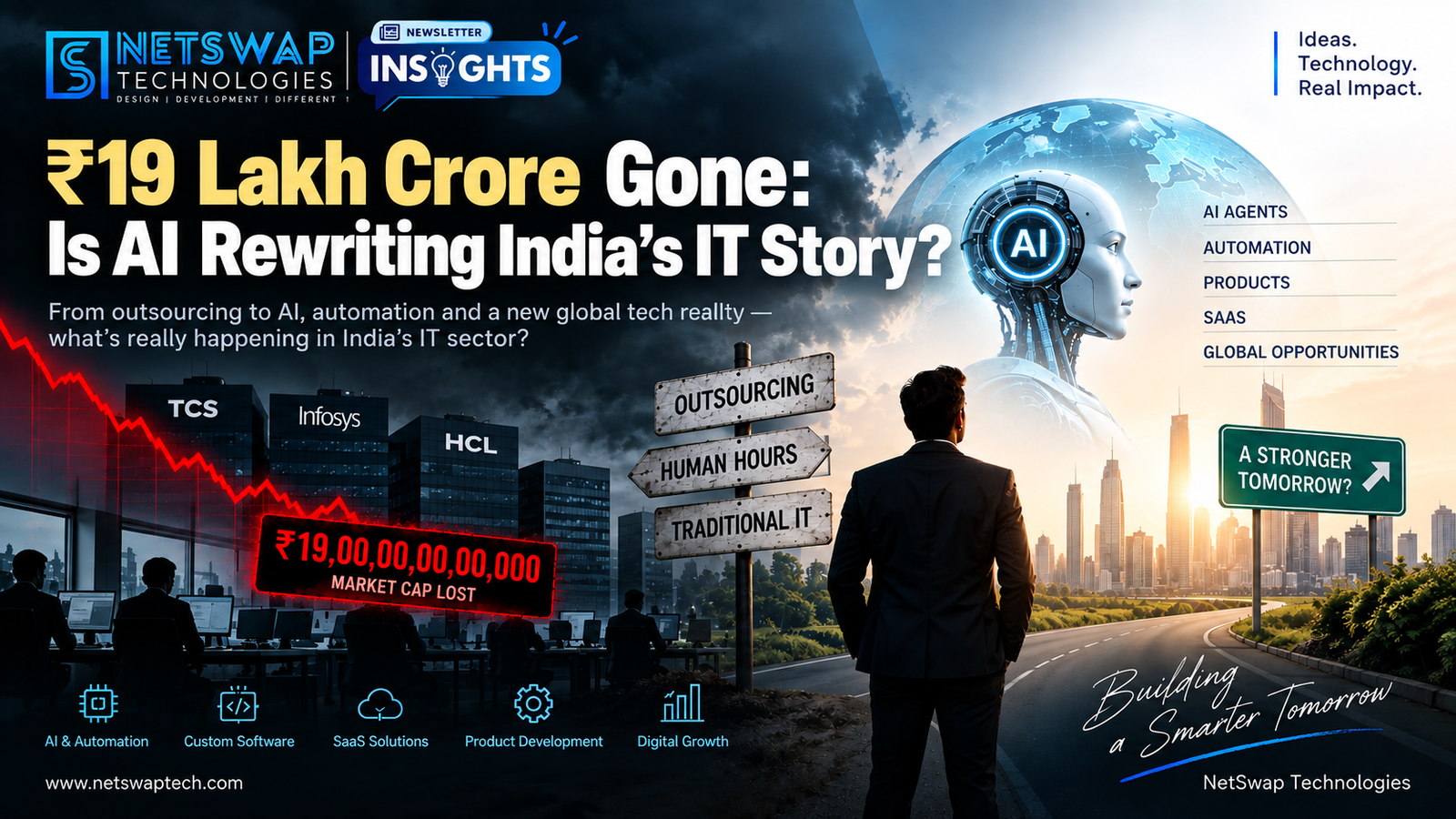
Technology | Indian IT Industry | Artificial Intelligence | Future of Work
India’s IT Industry Is Entering a New Era: How AI Is Changing the Outsourcing Business Model
India built one of the world’s most successful technology-services industries by combining skilled talent, lower delivery costs and global demand. But artificial intelligence is changing one of the assumptions that made that model work: the value of human hours.
Quick answer:
The pressure on India’s traditional IT outsourcing model is not caused by one factor alone. AI automation, changing global technology spending, geopolitical uncertainty and the industry's ability to move from labour-intensive delivery toward higher-value technology capabilities are all part of the larger story.
What Is Happening to the Indian IT Industry?
For decades, India’s IT industry operated around a relatively straightforward economic equation:
More projects → More people → More hours → More revenue
That model helped Indian technology companies become global delivery leaders. Businesses in the United States and Europe could access large engineering teams from India at comparatively competitive costs, while Indian companies could scale operations by adding employees and projects.
The problem is that software economics are changing.
Artificial intelligence can now assist with coding, testing, documentation, analysis, customer support, data processing and many other repetitive activities. AI does not eliminate every technology job, but it can reduce the amount of human effort required to produce certain kinds of software work.
That creates a difficult question for the traditional outsourcing industry: What happens when clients start paying for outcomes instead of hours?
The ₹19 Lakh Crore Question
A recent discussion around the Indian IT sector highlighted a striking figure: an estimated ₹19 lakh crore reduction in market capitalization among major Indian IT companies over a period of roughly one to one-and-a-half years.
That number should be treated carefully. The figure comes from the source discussion and its underlying calculations should be independently verified before being used as an audited market statistic.
But the larger question remains important even without accepting every number at face value.
What happens to a business model when the technology behind that business can suddenly make the same work faster, cheaper and more automated?That is where the Indian IT conversation becomes much bigger than stock prices.
Three Forces Putting Pressure on Traditional IT Outsourcing
1. Global Clients Are Becoming More Cost Conscious
Large technology contracts are increasingly being evaluated around measurable business outcomes, productivity and return on technology investment.
Economic uncertainty, geopolitical tensions and changing procurement priorities can also make enterprises delay technology projects or reconsider outsourcing arrangements.
For Indian IT companies that historically depended heavily on large enterprise contracts, even small changes in client spending behaviour can have significant consequences.
2. Artificial Intelligence Is Automating Repetitive Work
This may be the most structurally important change.
Modern AI tools can assist developers with code generation, debugging, refactoring and documentation. They can help analysts process information, support teams answer common queries and businesses automate repetitive workflows.
Businesses exploring this transition are increasingly looking at AI and automation solutions not simply as experimental technology, but as a way to redesign operational processes.
The next step is even more interesting: AI agents.
Instead of using AI only as a chatbot or coding assistant, organizations can build systems capable of completing multi-step tasks. This is why AI agent development is becoming an important area for companies thinking about the next generation of business automation.
3. The Industry Needs More Technology Capability, Not Just More Delivery Capacity
Another issue raised in the source discussion is the balance between shareholder returns, acquisitions, research and development, and long-term capability building.
Some of the exact financial comparisons mentioned in the original discussion should be independently verified. The strategic question, however, is valid: Are technology companies investing enough in the capabilities that will define the next decade?
AI Is Not Simply Replacing Developers
One of the easiest conclusions to make is that AI will replace software developers.
The reality is more nuanced.
AI can generate code, but production software requires architecture, security, testing, integrations, deployment, monitoring, business logic and long-term maintenance.
A generated code snippet is not automatically a reliable production system.
That makes disciplines such as software quality assurance and testing increasingly important rather than irrelevant.
The role of developers is therefore likely to move upward in the value chain.
Instead of spending most of their time writing repetitive code, engineers can increasingly spend more time defining architecture, validating AI-generated solutions, designing systems, solving complex problems and understanding business requirements.
In other words, the important question may not be: "Will AI replace developers?"
It may be: "Which developers will become significantly more productive because of AI?"
The Biggest Change: From Selling Hours to Selling Outcomes
Traditional outsourcing is often closely associated with manpower, project teams and billable hours.
AI introduces a different economic model.
| Traditional Model | AI-Era Model |
|---|---|
| More people | More automation |
| More billable hours | More productivity per employee |
| Routine implementation | AI-assisted engineering |
| Project delivery | Business outcomes |
| Labour scale | Technology leverage |
This does not mean traditional software development disappears. It means the economics surrounding it can change.
Companies that understand custom software development as a business capability rather than merely a coding exercise will be better positioned to adapt.
Why R&D and Acquisitions Matter More in the AI Economy
Technology companies cannot depend indefinitely on the same service portfolio while the underlying technology landscape changes.
Acquisitions can provide access to new technologies, talent and capabilities. Research and development can create intellectual property and new products. Internal experimentation can help companies discover entirely new business models.
The source discussion compares acquisition activity across major technology companies and uses those comparisons to question whether Indian IT firms have been aggressive enough in building future capabilities. The exact acquisition numbers cited in that discussion should be independently verified.
What matters strategically is the principle:
In technology, yesterday's competitive advantage can become tomorrow's commodity.Companies need a mechanism for continuously creating the next advantage.
SaaS Could Be One of India’s Biggest Opportunities
If the traditional outsourcing model is increasingly challenged by automation, one logical response is to move further toward ownership.
Instead of only building software for another company, technology businesses can build platforms that solve repeatable problems for thousands of customers.
This is where SaaS development becomes strategically important.
A successful SaaS business can potentially generate recurring revenue from intellectual property rather than relying entirely on project-by-project billing.
That transition requires more than writing software. It requires product discovery, customer validation, architecture, cloud infrastructure, security, analytics and continuous iteration.
For early-stage companies, structured product discovery and MVP development can help validate whether an idea deserves to become a larger technology product.
India Needs to Move From Outsourcing to Technology Ownership
India has already demonstrated that it can build a world-class technology-services industry.
The next challenge is different.
Can India build more globally competitive software products, AI companies, developer platforms, SaaS businesses and intellectual property?
The answer will determine whether the next chapter of India's technology story is based primarily on exporting engineering talent or exporting technology itself.
India remains one of the world's major technology development ecosystems, and companies exploring software development in India have access to a large engineering and startup ecosystem.
What Does This Mean for Indian IT Cities?
The impact of the technology transition will not be limited to large corporations.
Cities built around IT employment have developed ecosystems of housing, education, retail, restaurants, travel, professional services and commercial real estate around technology workers.
If technology employment changes significantly, the effects can spread beyond software companies.
At the same time, the AI economy could create new opportunities for smaller technology ecosystems.
Indore is a good example.
The city does not need to replicate Bengaluru's scale to participate in the next technology cycle. Smaller technology companies can build SaaS products, AI systems, automation platforms and specialized software for global customers.
The growing ecosystem around software development in Indore, AI development in Indore and AI automation in Indore shows how regional technology ecosystems can participate in this shift.
AI Will Not Automatically Make Software Businesses Better
There is another side to the AI story that businesses often underestimate.
Adding an AI tool to an inefficient organization does not automatically create an efficient organization.
If data is fragmented, APIs are poorly designed, workflows are manual and legacy systems cannot communicate with each other, AI may have limited impact.
This is why API and system integration becomes an important part of AI transformation.
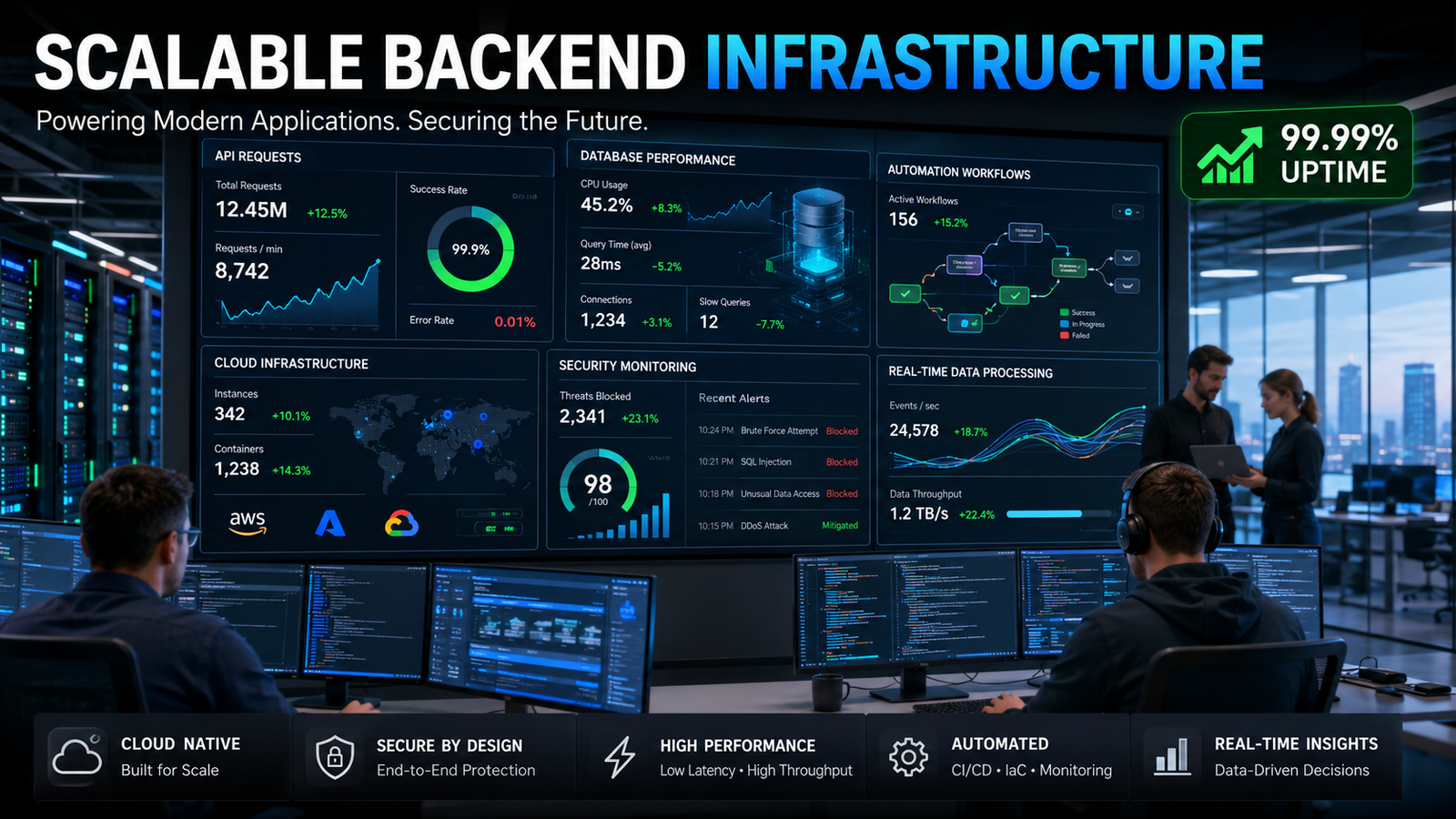
Likewise, scalable AI applications need reliable infrastructure, deployment pipelines, monitoring and security. Modern cloud and DevOps practices become increasingly important as applications become more automated and data intensive.
The lesson is simple: AI is a capability layer. It is not a substitute for sound software architecture.
What Should Businesses Do Now?
Companies do not need to replace their entire technology stack because AI is becoming popular.
A more practical approach is to identify where AI can create measurable value.
- Identify repetitive processes that consume significant employee time.
- Measure the current cost and turnaround time of those processes.
- Evaluate whether automation or AI can improve them.
- Connect the AI layer with existing business systems and APIs.
- Introduce human validation for important decisions.
- Test security, reliability and edge cases before production deployment.
- Track measurable business outcomes rather than simply counting AI features.
For organizations considering a larger transformation, a combination of custom software, AI automation, system integration and cloud infrastructure may be more valuable than implementing isolated AI tools.
What Should Investors Watch in Indian IT Companies?
Investors looking at the Indian IT sector may need to look beyond short-term stock movements.
Questions worth asking include:
- How seriously is the company investing in AI?
- Is AI improving employee productivity?
- How dependent is revenue on traditional outsourcing?
- Is the company developing proprietary products or platforms?
- What is the company's acquisition strategy?
- How much is being invested in research and new capabilities?
- Can the company move from selling manpower toward selling outcomes?
These questions do not guarantee investment performance, but they provide a more useful framework for thinking about structural change.
Important: The investment-related observations in the source discussion are commentary, not personalized financial advice. Investors should independently verify financial data and consult an appropriately qualified financial professional where necessary.
What Happens to Traditional IT Jobs?
This may ultimately be the most important human question.
It would be premature to conclude that AI will simply eliminate India's technology workforce.
Technology transitions usually change the composition of work before they completely eliminate it.
Some repetitive tasks may require fewer people. At the same time, demand can grow for AI engineering, cybersecurity, data engineering, product management, system architecture, AI governance, automation design and domain-specific technology expertise.
The difficult part is the transition.
A developer who only knows how to perform repetitive implementation work may face more pressure than a developer who understands architecture, business requirements and AI-assisted engineering.
The same principle applies to organizations. Companies that continuously upgrade their capabilities will have more options than companies that simply defend yesterday's delivery model.
The Opportunity Hidden Inside the Disruption
There is a temptation to read the current pressure on Indian IT companies as a decline story.
It may instead be a transition story.
India already has enormous software engineering talent, global client relationships and experience delivering complex technology systems.
What changes now is how that capability is packaged.
The next generation of technology companies may combine Indian engineering talent with AI-native development, SaaS products, automation, proprietary intellectual property and global distribution.
Startups and smaller technology companies can potentially move faster because they do not always have decades of legacy processes to protect.
This is why startup technology consulting and SaaS engineering can become important pieces of the new technology economy.
A Founder’s Perspective: The Real Risk Is Staying the Same
From a technology founder's perspective, the most interesting part of this discussion is not whether one particular IT company will gain or lose market value.
It is the change in the definition of productivity.
For years, scaling software services often meant scaling teams.
AI changes that equation.
A smaller team with better tools, better architecture and stronger automation can potentially deliver work that previously required a much larger organization.
That does not make people less valuable. It makes leverage more valuable.
At NetSwap Technologies, this broader shift is reflected in the way modern software work increasingly connects technology capabilities, automation, product development and scalable engineering rather than treating software development as nothing more than writing code.
Examples of this product-oriented approach can be seen in technology platforms such as AI-powered reporting platforms and multi-tenant SaaS platforms.
The objective is not to use AI because everyone else is using it. The objective is to build systems where technology creates measurable leverage for the business.
The Bigger Question for India
The Indian IT industry's next chapter will not be decided only by quarterly results.
It will be decided by whether India can successfully transition from a model built primarily around delivering technology services to a model that increasingly creates technology products, intellectual property and AI-native businesses.
The real question is not whether AI will change Indian IT.
It already is.
The question is who will adapt fast enough to benefit from it.
Frequently Asked Questions
Is AI a threat to the Indian IT industry?
AI creates both pressure and opportunity for Indian IT. It can automate repetitive technology work, but it can also increase demand for AI engineering, automation, product development, system architecture and higher-value technology services.
Why is India's traditional IT outsourcing model under pressure?
The traditional model depends significantly on people, projects and billable hours. AI can increase productivity and automate parts of this work, while global clients are also becoming more focused on efficiency, outcomes and technology value.
Will AI replace software developers in India?
AI is more likely to change the nature of software development than eliminate software engineering altogether. Repetitive implementation may become more automated, while architecture, product thinking, system design, security and AI-assisted engineering become more important.
Can Indian IT companies benefit from AI?
Yes. Indian technology companies have large engineering talent pools and extensive experience serving global clients. Companies that combine this foundation with AI, automation, product development and proprietary capabilities may be well positioned for the next phase of technology growth.
Is India moving from IT outsourcing toward SaaS and product development?
The shift is already visible across India's startup and technology ecosystem. SaaS, AI products and specialized software can allow companies to own technology assets rather than relying entirely on project-based services.
What should businesses do about AI automation?
Businesses should begin with measurable operational problems rather than technology trends. Identify repetitive processes, calculate their cost, evaluate automation opportunities and integrate AI into existing workflows with appropriate testing, security and human oversight.
Source note: This article is an independent editorial interpretation of the arguments presented in the referenced discussion about the Indian IT sector, outsourcing, AI automation, market capitalization, R&D and the future of technology services. Financial figures and company-specific comparisons mentioned in that discussion should be independently verified before being treated as audited or investment-grade data.
For the original discussion, refer to the original video and source discussion .
Building for the Next Technology Economy
Whether you are exploring AI automation, building a SaaS product, modernizing an existing application or creating a new digital platform, the important question is no longer simply how much software can be built.
It is how much business value that software can create.
Explore Technology Solutions
Tagged with:
Indian IT Industry
Artificial Intelligence
AI Automation
IT Industry India
Indian IT Companies
IT Sector
AI Agents
Future of IT
Software Development
IT Jobs
Technology Industry
Outsourcing
SaaS
Digital Transformation
R&D
Indian Economy
Future of Work
Software Industry
AI in Business
Technology Trends



Login to comment
To post a comment, you must be logged in. Please login. Login
Comments (0)