E-COMMERCE • CONSUMER RIGHTS • DIGITAL POLICY
India’s New E-Commerce Rules From January 2027: Why Your Online “Discount” May Finally Need to Tell the Truth
Fake discounts, unclear sponsored listings, manipulated search results and confusing return policies may soon face stricter scrutiny as India introduces major changes to its e-commerce consumer protection framework.
The next time an online platform says “50% OFF”, the more important question may be: 50% off compared to what?
Online shopping has become one of the most convenient habits of modern life. A few taps can bring groceries, electronics, clothing, medicines, furniture and almost anything else to our doorstep.
But convenience has also created a new kind of consumer vulnerability. The price shown on the screen may not always tell the complete story. The product appearing first in search results may not necessarily be the most relevant. A countdown timer may create urgency that does not really exist. And a discount badge may look impressive without giving shoppers a meaningful benchmark.
That is the problem India’s government is now trying to address.
The Department of Consumer Affairs has amended the
Consumer Protection (E-Commerce) Rules
,
introducing stricter requirements around price transparency, sponsored listings, search rankings, dark patterns, product disclosures, consumer complaints and the use of customer information.
The amended rules will come into force from
1 January 2027.
What Is Actually Changing for Online Shoppers?
The changes are not limited to discounts. They represent a broader attempt to make digital marketplaces more transparent and less dependent on confusing design, hidden information and aggressive selling techniques.
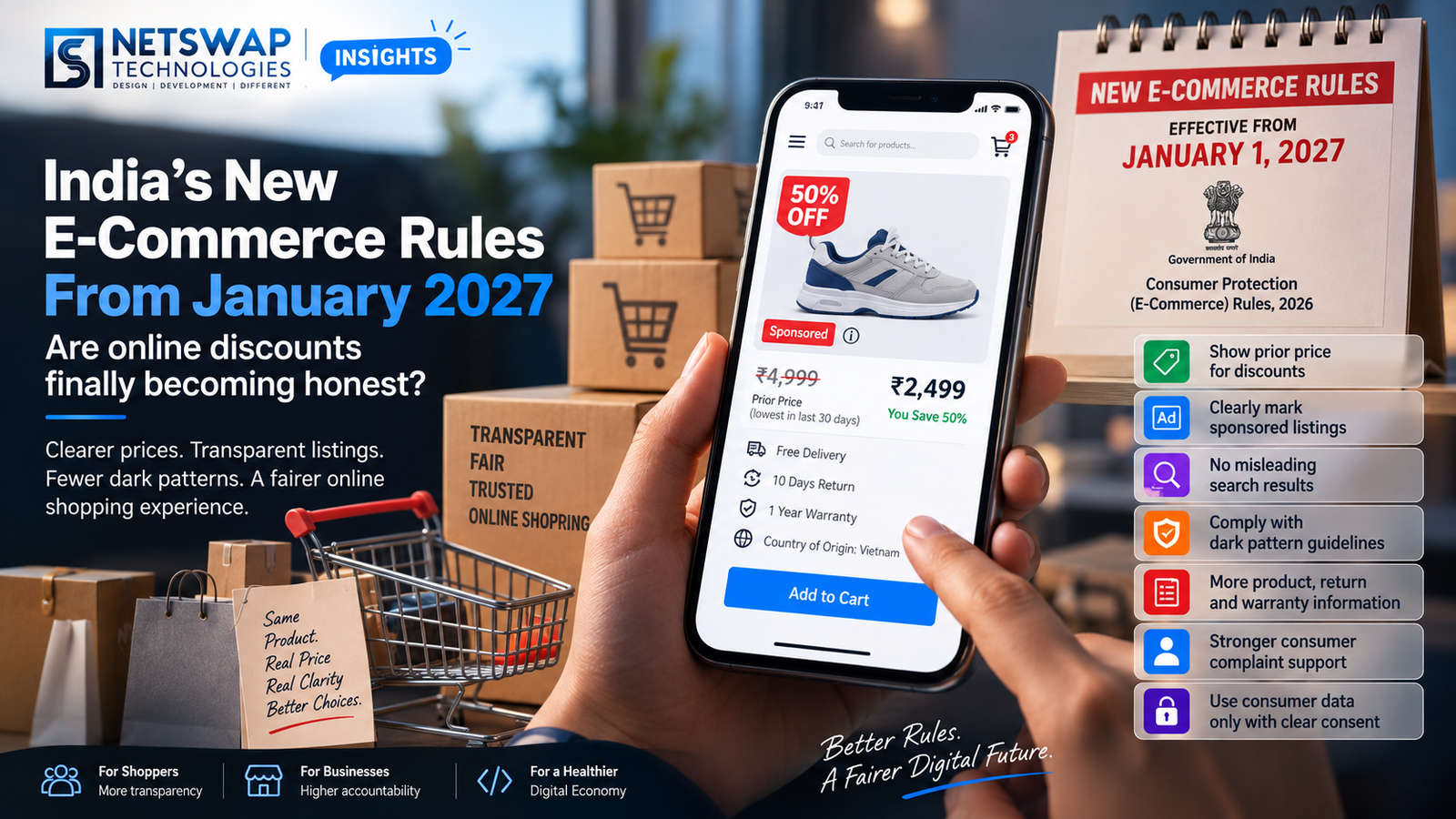
For shoppers, the most important changes involve eight major areas:
- Clear disclosure of the previous price when a discount is announced
- Prominent identification of sponsored product listings
- Restrictions on misleading manipulation of search results
- Annual self-audits against dark patterns
- Better product, seller, warranty and return information
- Stronger consumer complaint documentation
- Greater transparency for imported products
- Restrictions on certain uses of consumer data and unrelated bundled fees
1. “50% Off” Will Need a More Honest Reference Point
One of the biggest changes concerns how online discounts are displayed.
Under the amended rules, whenever an e-commerce platform or seller announces a price reduction, it must display both:
Reduced Price
The price the customer is being asked to pay.
Prior Price
The lowest price at which the product was offered during the preceding 30 days.
This definition matters.
A seller cannot simply display an artificially inflated “original price” and then claim a massive discount against it. The prior price must be linked to the lowest price offered during the previous 30-day period.
Consider a simple example.
Suppose a product is currently being sold for:
₹700
If the lowest price at which it was sold in the previous 30 days was ₹750, the platform cannot casually present an unrelated inflated price of ₹5,000 as the meaningful comparison point.
The intention is simple: consumers should be able to understand whether a discount is genuinely attractive or merely designed to look attractive.
This could significantly change the way festive sales, flash sales and large promotional campaigns are presented across Indian marketplaces.
2. Sponsored Listings Must Be Clearly Identified
Search results on e-commerce platforms are not always purely organic. Sellers and brands often pay for better visibility.
There is nothing inherently wrong with sponsored placement. Advertising is a legitimate part of digital commerce.
The problem begins when paid placement looks indistinguishable from an organically relevant recommendation.
The amended rules require sponsored listings to be identified through
clear and prominent disclosures.
In practical terms, shoppers should be able to understand when a product is appearing because it is commercially promoted rather than simply because it is the best match for their search.
This is particularly important as online marketplaces increasingly function like search engines, advertising platforms and recommendation systems at the same time.
3. Search Results Cannot Be Manipulated in a Misleading Way
Search ranking is one of the most powerful forms of influence in e-commerce.
Most users do not scroll through hundreds of products. They usually examine the first few results and make a decision based on price, reviews, delivery time, ratings and visibility.
That means the ranking system itself can shape consumer behaviour.
The amended rules prohibit e-commerce entities from manipulating search results or search indexes in a way that misleads users or negatively affects the relevance of results to their search query.
This raises an important question for the future of digital marketplaces:
If a customer searches for the most relevant product, should the platform show the most relevant product — or the product that creates the highest commercial return?
The answer will increasingly matter not only for e-commerce but also for search engines, app stores, travel platforms, food delivery applications and other recommendation-driven digital products.
4. Dark Patterns Will Face Greater Accountability
The phrase “dark patterns” has become increasingly common in discussions about digital products.
Dark patterns are interface designs or digital techniques that influence users into making choices they may not have otherwise made.
Examples may include:
- Hidden charges revealed only at the final payment stage
- Pre-selected subscriptions or add-ons
- Confusing cancellation processes
- False urgency or misleading countdown timers
- Fake scarcity messages
- Disguised advertisements
- Forced account creation
- Manipulative consent screens
- Complicated opt-out journeys
The amended rules require e-commerce entities to comply with the
Guidelines for Prevention and Regulation of Dark Patterns, 2023
.
Platforms will also be required to conduct a yearly self-audit and prominently display a certificate confirming compliance.
This is an important shift because it moves the discussion from merely asking whether a company violated a consumer rule to asking whether its entire digital experience has been designed responsibly.
5. Product Information Must Become More Useful Before Purchase
One of the most frustrating experiences in online shopping is discovering important information only after placing an order.
Customers may not know:
- Whether a product can be returned
- How refunds are processed
- Whether an exchange is available
- What warranty applies
- When the product will actually be delivered
- Which payment methods are supported
- Whether the product has an expiry or use-before date
- How complaints will be handled
The new rules require marketplace platforms to provide key information about products and services in a way that enables informed consumer decisions before purchase.
This is especially relevant for categories such as food, cosmetics, healthcare products, electronics, appliances and imported goods, where after-sales information can be just as important as the initial price.
6. Imported Products Must Reveal Their Origin and Importer Details
Imported goods will also face clearer disclosure requirements.
Marketplaces must provide information about the importer and disclose the country of origin of imported products.
For consumers, this can help answer questions such as:
- Where was the product manufactured?
- Who imported it into India?
- Is there an identifiable entity responsible for the product?
- Will after-sales service be available locally?
- Are warranty claims likely to be practical?
Product origin is not merely a geographical detail. In many categories, it affects quality expectations, warranty availability, compliance, safety and consumer trust.
7. Consumer Complaints Can No Longer Simply Disappear Into a Ticketing System
Anyone who has tried resolving an online shopping issue knows how exhausting customer support can become.
A complaint may generate a ticket number, followed by automated emails, repeated explanations and several days of waiting — without the consumer ever receiving a clear record of what was actually registered.
Under the amended rules, every e-commerce entity must provide the complainant with a copy of the complaint as recorded by its grievance officer.
The detailed notification also strengthens grievance-handling obligations, including acknowledgement and resolution timelines.
The government has also required e-commerce entities to become partners in the convergence process of the
National Consumer Helpline.
Why this matters
According to government data, the National Consumer Helpline received
17,71,622 grievances during 2025, of which
5,11,196 — approximately 29% — were related to e-commerce.
These numbers show that online shopping complaints are not isolated incidents. They are becoming a structural part of the digital economy.
8. Consumer Data Cannot Be Used Without Meaningful Consent
E-commerce platforms collect enormous amounts of information about customers.
Search history, purchase behaviour, browsing activity, preferences and transaction patterns can all become commercially valuable data.
The amended rules restrict marketplace entities from using consumer information for specified purposes without
express and affirmative consent.
The rules also restrict the use of collected information for certain promotional or sales activities involving sellers or brands associated with the marketplace, unless the required consent has been obtained.
This is significant because modern e-commerce is no longer just about selling products. It is also about collecting behavioural data and using that data to influence future purchases.
The new direction suggests that convenience cannot automatically become a justification for unrestricted data usage.
9. Unrelated Bundled Fees Will Face Restrictions
Another important change concerns bundled fees.
Marketplace platforms will not be allowed to collect bundled fees for services unrelated to the e-commerce platform, subject to specified exceptions for loyalty or membership programmes.
This is relevant in an environment where customers increasingly encounter additional charges during checkout:
- Convenience fees
- Platform charges
- Protection fees
- Optional service charges
- Membership-related add-ons
- Delivery or handling charges
The broader principle is that customers should understand what they are paying for and why.
The Bigger Issue Is Not Discounts. It Is Digital Trust.
At first glance, these rules may appear to be about fake discounts and misleading online shopping practices.
But the deeper issue is much larger.
Digital platforms increasingly control how people discover information, compare choices, interpret prices and make decisions.
When a platform controls the interface, ranking system, recommendation engine, payment journey and customer support process, it holds enormous influence over the consumer.
That influence creates responsibility.
A product can be technically functional and still be ethically problematic. A checkout flow can be legally complex and still be unfair. A recommendation algorithm can be commercially successful and still undermine consumer choice.
A good digital product should not merely make people complete a transaction. It should help them make an informed decision.
What This Means for E-Commerce Businesses
These amendments will require more than updating a few labels on a website.
E-commerce companies may need to review their entire digital operating model, including:
- Pricing and discount calculation systems
- Historical price tracking
- Sponsored listing disclosures
- Search-ranking logic
- Product information architecture
- Seller onboarding and verification
- Complaint management systems
- Consent management
- Checkout fee disclosures
- Dark-pattern detection and audits
- Imported product compliance information
This is where technology architecture becomes important.
Businesses that have built their platforms around short-term conversion optimisation may now need to redesign certain experiences around transparency, traceability and accountability.
Companies investing in
custom software development
and
API and system integrations
may increasingly need compliance-aware systems rather than software focused only on speed and sales.
A New Challenge for Product Designers and Developers
The technology industry has spent years discussing conversion rates, engagement, retention and user growth.
Those metrics are important. But they cannot be the only metrics that define a successful product.
A user who completes a purchase because the interface genuinely helped them is different from a user who completes a purchase because the interface confused or pressured them.
From a product-development perspective, this distinction matters enormously.
Ethical UX does not mean creating boring interfaces. It means creating interfaces that are persuasive without being deceptive, efficient without being manipulative, and commercially effective without undermining user autonomy.
Businesses building modern digital platforms can explore broader
UI/UX and product design capabilities
that place clarity and usability alongside business performance.
The Gen-Z and Digital Consumer Angle
Younger consumers are often described as highly digital-native, but being comfortable with technology does not automatically mean being protected from manipulation.
In fact, users who spend more time inside digital ecosystems may encounter more sophisticated forms of persuasion:
- Personalised recommendations
- Influencer-driven product discovery
- Limited-time offers
- Algorithmic shopping feeds
- Social commerce
- Buy-now-pay-later prompts
- Gamified discounts
- AI-generated product recommendations
The problem is not that young people lack intelligence or awareness. The problem is that digital systems are becoming increasingly effective at influencing attention and decision-making.
Digital literacy therefore needs to evolve beyond knowing how to use an app.
It should also include understanding how the app is trying to influence you.
Being digitally skilled is not only knowing how to navigate a platform. It is knowing when the platform is navigating you.
What Shoppers Should Do Before January 2027
Regulation can improve the marketplace, but consumers still need to develop better digital shopping habits.
-
Compare prices across platforms.
Do not assume that the largest discount badge represents the best deal.
-
Check seller information.
Especially when purchasing expensive, imported or warranty-dependent products.
-
Read return and refund conditions before payment.
Not after the product arrives.
-
Look for sponsored labels.
A highly visible product is not automatically the most relevant product.
-
Be cautious with urgency.
Countdown timers and “only 2 left” messages should not replace rational comparison.
-
Review additional fees at checkout.
The final payable amount matters more than the headline price.
-
Keep records of complaints.
Save order IDs, invoices, screenshots and support communications.
What Technology Companies Should Learn From This
The most important lesson for technology companies is that compliance should not be treated as a last-minute legal patch.
If a platform has no reliable price history, no transparent ranking explanation, no structured seller data and no auditable consent system, regulatory compliance becomes difficult because the underlying architecture was never designed for accountability.
Modern digital businesses need systems that are not only scalable but also explainable, traceable and responsible.
This is particularly relevant for companies building
SaaS platforms
,
marketplaces,
e-commerce systems
,
CRM platforms and
AI-powered automation products
.
The future of software will increasingly demand a balance between business objectives and user protection.
A Founder’s Perspective: Growth Should Not Depend on Confusion
As someone working in technology and building digital products, I find this development important for a reason beyond regulation.
The industry has become extremely good at measuring what makes users click, buy, subscribe and return.
But we need to become equally serious about measuring whether users understand what they are agreeing to.
A successful product should not require confusion to generate revenue.
A strong marketplace should not need misleading discounts to attract customers.
A good recommendation system should not hide commercial influence behind the appearance of neutrality.
At
NetSwap Technologies
,
we work across
custom software solutions
,
AI and automation
,
web application development
,
mobile applications
and digital business platforms.
One principle remains particularly relevant while building technology:
the product should create value for the user, not merely extract value from the user.
That distinction may become one of the defining principles of responsible digital commerce in the coming years.
Frequently Asked Questions
When will India’s new e-commerce rules come into effect?
The Consumer Protection (E-Commerce) (Amendment) Rules, 2026 will come into force from 1 January 2027.
What is the new discount disclosure rule?
When a price reduction is announced, platforms must display both the reduced price and the prior price. The prior price is defined as the lowest price at which the product was offered during the preceding 30 days.
What are sponsored listings?
Sponsored listings are paid product or service placements. Under the amended rules, they must be clearly and prominently identified so consumers can distinguish advertising from organic search results.
What are dark patterns in e-commerce?
Dark patterns are deceptive or manipulative interface designs that influence users into making choices they may not otherwise make, such as hidden fees, forced subscriptions, misleading urgency or difficult cancellation processes.
Will e-commerce platforms have to explain search rankings?
Marketplace entities will be required to provide an explanation of the main parameters that significantly determine the ranking of goods or sellers on their platform, using clear and understandable language.
What information must be disclosed for imported products?
Platforms must disclose importer details and the country of origin for imported goods.
How will the new rules affect consumer complaints?
E-commerce entities must provide complainants with a copy of the complaint as recorded by their grievance officer and participate in the convergence process of the National Consumer Helpline.
Why are these e-commerce amendments important?
The amendments aim to improve price transparency, reduce misleading digital practices, strengthen grievance redressal and create a more accountable online shopping ecosystem.
Final Thought
The future of e-commerce will not be defined only by faster delivery, larger catalogues or bigger discounts.
It will also be defined by how much consumers can trust the information placed in front of them.
The real test of a digital marketplace is not how effectively it convinces people to buy.
It is how honestly it helps them decide whether they should buy.
From January 2027, India’s e-commerce sector will have to take that question much more seriously.
About NetSwap Technologies
NetSwap Technologies
is a technology company focused on building practical digital solutions across
AI and automation
,
custom software development
,
SaaS platforms
,
web applications
,
mobile apps
,
CRM and ERP systems
,
and digital business transformation.
If your business is building an e-commerce platform or digital marketplace that needs transparency, scalability and better user experiences, you can
connect with our technology team
.





Comments (0)